
Bufflehead
(Bucephala albeola)
The bufflehead is a small, chunky, energetic diving duck that visits the open waters of the Chesapeake Bay and its rivers from autumn through spring.
This section shows one large critter image at a time. Use the thumbnails that follow to select a specific image to display here.
This gallery contains a grid of small thumbnails. Selecting a thumbnail will change the main image in the preceding section.
Appearance
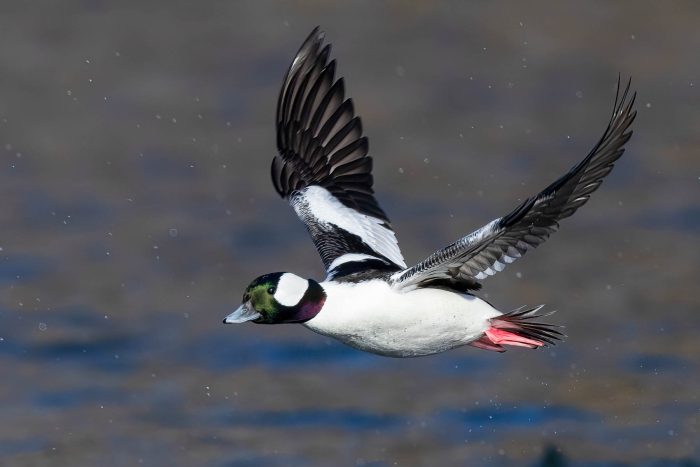
The bufflehead has a small, chunky body, a short neck and a short, gray bill. They grow to about 15 inches with a wingspan of 24 inches. Males and females have different patterns and coloring. Males are mostly white with a black back. They have a glossy, greenish-black head with a large white patch on the back that looks like a bonnet. Females have a whitish-gray chest and a grayish-brown back, head and wings. They have a white patch on their wings and a small white smudge on their cheeks.
Feeding
The bufflehead’s diet varies seasonally and by habitat. When visiting the Chesapeake Bay watershed, the bufflehead eats a variety of seeds, aquatic plants and small animals, including insects, mollusks, crustaceans and small fish. It dives for its prey and swallows it whole while still underwater.
Predators
Buffleheads are vulnerable to a variety of predators, including minks, hawks, falcons and bald eagles. One bufflehead will usually watch for predators while the others in its flock dive for food. Female buffleheads are particularly vulnerable when perched on the nest. Squirrels, black bears and weasels have all been known to feed on bufflehead eggs.
Flight
The bufflehead takes off by flying straight up from the water. This is different than most diving ducks, which run across the water’s surface before taking off. It flies low over the water and high over the land, and can be identified in flight by its black-and-white patterns and white wing patches. You can also identify buffleheads by their small size, fast wingbeats and habit of rocking side-to side as they fly.
Voice
Buffleheads are usually silent during winter, when it is not breeding season. Courting males make a hoarse squeak, squeal or rasp. Females may make a loud, deep throated vocalization in response. Females also use a distinct low note to call their young. The sound speeds up and increases in volume if she becomes distressed.
Reproduction and life cycle
Buffleheads breeding grounds are located mostly in Alaska and northern Canada. Males court females by bobbing their heads and flying low over females to display their black and white underside and pink legs. Unlike most ducks, buffleheads are monogamous and stay with the same mate for several years. Females lay an average of nine eggs per clutch, primarily using nests constructed by other species. These nests are typically hollowed out cavities in trees and are close to a body of water.
Bufflehead chicks hatch after 28 to 35 days. They live in the nest for up to two days before they are encouraged to leave. The mother bufflehead will continue to protect her chicks for three to six weeks, at which point the young buffleheads are considered independent. Buffleheads live 2.5 years on average in the wild, though some have been known to live as long as 18 years.
Did you know?
- Buffleheads are also known as “butterballs.”
- They are the smallest diving duck in North America.
- Buffleheads are constantly moving, either swimming along the water’s surface or diving underneath in search of food.
- Like other diving ducks, buffleheads are clumsy on land because their legs are located far back on their bodies.
Sources and additional information
- Life in the Chesapeake Bay by Alice Jane Lippson and Robert L. Lippson
- Chesapeake Bay: Nature of the Estuary, A Field Guide by Christopher P. White
- Animal Diversity Web: Bucephala albeola – University of Michigan Museum of Zoology
- Waterfowl ID: Bufflehead – Ducks Unlimited
- All About Birds: Bufflehead – The Cornell Lab of Ornithology