
Cobia
(Rachycentron canadum)
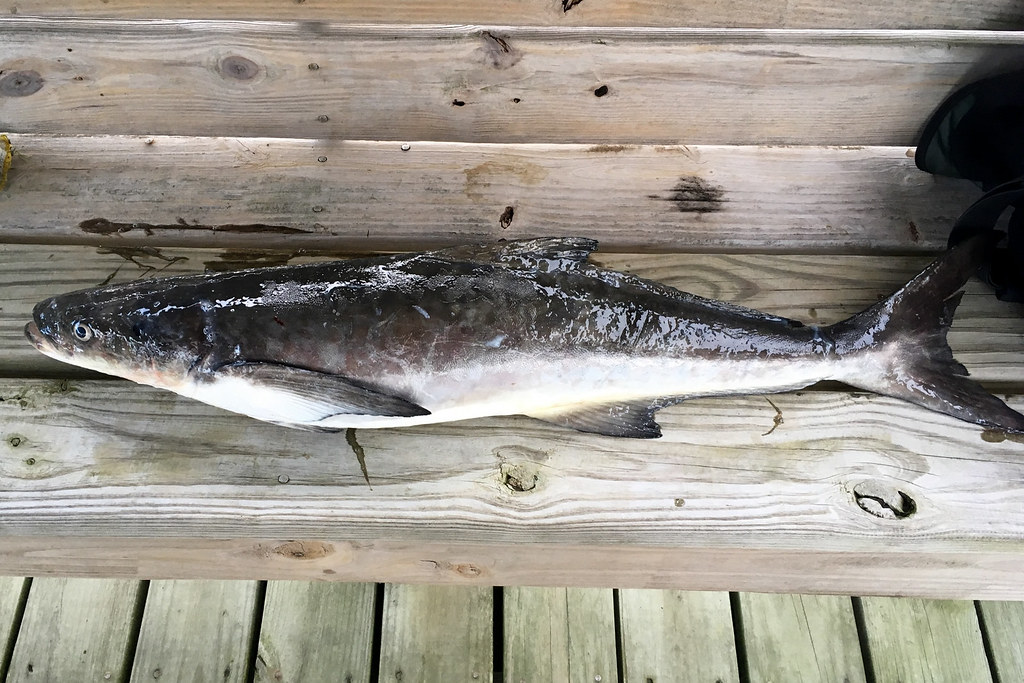
Cobia are large, long fish with a dark stripe running along the sides of the body. They visit the lower Chesapeake Bay's open waters from spring through autumn.
This section shows one large critter image at a time. Use the thumbnails that follow to select a specific image to display here.
This gallery contains a grid of small thumbnails. Selecting a thumbnail will change the main image in the preceding section.
Appearance
The cobia has a long body that that is blackish on the back and brown on the sides, usually growing 3 to 4 feet long and weighing more than 50 pounds. Two silvery bands sandwich a dark band that runs along its sides from the head to the tail. Its belly is yellowish- or grayish-white. Its flattened head has a large mouth with a protruding lower jaw. Seven to 10 sharp spines run along the front of its dorsal fin, and its tail fin is forked.
Feeding
An opportunistic hunter, cobia have a broad diet and big appetite. They eat mostly crabs and shrimp but will also feed on squid and smaller fish.
Predators
Larger fish prey on young cobia.
Reproduction and life cycle
Spawning occurs from June through mid-August near the mouth of the Bay or just offshore. Around October, cobia migrate out of the Bay to warmer southern waters near the Florida Keys.
Cobia can spawn more than once during the spawning season. Eggs collect near the surface of the water and usually hatch within 24 hours of being fertilized. Young grow rapidly during their first two years. Mostly solitary, cobia will sometimes form small groups. They have prominent white stripes on their sides that fade as they grow. Cobia can live up to 12 years.
Did you know?
- Cobia are known by many different names, including crab-eater and kingfish.
- When hooked by an angler, cobia will put up quite a fight, leaping and running to escape.
- The Chesapeake Bay record cobia, caught at York Spit near Hampton, Virginia, in June 2006, weighed 109 pounds and measured 69.5 inches long.
Sources and additional information
- Fishes of Chesapeake Bay by Edward O. Murdy, Ray S. Birdsong and John A. Musick
- Cobia – NOAA FishWatch
- Cobia – Florida Museum of Natural History
- Rachycentron canadum – FishBase