
Common Waterweed
(Elodea canadensis)
Common waterweed is an underwater grass that grows in slow-moving, fresh waters throughout the Chesapeake Bay watershed.
This section shows one large critter image at a time. Use the thumbnails that follow to select a specific image to display here.
This gallery contains a grid of small thumbnails. Selecting a thumbnail will change the main image in the preceding section.
Appearance
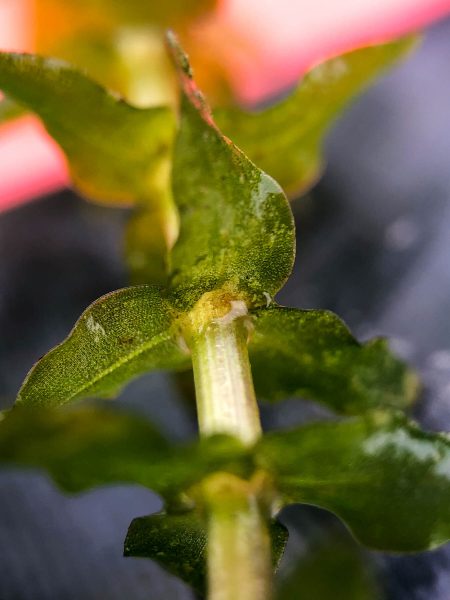
The common waterweed has slender, branching stems and tiny, narrow leaves. The leaves are straight or oval-shaped and grow in whorls of three along each stem. Whorls become more crowded toward the tip of the stems. Leaves have extremely tiny teeth that may only be visible under magnification.
From July through September, tiny flowers grow on long stalks from a tubular structure at the leaf axil. Common waterweed has a weak, thread-like root system.
Predators
Migratory waterfowl, especially ducks, feed on the common waterweed, as do muskrats and beavers.
Reproduction and life cycle
This grass usually reproduces asexually when stem fragments bud and grow into new plants. It rarely reproduces sexually because male plants are very uncommon. When sexual reproduction occurs, the plants produce cylindrical pods that contain several seeds.
Did you know?
- Common waterweed is also known as Canadian waterweed.
- Migratory waterfowl, especially ducks, feed on the common waterweed, as do muskrats and beavers.
- It provides habitat for fish, amphibians and aquatic invertebrates.
- Common waterweed can be confused with hydrilla or Brazilian waterweed. You can distinguish common waterweed by its leaves, which grow in whorls of three and do not have visible teeth.
Sources and additional information
- Underwater Grasses in Chesapeake Bay & Mid-Atlantic Coastal Waters by Maryland Sea Grant
- Life in the Chesapeake Bay by Alice Jane Lippson and Robert L. Lippson
- Chesapeake Bay: Nature of the Estuary, A Field Guide by Christopher P. White
- Submerged Aquatic Vegetation (SAV) Identification Key: Common Waterweed – Maryland Department of Natural Resources
- PLANTS Database: Elodea canadensis – USDA Natural Resources Conservation Service