
Mantis shrimp
(Squilla empusa)
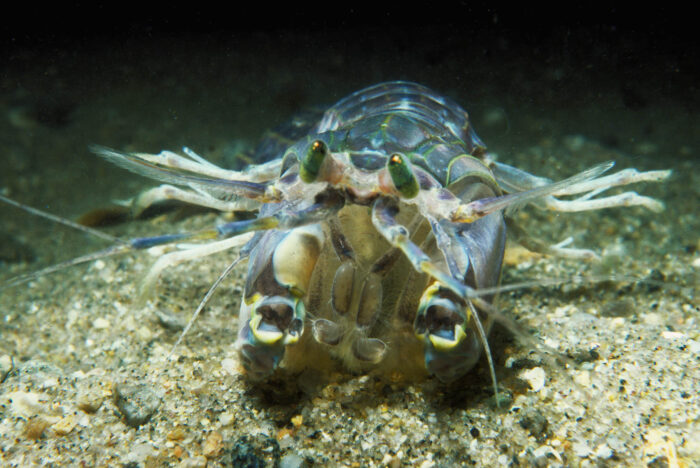
The mantis shrimp is a crustacean with a flattened, segmented body and praying mantis-like claws. It burrows within muddy flats along the shoreline of the middle and lower Chesapeake Bay.
This section shows one large critter image at a time. Use the thumbnails that follow to select a specific image to display here.
This gallery contains a grid of small thumbnails. Selecting a thumbnail will change the main image in the preceding section.
Appearance
The mantis shrimp grows to 8 to 10 inches in length. It has a flattened, translucent body with a pale green hue. Its abdomen and carapace (shell) are segmented, with each segment outlined in dark green or yellow. It has three pairs of walking legs, four pairs of clawed appendages (called maxillipeds) and one pair of long, jackknife claws that resemble a praying mantis. Its emerald green eyes are on stalks located on the top of its head.
Feeding
Mantis shrimp eat live fish, crabs, worms and shrimp, including other mantis shrimp. They are aggressive, violent predator, using their sharp claws to spear or slice through prey with a quick, slashing motion.
Predators
The mantis shrimp is very territorial and protective of its burrow and will defend it against other mantis shrimp with its claws.
Reproduction and life cycle
Because of its secretive, nocturnal habits, little is known about the mantis shrimp life cycle and mating habits.
Did you know?
- The mantis shrimp is not actually a shrimp, but rather a shrimp-like crustacean.
- Mantis shrimp are mostly nocturnal.
- Their distinctive emerald eyes contain more photo receptors than human eyes.
- The strike velocity of a mantis shrimp’s large, powerful claws is one of the fastest movements of any animal on earth. It takes a mantis shrimp less than 8 milliseconds to strike, which is about 50 times faster than the blink of a human eye.
- Mantis shrimp claws are strong enough to wound a human, giving them the nickname “thumb splitters.”
Sources and additional information
- Life in the Chesapeake Bay by Alice Jane Lippson and Robert L. Lippson
- Animal Diversity Web: Squilla empusa – University of Michigan Museum of Zoology