
Sandbar Shark
Carcharhinus plumbeus
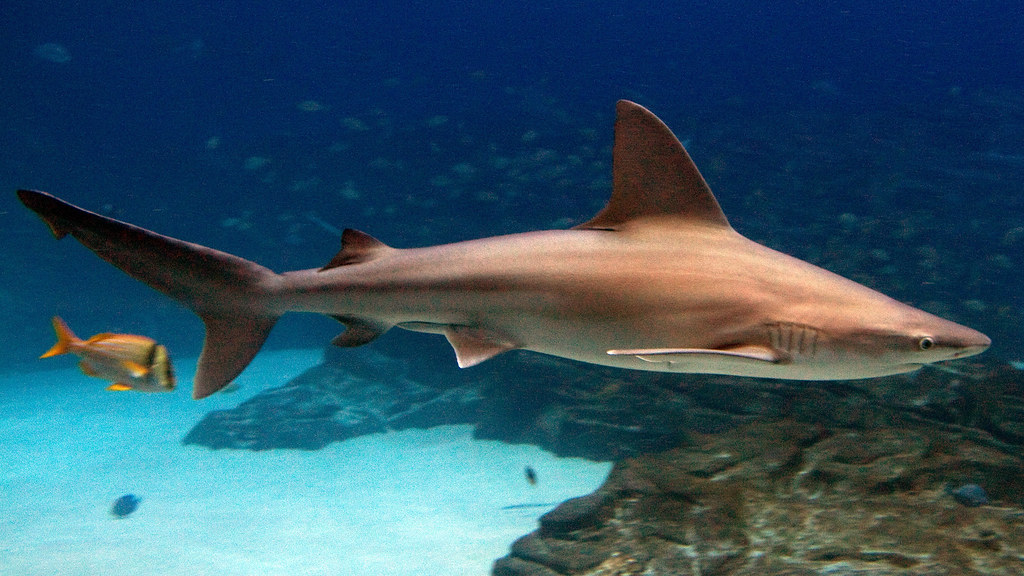
Also known as the brown shark, the sandbar shark is a stocky shark that visits the grassy shallows of the lower and middle Chesapeake Bay in summer and autumn.
This section shows one large critter image at a time. Use the thumbnails that follow to select a specific image to display here.
This gallery contains a grid of small thumbnails. Selecting a thumbnail will change the main image in the preceding section.
Appearance
The sandbar shark has a brownish or dark gray body with a whitish belly. It has a rounded snout and triangular, saw-like teeth. It has a tall, triangular dorsal fin that increases its swimming stability, and a thick, narrow ridge of skin runs along its back between its two dorsal fins. Adults reach seven feet in length, but the juveniles that are found in the Chesapeake Bay are two to three feet long.
Feeding
Sandbar sharks feed on bottom-dwelling fish and invertebrates. In the Chesapeake Bay, juveniles often feed on blue crabs.
Predators
Adults have few predators. Juveniles may be preyed upon by bull sharks and other large sharks.
Reproduction and life cycle
Females give birth every other year; they are pregnant for eight to 12 months before giving birth between June and August to eight to 10 live young. Juveniles remain in shallow waters until late autumn, when they form schools and move to warmer, southern waters. Males can live up to 15 years, while females can live as long as 21 years.
Did you know?
- The sandbar shark is the most common shark found in the Chesapeake Bay and along the mid-Atlantic coast. In fact, the Chesapeake Bay is one of the most important sandbar shark nursery areas on the East Coast.
- Sandbar sharks are listed as vulnerable on the International Union for Conservation of Nature's Red List of Threatened Species.
- Like other sharks, the sandbar shark's skeleton is made entirely of cartilage.
- Sandbar sharks have been rarely associated with attacks on humans. However, you should always use caution to protect yourself from sharks and other underwater creatures when swimming or wading.
Sources and additional information
- Fishes of Chesapeake Bay by Edward O. Murdy, Ray S. Birdsong and John A. Musick
- Life in the Chesapeake Bay by Alice Jane Lippson and Robert L. Lippson
- Sandbar Shark – Florida Museum of Natural History