
Sea cucumbers
(Order: Dendrochirotida)
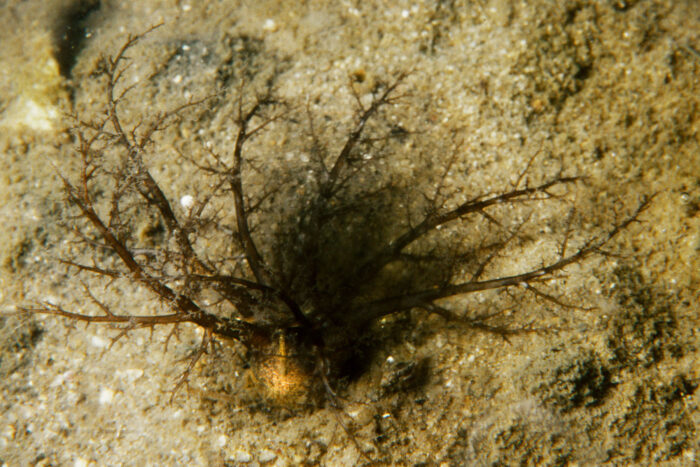
Sea cucumbers are echinoderms with elongated, spiny-skinned bodies. They live at the bottom of the lower Chesapeake Bay’s deep, salty waters.
This section shows one large critter image at a time. Use the thumbnails that follow to select a specific image to display here.
This gallery contains a grid of small thumbnails. Selecting a thumbnail will change the main image in the preceding section.
Appearance
Two species of sea cucumbers can be found in the Chesapeake Bay:
- The hairy or common sea cucumber, Sclerodactyla briareus
- The splended sea cucumber, Pentamera pulcherrima
Sea cucumbers have elongated, cucumber-like bodies that are thickest in the middle. They have distinct front and rear ends, with 10 finger-like tentacles around their mouth. The hairy sea cucumber is dull brown and grows four to five inches long. Its fat, rounded body is covered with tube feet. The splended sea cucumber is white or pale yellow and grows one to two inches long. Its tube feet are arranged in five distinct rows.
Feeding
The sea cucumber uses its tentacles to capture plankton and other tiny particles, then sweeps the food into its mouth.
Reproduction and life cycle
Sea cucumbers spawn by releasing eggs and sperm into the water, where the eggs are fertilized. During spawning, sea cucumbers develop a cobra-like appearance, with their front end raised up from the bottom. Larvae spend several weeks floating in the water.
They eventually settle to the bottom and morph into tiny juveniles. Juveniles take several years to grow to their adult size. Sea cucumbers can live up to eight years.
Did you know?
- Sea cucumbers are related to sea stars: both are echinoderms, which means “spiny-skinned.” All echinoderms have five-part radial symmetry.
- If a sea cucumber loses a tentacle, it can grow a new one in about three weeks.
- If you pick up or bother a sea cucumber, it will squirt water from its rear hole, and it may even eject its innards. This is a defense mechanism that sea cucumbers use to protect themselves from predators.
Sources and additional information
- Life in the Chesapeake Bay by Alice Jane Lippson and Robert L. Lippson
- Invertebrate Academy Online: Sclerodactyla briareus – Lander University