
Carpenter Frog
(Lithobates virgatipes)
Known for its secretive behavior, the carpenter frog is a medium sized amphibian that can be found in wetlands all throughout the Bay watershed.
This section shows one large critter image at a time. Use the thumbnails that follow to select a specific image to display here.
This gallery contains a grid of small thumbnails. Selecting a thumbnail will change the main image in the preceding section.
Appearance
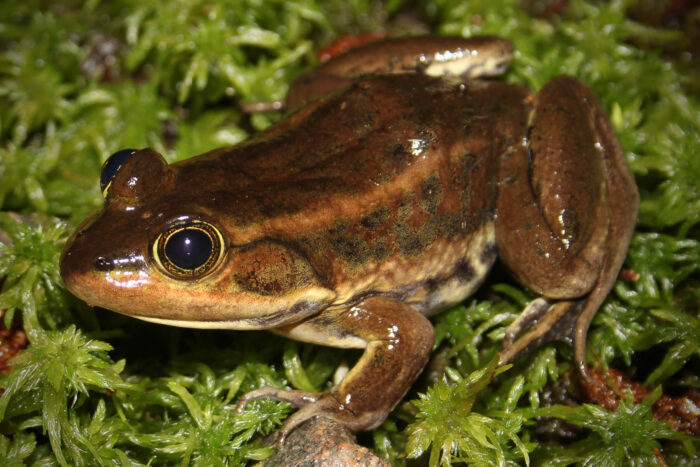
The carpenter frog is a medium sized species which is typically brown in color with yellowish stripes on its back, making it perfect for camouflaging in its environment. The underside of the frog is a pale yellow or white color. The carpenter frog is set apart from other species as its webbing on their feet does not reach the tip of their toes.
Feeding
Adult carpenter frogs often eat crayfish, spiders and other invertebrates, while tadpoles will eat algae, plant tissue and sometimes small invertebrates.
Predators
Known predators of carpenter frogs include various species of snakes, American bullfrogs, small mammals such as raccoons and some predatory birds.
Voice
Carpenter frogs get their name from their voice, which often sounds like a crew of workmen hammering when calling in a chorus. The individual call is often described as a repetitive pu-tunk, pu-tunk, pu-tunk.
Reproduction and life cycle
Male carpenter frogs will try to attract the attention of females through aggressive vocalizations, upright posting displays and combat practices. Females will choose their mates and lay a clutch of anywhere between 200-600 eggs, sometimes laying multiple clutches each breeding season. The mass of eggs is attached to submerged aquatic vegetation within the male’s territory, and will hatch after about one week. Tadpoles take about a year before they reach maturity.
Did you know?
- Carpenter frogs are often described as a secretive species because they are so difficult to see and capture due to their natural camouflage and shy behavior.
- Carpenter frogs are nocturnal animals, foraging and interacting with others during the night.
- The eggs of carpenter frogs can tolerate high levels of water acidity compared to other species of frogs, making them much more adaptable to changing water temperatures.
Sources and additional information
- Carpenter Frog - Virginia Herpetological Society
- Carpenter Frog - Conserve Wildlife Foundation of New Jersey
- Lithobates virgatipes - Animal Diversity Web
- Carpenter Frog - Virginia Department of Wildlife Resources