
Common sea star
(Asterias forbesi)
The common sea star is a spiny-skinned echinoderm with five pointed arms. It lives mainly on rocks, jetties and pilings in the shallow, salty waters of the lower Chesapeake Bay.
This section shows one large critter image at a time. Use the thumbnails that follow to select a specific image to display here.
This gallery contains a grid of small thumbnails. Selecting a thumbnail will change the main image in the preceding section.
Appearance
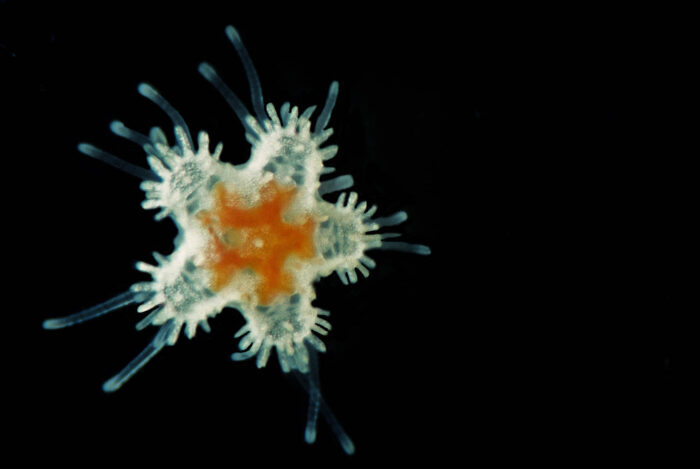
Common sea stars have five pointed arms and hundreds of tiny tube feet on their pale undersides. They vary in color from yellowish-orange to deep purple, and have small, pale spines that give them a rough appearance. A bright red or orange "eye" spot appears in the center of its body. They grow to be approximately five inches.
Feeding
The common sea star eats snails, clams, oysters, mussels and barnacles. It feeds by latching its tube feet onto its prey’s shells, then prying the shells open just enough for the sea star to reach its stomach inside.
Predators
Due to its tough, spiny skin, the common sea star has few predators.
Reproduction and life cycle
The sea star spawns by releasing eggs and sperm into the water, where the eggs are fertilized. Females can release up to 2.5 million eggs. Fertilized eggs develop into free-swimming larvae. After about three weeks, the larvae settle and morph into adults.
Did you know?
- Sea stars are more commonly referred to as starfish.
- They are related to sea cucumbers: both are echinoderms, which means “spiny-skinned.” All echinoderms have five-part radial symmetry.
- An active sea star can travel one mile in about a week.
- If a sea star loses an arm, it can quickly grow a new one. Sometimes it overcompensates and grows an extra arm or two. This is why sea stars with six or more arms are occasionally found.
Sources and additional information
- Life in the Chesapeake Bay by Alice Jane Lippson and Robert L. Lippson
- Chesapeake Bay: Nature of the Estuary, A Field Guide by Christopher P. White
- Animal Diversity Web: Asterias forbesi – University of Michigan Museum of Zoology