
Golden Ragwort
(Packera aurea)
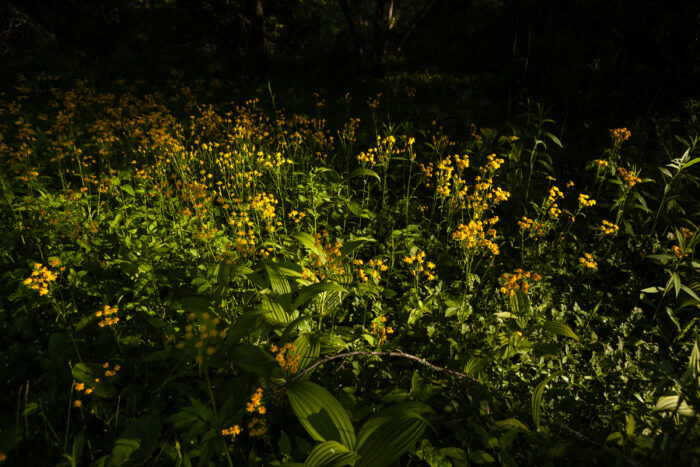
Golden ragwort is a sign of spring that functions as groundcover for woodlands and can also assist with erosion control.
This section shows one large critter image at a time. Use the thumbnails that follow to select a specific image to display here.
This gallery contains a grid of small thumbnails. Selecting a thumbnail will change the main image in the preceding section.
Appearance
Golden ragwort plants have a single long stalk that blooms with a cluster of bright yellow flowers with 7–20 petals. Low, heart-shaped leaves sit at the base of its mostly bare stem, and the undersides of its leaves are a purple-ish color.
Predators
While generally avoided by deer and other small mammals due to its mild toxicity, the golden ragwort has some predators such as caterpillars and various aphids, which will feed on the foliage.
Reproduction and life cycle
The blooming period for golden ragwort is in very early spring and lasts about three weeks. Soon after blooming, the florets are replaced by bullet-shaped achenes that are distributed by the wind before germination. Golden ragwort can self seed and can also spread by rhizomes to form a dense mat of foliage.
Did you know?
- Because golden ragwort grows so fast and aggressively, it can quickly occupy ground, making it a great resource for retaining water and soil in spaces that may be prone to soil erosion.
- Native Americans have used the leaf and root of the golden ragwort to aid heart trouble, treat lung diseases and prevent infections.
- Since it is one of the first flowers to bloom in the spring, golden ragwort is an important source of nutrients for early pollinators.
Sources and additional information
- Native Plant Profile: Golden Ragwort (Packera aurea) - Maryland Department of Natural Resources
- Packera aurea - North Carolina Plant Toolbox
- Golden Ragwort - United States Department of Agriculture
- Make Your Garden Shine Like Gold This Spring With Golden Ragwort - Maryland Grows