
Wild Celery
(Vallisneria americana)
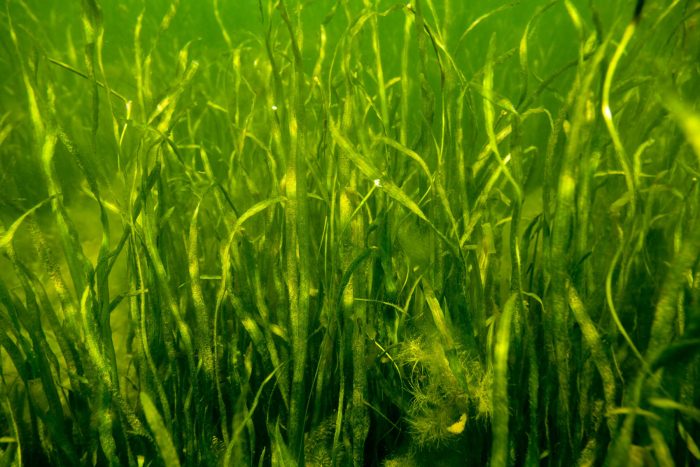
Wild celery is an underwater grass with long, ribbon-like leaves that have a light green stripe running down the center. It grows in fresh and slightly brackish waters throughout the Chesapeake Bay watershed.
This section shows one large critter image at a time. Use the thumbnails that follow to select a specific image to display here.
This gallery contains a grid of small thumbnails. Selecting a thumbnail will change the main image in the preceding section.
Appearance
Wild celery is made up of long, flat, ribbon-like leaves that can grow to nearly 5 feet in length. The leaves have finely toothed edges; blunt, rounded tips; and a light green stripe running down the center. Leaves grow in a cluster from the base of the plant, which is white.
In late summer, female plants have tiny, white flowers that grow at the end of a stalk that reaches the water’s surface.
Predators
Waterfowl rely on wild celery’s buds and roots while migrating and during their winter stay in the Bay region.
Reproduction and life cycle
Asexual reproduction takes place when buds form at the stem in late summer and grow into new plants in spring. Sexual reproduction occurs in late summer, when male flowers release pollen and fertilize female flowers. This produces a long cylindrical seed pod.
Did you know?
- The scientific name for the canvasback, Aythya valisineria, comes from the first part of wild celery’s scientific name, Vallisneria.
- Waterfowl rely on wild celery’s buds and roots while migrating and during their winter stay in the Bay region.
- Wild celery can be confused with eelgrass. You can distinguish wild celery by the light green stripe running down the center of each leaf. Additionally, wild celery grows mostly in fresh water, while eelgrass only grows in the saltier waters of the middle to lower Bay.
Sources and additional information
- Underwater Grasses in Chesapeake Bay & Mid-Atlantic Coastal Waters by Maryland Sea Grant
- Life in the Chesapeake Bay by Alice Jane Lippson and Robert L. Lippson
- Chesapeake Bay: Nature of the Estuary, A Field Guide by Christopher P. White
- SAV Key: Wild Celery – Maryland Department of Natural Resources
- PLANTS Database: Vallisneria americana – USDA Natural Resources Conservation Service