
My Clean Water Story: Brooke Landry
From the farm of my childhood to the seagrasses of the world—nature has been a constant source of inspiration
I grew up on a cattle farm in Virginia, not exactly the kind of place you think would churn out marine biologists. But while I was expected to help with farm chores, like chasing cows into pens and stacking hay bales, I was also expected to “go play outside” (nod to my fellow Gen Xers). This resulted in hours on end of unsupervised exploration - especially in the summer when school was out. About a quarter of the property was wooded and the shade was a welcome respite from the heat of the open fields, but more frequently, I’d end up in the creek that ran through the farm.
In that creek, I was on a perpetual hunt for “crawdads” and other critters trying their best to hide from me under rocks and between the blades of aquatic grasses. I didn’t know it then, but something about water – its quiet but persistent flow, the life it contains and sustains – was already teaching me to pay attention, ask questions and care about the environment. By the time I reached middle school, I was solidly into all things nature-related. And my teachers noticed.
My seventh-grade science instructor, a woman not long out of college, invited me to join her on a group eco-tour to Belize. My mother - against all odds - made it happen, bless her! Among other adventures, we camped on a tiny island a few miles off the coast and spent several days snorkeling coral reefs and drifting over seagrass beds. I remember floating there, suspended in salt water, looking down at a world I had only imagined until then. It was breathtaking, abundantly alive, and in some areas, as vivid as the Lisa Frank technicolor school supplies we had as kids. It was then that I decided, like so many other 12-year-olds in the late ‘80s influenced by Frank’s promise of adventure and hot pink dolphins, to become a marine biologist.
It’s not unusual to decide your life path at 12, but it is unusual to stay on it. Nevertheless, every decision after that felt simple, filtered through a single question: does this bring me closer to the water? I didn’t set out to work on submerged aquatic vegetation (SAV)at first. That part of my clean water story began with a well-timed opportunity. As an undergraduate in the Environmental Science Department at the University of Virginia, I applied for a work-study creating maps of seagrasses from data collected by graduate students.
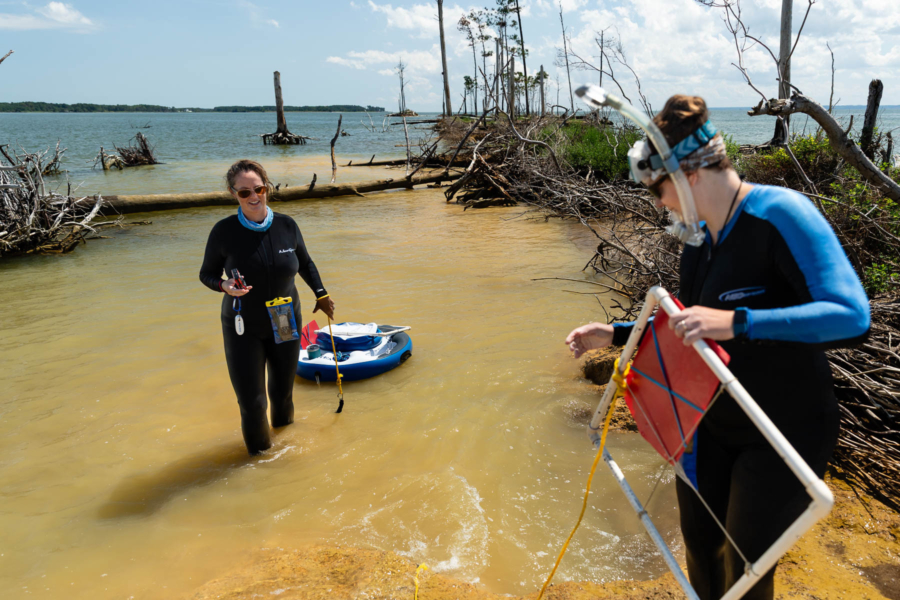
It connected me, serendipitously, to one of the foundational scientists in the field of seagrass research and conservation. He soon became my official college advisor, and I spent the next three years working for him and his graduate students. Though I was doing the tedious work of making maps and helping his students with their research during the school year, I spent many of my summer days collecting data with them in salt marshes and swimming in the eelgrass beds of the lower Chesapeake Bay.
Fond of seagrasses but not fully convinced yet that they would be my specialty, I considered several focus areas when I started thinking about applying to grad school. It turned out the web had already been spun though. A letter of interest to one professor working on tropical sponges at the University of North Carolina Wilmington turned into an irresistible opportunity with another. The professor I had written to didn’t have funding for a new student at the time, but because I had mentioned my experience with seagrasses, he passed my resume and transcript on to a colleague doing research in Florida Bay, Florida. I was offered a place in his lab, full financial support, and the chance to study seagrass ecosystems for my own graduate research. I accepted immediately.
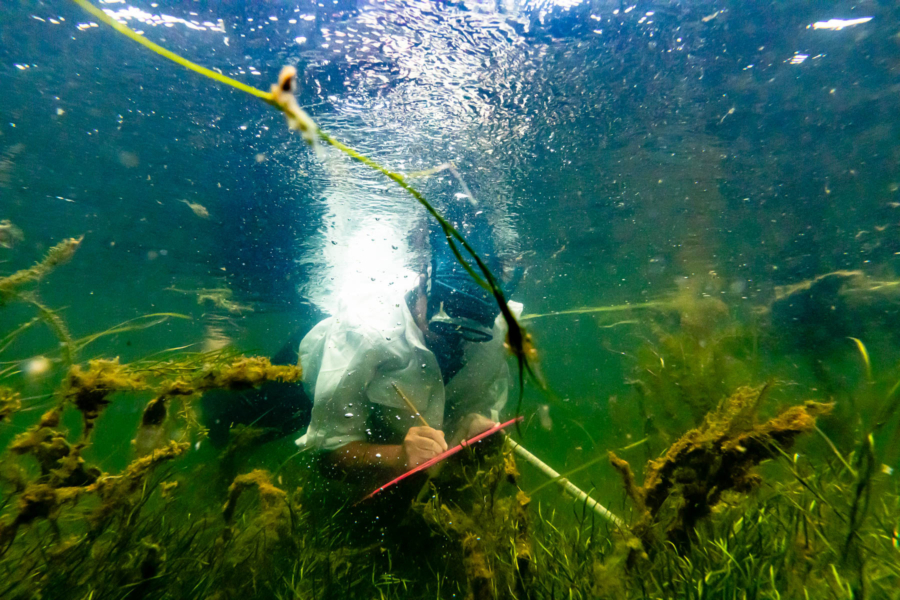
Graduate school was a dream come true and I loved (almost) every minute of it. Snorkeling over a seagrass bed isn’t just an exercise in observation and data collection, it’s full immersion. You move slowly and deliberately, with no noise but the sound of your own breathing. As you drift, gradually you start to notice that what at first looks like a simple, green meadow is surprisingly complex. You see delicate flowers and the flexible strength of their leaves. You see the silent movements of the life within - tiny fish and invertebrates of every shape and color clinging to the grass or swaying with the current. And, if you’re blessed by the water gods, you capture the overwhelmingly bizarre beauty of a seahorse.
It’s impossible to think about anything but what’s in front of you in that moment. I call it the “seagrass trance.” It’s where I feel the most calm and grounded. I wish everyone could experience it at least once.
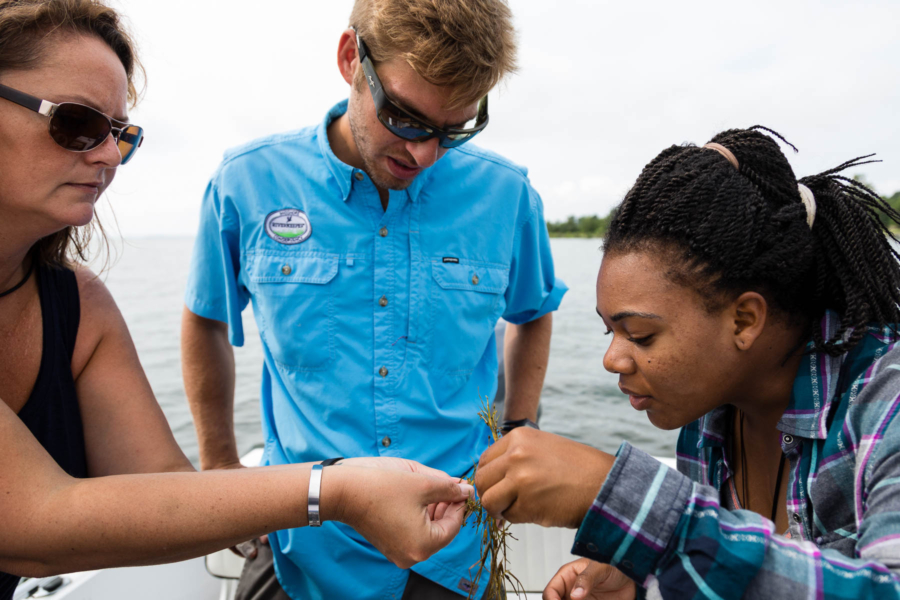
My graduate work in Florida Bay sealed the deal on my love of underwater grasses, and from there I pursued a contractual position working in the seagrass lab at the National Oceanic and Atmospheric Administration in Beaufort, North Carolina. If you’ve never been, it’s possibly one of the most charming little towns on the East Coast. But after three years and hundreds (maybe thousands?) of hours below the surface studying seagrasses from the Pamlico Sound to Puerto Rico, it was time to find my way back north to the Chesapeake.
The Maryland Department of Natural Resources Submerged Aquatic Vegetation Program was hiring, and I applied. I started as an entry level Natural Resource Biologist in 2008, became the chair of the Chesapeake Bay Program’s SAV Workgroup in 2016, co-founded the East Coast SAV Collaborative in 2024, and now lead the SAV Program that first brought me back to the Chesapeake all those years ago. It’s been an incredible ride so far and I’m grateful for every opportunity that has come my way.
Today, though, the work feels heavier and more consequential. The challenges facing our waters, our planet, and the Bay, in particular, are accelerating. It’s easy to wonder if we can keep up - or reverse the loss we see each day. But while pessimism is tempting, there’s a world to save and no time for negativity. Often I’ve been told restoring SAV in Chesapeake Bay is a losing battle - but nothing motivates ambitious women more than being told we can’t do something!
I’ve learned not to let the limits of others define my own. What seemed impossible yesterday may not be impossible today. And just as the challenges we face are accelerating, so are the solutions. I recently came across a quote in the vast chaos of the internet that really resonated with me, and felt particularly relevant to this field: "It may not be your fault, but it is your problem." There is a path forward. There are solutions. We just have to find them.
Comments
I hade the pleasure of working with Brooke. It was amazing to watch her passion for the science. A good read!
Lovely and moving. I hope you can continue your work to restore grasses in the Chesapeake Bay. It is a noble cause.
Ms Landry is clearly brilliant!
Thank you!
Your comment has been received. Before it can be published, the comment will be reviewed by our team to ensure it adheres with our rules of engagement.
Back to recent stories