
The anatomy of a burn
Biochar’s proponents are revealing new benefits of an ancient practice
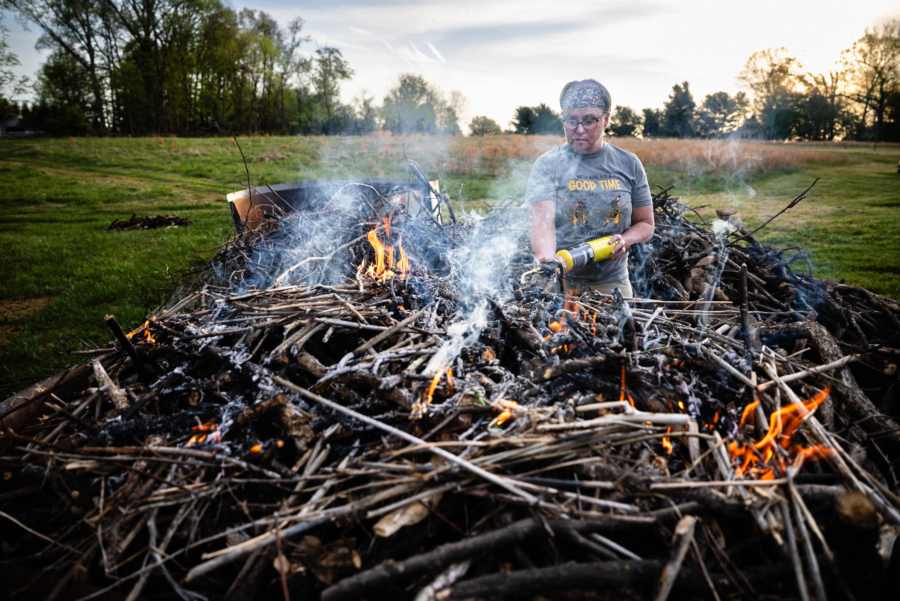
Whether it’s a cozy fireplace or a campfire weenie roast—setting flame is usually about the warmth it provides and not what’s left behind when the embers die. But under special conditions, a fire can produce something more valuable than ashes.
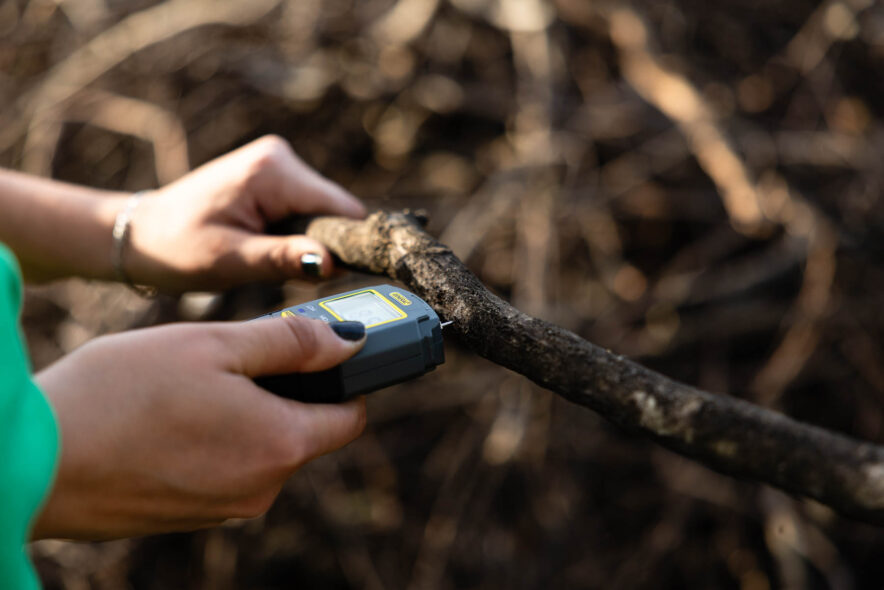
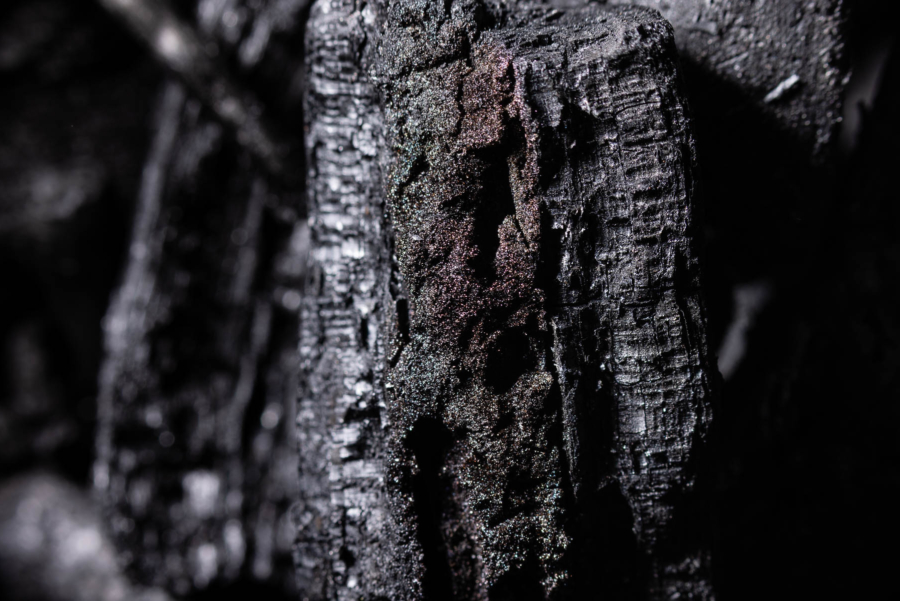
Wood or other biomass, when burned hot enough in a low-oxygen environment, creates a process called pyrolysis that leaves behind a very stable form of carbon called biochar. With an intricate three-dimensional structure, biochar can provide a scaffolding for beneficial microorganisms and slow the release of nutrients. For over 2,500 years, people across the world have produced biochar to improve soil for agricultural purposes. In recent years, studies have led to renewed interest in biochar for its ability to improve stormwater management as part of the Chesapeake Bay restoration effort—while providing a range of additional benefits.
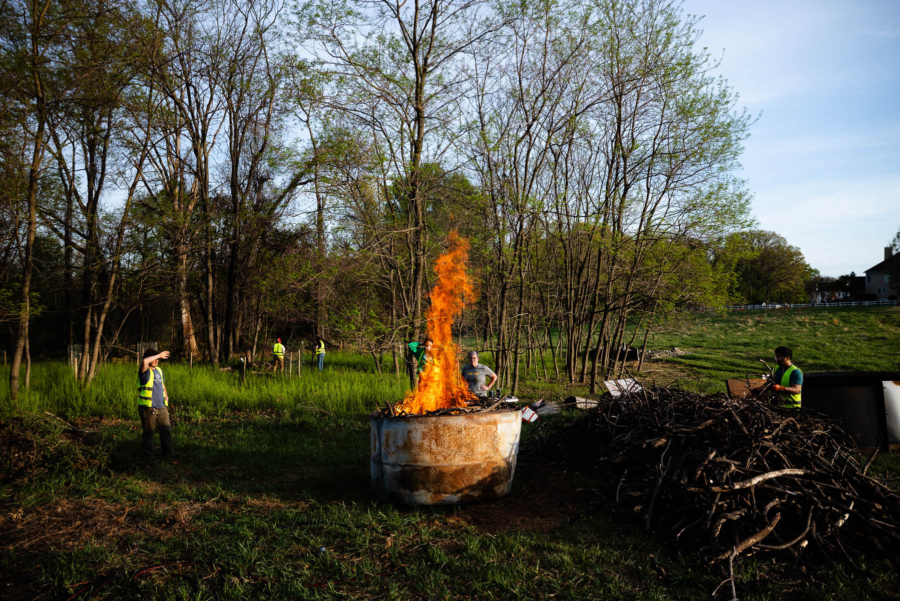
One benefit—waste management—was getting underway just after sunrise at Holly Hills, the headquarters of Howard EcoWorks, in Glenwood, Maryland. Piled inside an eight-foot fire ring made of double-walled steel panels was a mountain of dried vines and tree limbs. It was the byproduct of clearing invasive species from the 16-acre property.
“We have a philosophy of keeping that organic matter on site and not using our trucks to take it to the landfill and spew carbon dioxide out into the atmosphere at the same time,” said Lori Lilly, then-director of EcoWorks, standing with her crewmembers next to the woody debris.
That morning the temperature was in the low 60s, but the crisp air would soon get much hotter.
Lilly circled the fire ring with a propane torch, lighting up the dead pieces of tree-of-heaven and bittersweet. The flames soon rose high, getting so hot that barely any smoke was produced—the sign of a good burn.
Enhancing stormwater management
Lilly first learned about biochar while working on an outreach campaign called Soak It Up, supported in part by the National Fish and Wildlife Foundation’s (NFWF) Chesapeake Bay Stewardship Fund and the Chesapeake Bay Trust. The effort focused on Ellicott City in the time between two historic floods ravaged its downtown in 2016 and 2018. The goal was to engage private landowners in adopting practices to reduce runoff, like rain gardens, tree plantings and conservation landscaping.
The grant also allowed Lilly to work with Dr. Paul Imhoff of the University of Delaware, who had been researching the use of biochar as a soil amendment along grassy roadsides to improve stormwater retention. Together, they determined that the soils in Ellicott City would benefit in a similar way.
“And [biochar is] appealing for that type of application because, you literally can just till it into the soil and you will help to reduce runoff.
With knowledge from the Ellicott City study, Lilly expanded from research into practice as she and Imhoff joined another effort, called Scaling Up Biochar, led by the Center for Watershed Protection (CWP) and supported by NFWF’s Innovative Nutrient and Sediment Reduction (INSR) grant program.
“We supported [Lilly] in providing biochar to some of her projects, and she supported us with her technical assistance,” said Carol Wong, Director of Operations at CWP.
Beginning in 2023, the first phase of Scaling Up Biochar was focused on getting biochar into urban stormwater best management practices such as soil amendment, bioretention, sand filters, tree planting and dry ponds.
An ongoing challenge, however, is that commercial suppliers aren’t yet producing enough biochar, citing a lack of demand.
“But people aren't using biochar because there's no local source of biochar,” Wong said. To get the ball rolling, CWP provided partners with biochar from West Coast suppliers. That allowed them to start figuring out other logistical challenges.
It turns out there are many nuances in the world of biochar. Like coffee beans for a gourmet cup of coffee, it has to be ground to a particular uniform size for specific projects, like the sandy filtering layer within a rain garden or bioretention.
“If you use too fine of a biochar, it could clog a bioretention,” Wong said.
Planted trees, on the other hand, are less picky “because the tree roots can go through a lot of stuff,” Wong said. “You have a lot more leeway when we're talking about soils and soil amendment.”
Ultimately, Scaling Up Biochar was able to compare stormwater projects with and without biochar at sites across Virginia, D.C., Maryland and Pennsylvania. One finding was that biochar—which holds onto moisture during dry periods—helped plants establish better in the crucial first year of growth.
“And that's a big perk for maintenance,” Wong said. “If the native plants can establish, they can outcompete the potential invasives a little bit easier.”
Though biochar might increase the cost of a project by a few percent, it might ease the cost of, say, replacing dead plants year after year. But on the flip side, Wong said, they learned from one project that biochar also boosted weed growth—making it important to use soil free of weed seeds.
“All these little things are lessons learned…that we're writing down and letting people know just to make sure that we're all using biochar correctly,” Wong said.
Now in its second phase of INSR funding, Scaling Up Biochar has expanded its focus from urban areas to include agriculture, exploring ways that farms can incorporate biochar into best management practices. Wong said there is more flexibility in agriculture, because a farm could use different types of biochar to get different results, such as water infiltration versus water-holding capacity.
“I think on the agriculture side, we have an ability to be a little bit more creative,” Wong said. “It typically depends on what you want.”
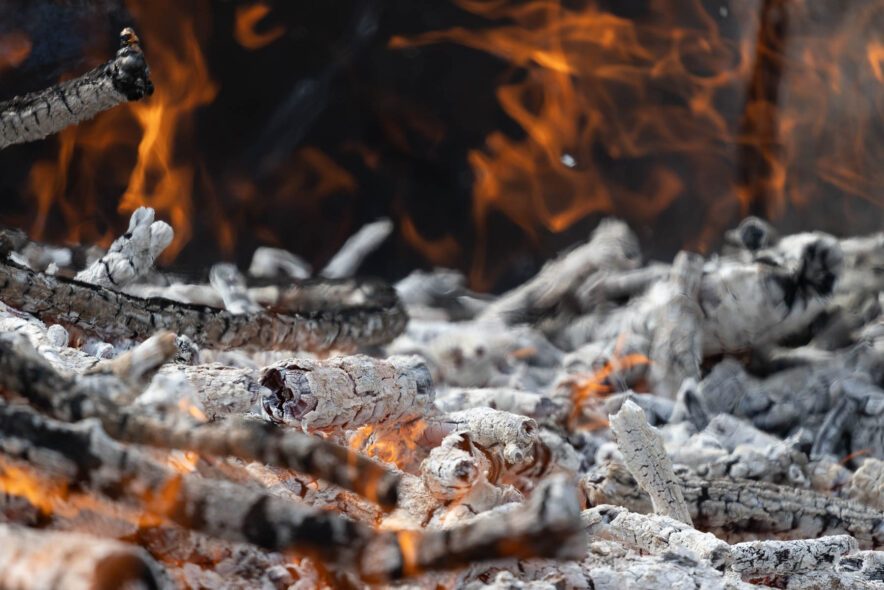
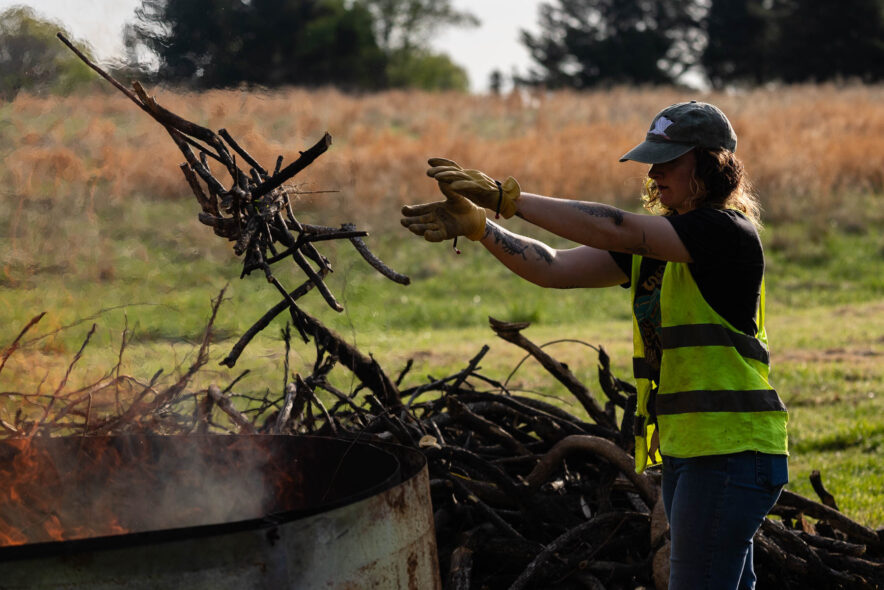
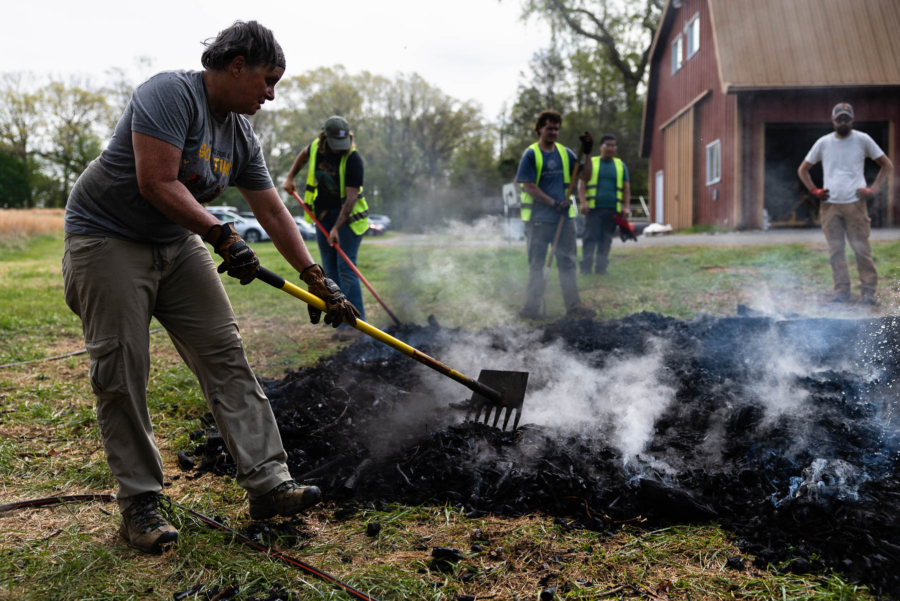
At Holly Hills, the creative forces of Lilly and her crew were focused on keeping their fire fed until the last of their pile dwindled away. At its peak, the fire reached well above the threshold for biochar—about 600 degrees Fahrenheit.
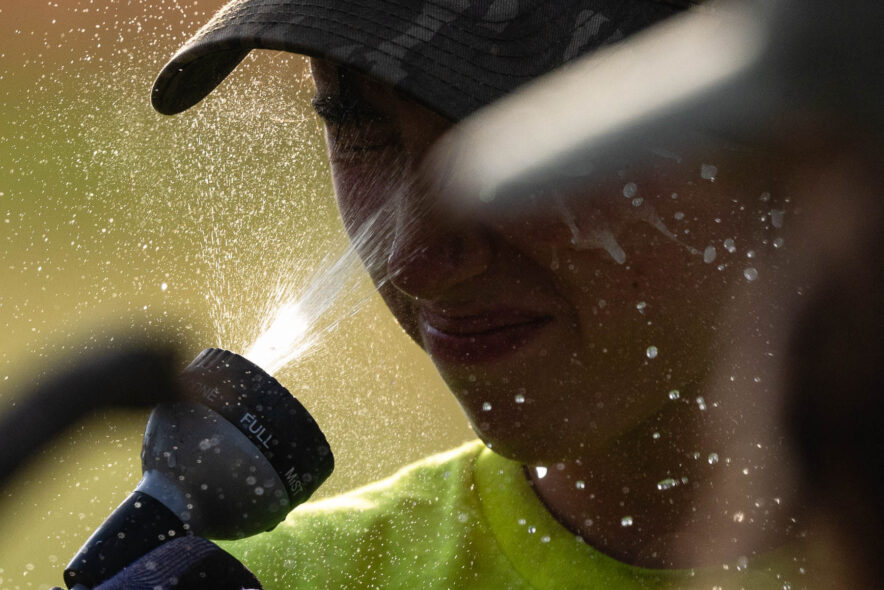
With no more fuel to keep it hot enough, a garden hose quickly put an end to the process. The crew opened up the steel fire ring, laying it flat and using rakes to spread out a new batch of biochar.
Counterintuitively, burning wood to create biochar helps sequester more carbon than if it was simply left to decompose, which would eventually cycle carbon back into the atmosphere.
“We're intercepting that and making this stable carbon form that is then resistant to decomposition for hundreds or thousands of years,” Lilly said, addressing her crew, who were staffed through EcoWorks’ Uplift workforce development program.
Besides sequestering carbon, the raw material will find several different uses as a soil and compost amendment at Holly Hills. As it clears invasives, EcoWorks is rehabilitating meadow and forest habitat on its campus, and also hosts a native plant nursery that makes use of the biochar.
“It fits into a lot of different areas for me as an environmental advocate,” Lilly said. “That's really why I like it.”
Comments
There are no comments.
Thank you!
Your comment has been received. Before it can be published, the comment will be reviewed by our team to ensure it adheres with our rules of engagement.
Back to recent stories