
Comb jellies
(Phylum: Ctenophora)
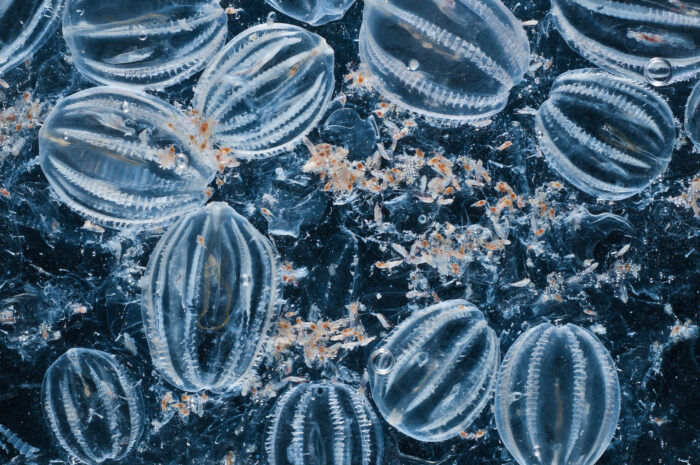
Comb jellies are transparent, jelly-like invertebrates with bright, iridescent color bands. They live near the water’s surface in the middle and lower Chesapeake Bay.
This section shows one large critter image at a time. Use the thumbnails that follow to select a specific image to display here.
This gallery contains a grid of small thumbnails. Selecting a thumbnail will change the main image in the preceding section.
Appearance
Two species of comb jellies can be found in the Chesapeake Bay: sea walnuts, Mnemiopsis leidyi, and pink comb jellies, Beroe ovata.
Comb jellies have transparent, jelly-like bodies with bright, iridescent color bands, which are made up of tiny hairs called combs. The bands divide the body into eight symmetrical parts. Sea walnuts have a colorless, walnut-shaped body, with two of their body lobes longer than the rest. Pink comb jellies have a sac- or egg-shaped body that is often tinted pinkish to reddish-brown. Comb jellies grow to about 4 inches.
Feeding
Sea jellies feed on planktonic organisms, including copepods and fish larvae. They can consume almost 500 copepods per hour. They eat by continuously pumping water into their body cavities.
Predators
Even though they are both comb jellies, the pink comb jelly is a major predator of the sea walnut.
Reproduction and life cycle
Spawning occurs at night when water temperatures warm to 66-73 degrees. Comb jellies have both male and female reproductive organs and can fertilize themselves. Each comb jelly releases about 8,000 eggs per spawn.
Unlike jellyfish, comb jellies develop without distinctive larval and polypoid stages. Comb jelly species are difficult to distinguish from each other when they are young. Young are able to reproduce 13 days after hatching.
Did you know?
- Unlike jellyfish, comb jellies do not have stinging tentacles.
- Comb jellies break apart when taken out of the water. If you find a comb jelly and would like to view its true shape, gently scoop it out of the water with a clear container and view it through the sides of the container.
- Although sea nettles and other stinging jellyfish are more well-known, comb jellies are much more abundant in the Bay.
- When disturbed at night, the color bands of the sea walnut glow soft green.
Sources and additional information
- Life in the Chesapeake Bay by Alice Jane Lippson and Robert L. Lippson
- Chesapeake Bay: Nature of the Estuary, A Field Guide by Christopher P. White
- Animal Diversity Web: Mnemiopsis leidyi – University of Michigan Museum of Zoology