
Gould's shipworm
(Bankia gouldi)
Gould’s shipworm is a bivalve with a long, worm-like body. It lives within untreated wood, such as pilings and driftwood, in the middle and lower Chesapeake Bay.
This section shows one large critter image at a time. Use the thumbnails that follow to select a specific image to display here.
This gallery contains a grid of small thumbnails. Selecting a thumbnail will change the main image in the preceding section.
Appearance
Gould's shipworm grows to several inches in length with a long, worm-like body. It has two small shells with toothed ridges at one end of its body and two small siphons and two hard, segmented pallets at the other end of its body. The pallets look like stacks of tiny ice cream cones.
Feeding
Shipworms feed mainly on wood, but may also eat planktonic particles brought in through the incurrent siphon.
Reproduction and life cycle
Shipworms release eggs into the water column. Free-swimming larvae eventually hatch from the eggs. Larvae remain in the water for 2 to 3 weeks before settling on any submerged untreated wood surface, such as pilings, ship planking, and tree trunks or branches.
Larvae use a small foot to move around on the wood’s surface. Once they find a suitable place, they anchor themselves using thin threads secreted from a gland on the foot. Larvae use their tiny boring shells to drill and burrow into the wood, where they develop into adults.
Did you know?
- Although they look like worms, shipworms are actually mollusks. They are closely related to boring clams.
- To protect their soft bodies, shipworms use its boring shells to scrape away pieces of wood to form a tunnel. The end of each tunnel has a pinhole-sized entryway to the water; the shipworm’s siphons stick out into the water through this hole. Each shipworm’s tunnel never intersects with another tunnel, even if there are multiple tunnels in a single piece of wood.
- As early as 412 B.C., mariners tried to protect their ships’ hulls from shipworms using chemicals such as sulphur and arsenic.
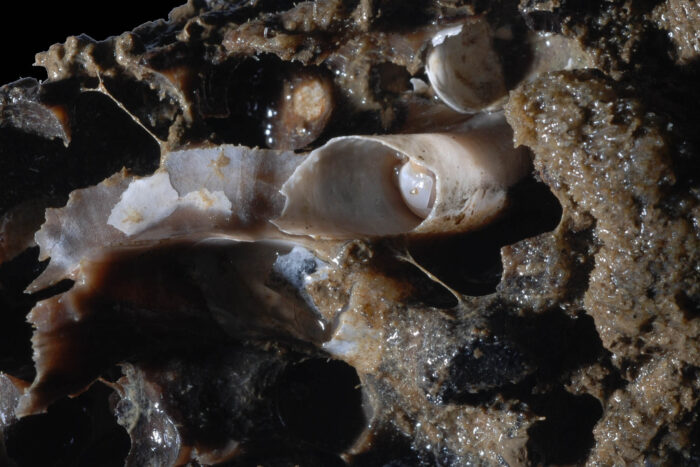
- White shipworm tunnels are often seen in pieces of driftwood that wash ashore. The tunnels are about the width of a pencil and follow the wood’s grain.
Sources and additional information
- Life in the Chesapeake Bay by Alice Jane Lippson and Robert L. Lippson
- Bankia gouldi – National Museum Wales