
Trout Lily
(Erythronium americanum)
Trout lily is a native perennial plant with nodding yellow flowers that bloom in early spring.
This section shows one large critter image at a time. Use the thumbnails that follow to select a specific image to display here.
This gallery contains a grid of small thumbnails. Selecting a thumbnail will change the main image in the preceding section.
Appearance
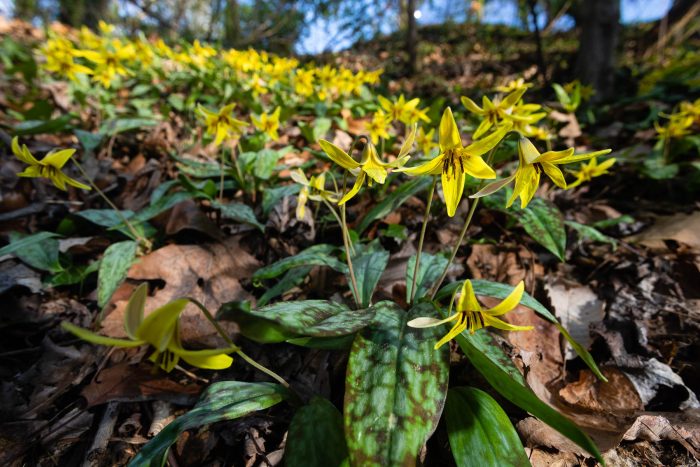
The trout lily has a single, nodding flower at the top of a short stalk. Flowers are yellow on the inside and bronze-colored on the outside, with six petals that curve upward away from six brown stamens.
The flowers bloom in March to May. Mottled brown and green leaves grow at the base of the plant. Young plants have only one leaf, while mature adult plants have two leaves. Trout lilies grow 6 to 8 inches tall.
Reproduction and life cycle
The trout lily sprouts and flowers in early spring, before new tree leaves grow and block out the sun. Plants grow from a white bulb that has a tooth-like shape
New plants usually grow when underground rhizomes (underground portions of a plants stem) spread and form colonies. Mature plants also spread via seeds. Ants scatter the seeds, eating part of the seed and leaving the rest to germinate and sprout.
Did you know?
- The name “trout lily” comes from the plant’s mottled leaves, which look like the markings on brook trout. It is also known as the dogtooth violet or adder’s tongue.
- Some trout lily colonies are 200 to 300 years old.
- Trout lily leaves and bulbs were once eaten for medicinal purposes as a contraceptive.
Sources and additional information
- Native Plants for Wildlife Habitat and Conservation Landscaping: Chesapeake Bay Watershed – U.S. Fish and Wildlife Service
- Lady Bird Johnson Wildflower Center: Erythronium americanum – The University of Texas at Austin
- Trout Lily – Canadian Wildlife Federation