
Green Frog
(Lithobates clamitans)
The green frog is a medium sized amphibian that can be found in shallow aquatic habitats all across the Chesapeake region.
This section shows one large critter image at a time. Use the thumbnails that follow to select a specific image to display here.
This gallery contains a grid of small thumbnails. Selecting a thumbnail will change the main image in the preceding section.
Appearance
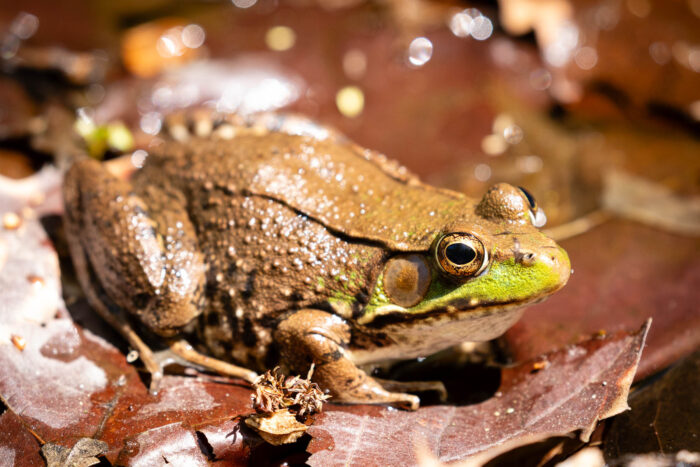
Contrary to its name, the green frog is more often brown or bronze colored than green, but it has some bright green spots present around its face. It has a white underside, typically with some darker spots. Green frogs have dorsolateral folds that go from their eyes to halfway down their bodies. Male green frogs often have bright yellow throats. Blue-colored frogs have been found, indicating a lack of yellow pigmentation.
Feeding
Adult green frogs practice “sit and wait” hunting and will prey on any animals that are large enough to detect but small enough to swallow. Their diet mostly consists of insects, spiders, small fish, shrimp, smaller frogs, tadpoles, small snakes and snails. Tadpoles of this species will eat algae and zooplankton.
Predators
Green frogs are threatened by various predators at all stages of life. Their eggs are most commonly eaten by turtles and tadpoles eaten by water bugs and diving beetles. In adulthood, green frogs are most often eaten by ducks, herons and crows.
Voice
Green frogs have a call that resembles a banjo string being plucked. A single, short gunk or plunk is often exhibited in an aggressive manner.
Reproduction and life cycle
Male green frogs will establish breeding territories and maintain them throughout the entirety of the breeding season which takes place from spring through summer. Females will select a male mate and lay 1 or 2 clutches in shallow water and attach to vegetation each season which can consist anywhere from 1,000 to 7,000 eggs. Fertilized eggs typically hatch 3 to 6 days after being deposited into the male’s territory. The newly hatched tadpoles generally remain in this juvenile stage for about 3 months before metamorphosis occurs. Sexual maturity is reached about a year after metamorphosis.
Did you know?
- During breeding season, male green frogs will defend their territory and demonstrate dominance with vocalizations and through aggressive behavior such as chases and jump attacks.
- Research shows that wild green frogs can switch sexes during their larval stage.
- Some larger male frogs will hold up to 5 territories at once to increase their mating appeals to females. Females often pick mates based on their dominance in hopes the male will protect their young and pass down strong traits.
Sources and additional information
- Green Frog (Lithobates clamitans) - iNaturalist
- Green Frog - Virginia Herpetological Society
- Lithobates clamitans (Green Frog) - Animal Diversity Web
- Green Frog - Amphibians and Reptiles of North Carolina