
Libraries are hotspots in an effort to cool down Richmond
Communities and waterways share the benefits of new trees and green space
Anyone who has “leafed” through the pages of a book understands that there’s a connection between trees and libraries. Indeed, “library” comes from the Latin word “liber” for the inner bark of a tree, from which books were made. Today trees are still helping sustain libraries—and not just by being chopped down.
The James River Association (JRA), like many watershed organizations, plants trees for their ability to soak up stormwater pollution and protect waterways from agricultural runoff. In Richmond, the nonprofit plants trees as part of its green infrastructure efforts, a practice that uses nature-based methods to capture and filter runoff. Since 2019, JRA has partnered with the Richmond Public Library and RVAH20 to install green infrastructure on library campuses across Richmond, aligning watershed goals with communities’ interests. In 2024, the nonprofit received a nearly $750,000-dollar grant from the Chesapeake Bay Innovative Nutrient and Sediment Reduction Grant Program, funded by the Environmental Protection Agency and administered by the National Fish and Wildlife Foundation, to continue the work at additional library branches.
“We approach these projects with the health of the James River in mind,” said JRA’s Director of Community Conservation, Justin Doyle,. “But we’re also able to achieve other benefits through these projects, and increasing tree canopy has emerged as a top priority among residents and library users.”
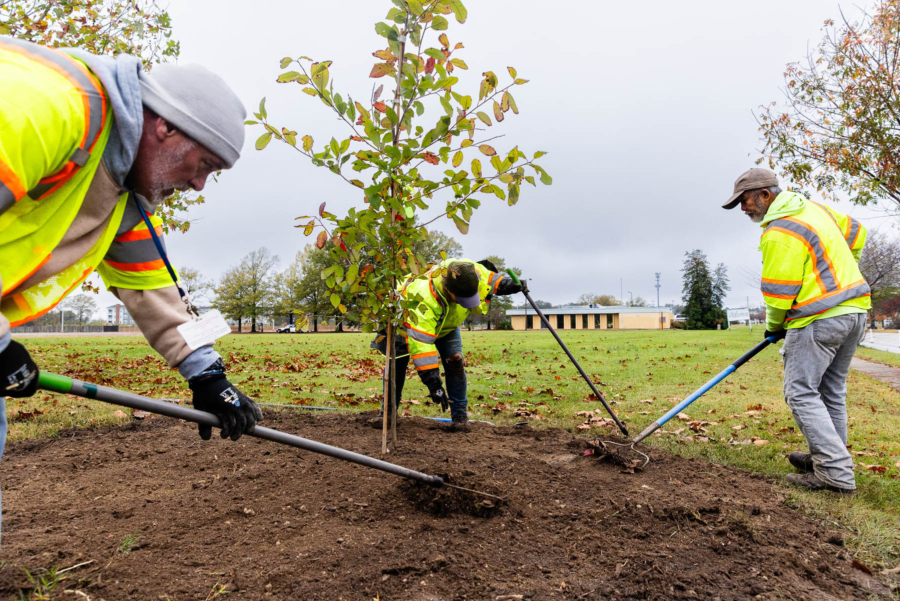
Public interest in trees stems largely from the shade they provide. During a heat wave in 2017, for example, a citywide temperature survey found a 16-degree difference between the coolest and warmest parts of Richmond. The Richmond Master Plan, adopted in 2020, calls for increasing urban tree canopy from 42% to 60% as part of a goal to “positively adapt to the effects of a changing climate” and to “ensure that all residents have equitable access to nature and a healthy community.”
JRA’s program, called Greening Richmond Public Libraries, recently completed installation of one such green infrastructure project at the Ginter Park Branch. Surrounded by neighborhoods, Ginter Park’s one-acre campus is one of the larger in the Richmond Public Library system. The project began in early 2024, with a community engagement meeting at the library and an online questionnaire for community members. That fall, volunteers helped plant 20 trees and shrubs, including sweetbay magnolias, black gums and arrowwood viburnums. For the planting, JRA chose species that are native to the region and more capable of withstanding both wet and dry weather extremes.
“They're resilient in that way,” Doyle said.
In early 2025, the project continued, with the construction of three new bioretention basins—otherwise known as rain gardens—as well as conservation landscaping around three sides of the building and an accessible walkway across the library campus. Late 2025 saw the addition of an outdoor reading area and a permeable paver system at one of the library’s two entrances. Last month, the project wrapped up with the addition of new benches and a blue shade canopy in front of the library.
The library “has completely undergone a transformation,” Doyle said. The campus now captures stormwater flowing off of the library building and parking lot, reducing nitrogen pollution by five pounds a year and phosphorus by a third of a pound.
Including the work at Ginter Park, the program has installed green infrastructure projects at six library branches since 2019. Doyle said the bioretention structures alone have reduced nitrogen by almost 15.97 pounds and phosphorus by 1.66 pounds annually. Additionally, the permeable pavement and planted trees have taken an additional bite out of stormwater pollution.
The project also included an irrigation system to keep the many young plants alive. JRA’s focus has now turned to keeping the landscaping alive and doing its job.
“Maintenance has become a big focus of ours,” Doyle said. “And helping the libraries to maintain the new practices that have been installed on the grounds has been a top priority of the team.”
Branching out
JRA is finalizing plans for green infrastructure projects at two more library branches in 2026. And it is also ramping up its tree planting work in the residential areas surrounding Richmond libraries. Overall, JRA’s priority has been watersheds identified in the city’s RVA Clean Water Plan, such as the Cannon’s Branch/Shockoe Creek watershed, which includes some of the library branches where the nonprofit has worked.
“I think we'll continue to consider organizing community tree planting events in the neighborhoods around those libraries just to help create that ripple effect that the library projects are intended to have in the communities around them,” Doyle said.
For example, last year JRA partnered with a community-based organization, Church Hill Trees, to plant approximately 90 trees near the smaller campus of East End Branch, a region of the city where urban heat and stormwater management are high priorities. In a previous partnership, JRA helped establish a 0.4-mile green street in Richmond’s Bellemeade community.
JRA’s green infrastructure work complement similar efforts by Richmond organizations such as Southside Releaf. That nonprofit has developed five new parks and organized hundreds of volunteers while planting and maintaining thousands of trees in the Southside area of Richmond, south of the James River, including at several public school campuses and a community center.
The upside of all the new living greenery is that the benefits will accrue as the tree and plants mature.
“As the trees continue to grow, you know, there's additional stormwater runoff reductions,” Doyle said. “And then you also get more evapotranspiration, you get more shade…hopefully a cooler environment in the long run.”
Comments
There are no comments.
Thank you!
Your comment has been received. Before it can be published, the comment will be reviewed by our team to ensure it adheres with our rules of engagement.
Back to recent stories