
Baltimore’s floating wetlands are bubbling with life
The National Aquarium’s Harbor Wetland attracts species big and small
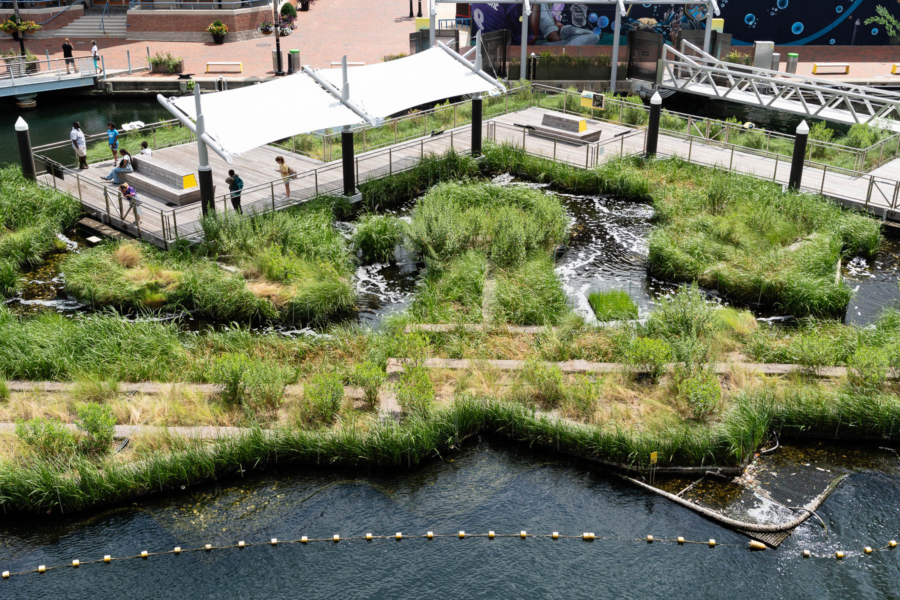
In 2024, next to its campus in downtown Baltimore, the National Aquarium installed a sweeping, 10,000-square-foot artificial floating habitat known as the Harbor Wetland. Passersby can look down on the swath of native grasses and shrubs planted into a structure that recently marked its first full year as a carefully designed approximation of the vast natural marshes that would have lined the Inner Harbor in centuries past.
Harbor Wetland is more than just a stylistic flourish to beautify the strip of water between Pier 3 and Pier 4. It shows how even a relatively small wetland—one of the most biodiverse types of habitats—can provide meaningful support for wildlife in the heart of a city. Species started showing up soon after the aquarium completed construction two summers ago.
“Before we were even actually finished planting, the first thing that happened was we had a pair of nesting mallards,” said Taylor Long, a conservation coordinator with the aquarium.
Long witnessed a parade of early birds that included ducks, geese and Cooper’s hawks. Great blue herons also quickly inhabited the wetland, feeding on a range of small fish, crabs and shrimp found in the artificial shallows between artificial islands. Mammals have also moved in, and on her daily rounds, Long has spotted muskrats and foxes in addition to perhaps the most notorious visitors—North American river otters.
“Before Harbor Wetland was here, there wasn't much habitat that was usable for them in the Inner Harbor,” Long said. “So now that Harbor Wetland is here and provides them with that space to do normal otter social behaviors—scent mark, socialize with other otters, have a latrine—that’s probably what drew them in.”
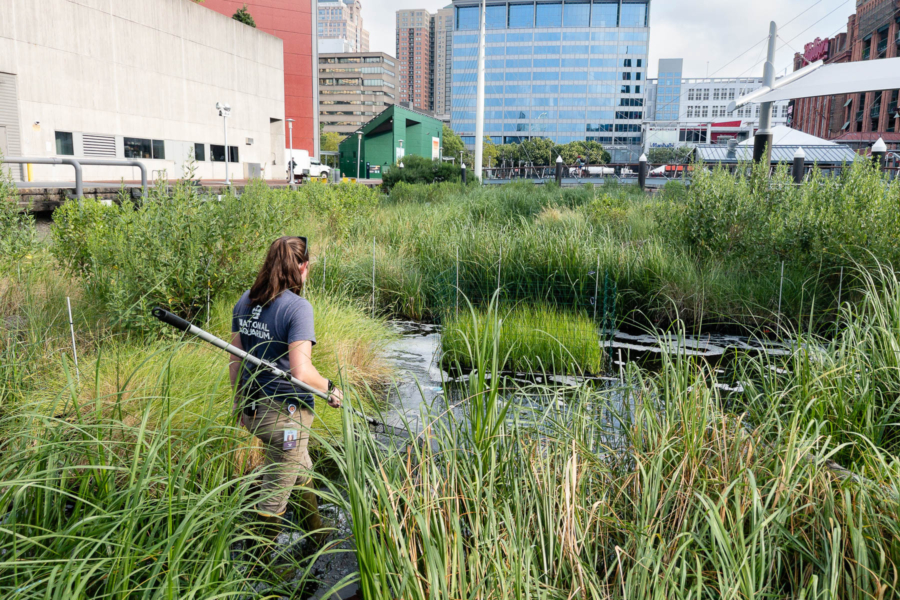
Long has more chances than most to see wildlife at Harbor Wetland, since she starts most days walking and wading throughout the structure in search of litter that has washed off the land with stormwater and become trapped.
“When we have a big rain storm, a lot of this stuff comes down through the Jones Falls,” Long said.
On a sunny morning in the peak of summer, Long held a long net as she conducted her morning routine, passing a large piece of driftwood placed strategically for wildlife like turtles that bask in the sun. She stepped carefully over the submerged hoses that pump air through the wetland, creating bubbles and oxygenating the water.
Below her boots, in about 8–12 inches of water, was the foundation of the wetland, a matrix of panels made out of a very strong fiberglass material called fibergrate.
“That gives it the connectivity, but that also gives us the ability to adjust each individual module,” Long said.
Between islands of marsh plants, with their roots enmeshed with the fibergrate, Long stepped from the water onto coir-covered floats that would keep the wetland from sinking if there was ever a failure of its pontoon systems.
“You can essentially think of that like the life jacket of Harbor Wetland,” Long said.
So far, the structure has withstood weather extremes and major storms. And although the wetland’s aeration system can’t prevent large-scale low-oxygen episodes called dead zones, it can provide a small-scale refuge for aquatic life within a heavily developed urban inlet.
“Having harbor wetland here—with this meandering channel, with this water mixing—helps to improve the water quality in this area,” Long said. “And we can definitely see that animals do come here during times of low water quality events.”
Despite an exceptionally long low-oxygen event called a pistachio tide that released a rotten egg smell and turned the Inner Harbor green for weeks in 2025, the waterway is still improving in the long term. That is according to the annual Healthy Harbor Report Card, which is based on water quality data collected by Blue Water Baltimore and the Waterfront Partnership of Baltimore.
The aquarium now collects its own water quality data at Harbor Wetland. After picking up litter, Long returns once a week with a monitoring probe, dropping it through a small gap in one of the wetland modules. She repeated the procedure at the edge of the wetland, where the foot-deep platform drops off suddenly to the unseen bottom of the Inner Harbor.
Around her, blue dragonflies perched on tall green grasses whose roots were anchored firmly onto the floating platforms below. Hundreds of mummichogs scattered underneath the surface as schools of Atlantic menhaden swirled along the wetland’s edges, chased by a cormorant diving below the Harbor Bridge Walk. The bridge provides a view of Harbor Wetland that rivals the aquarium’s indoor offerings of native and exotic species, found just yards away. Though, this exhibit and the natural visitors it attracts are offered daily, free of admission.
Comments
How can I convey all of this to my family in Maryland, South Carolina and Oregon?
Thank you!
Your comment has been received. Before it can be published, the comment will be reviewed by our team to ensure it adheres with our rules of engagement.
Back to recent stories