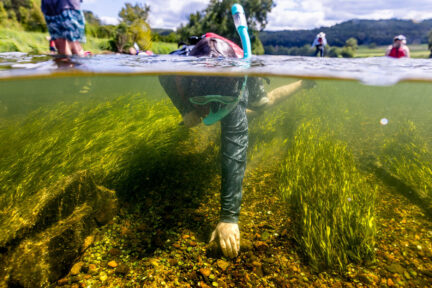
Removing stream blockages opens 303 miles for fish passage in 2022-2023
The collaboration of Chesapeake Bay Program partners helps migratory fish reach their spawning grounds
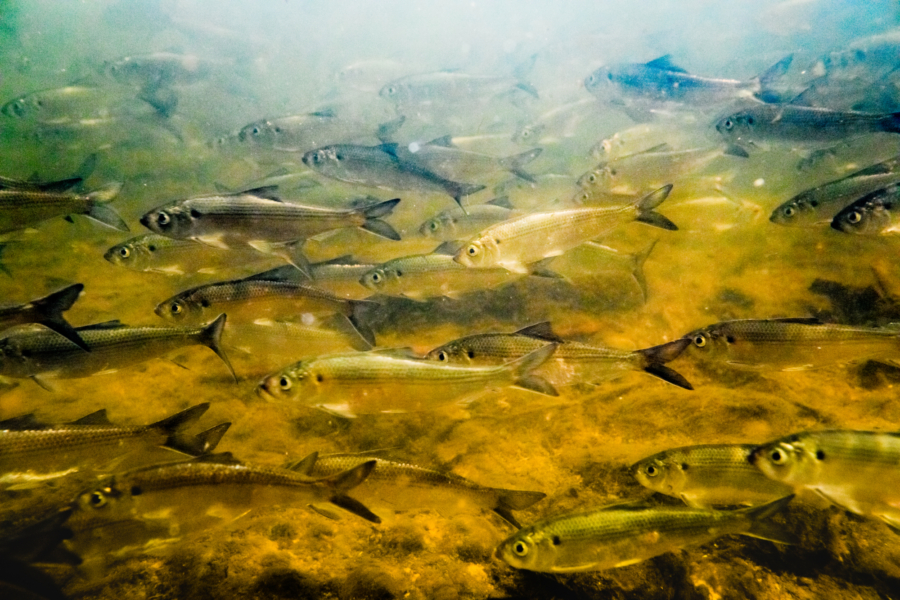
Substantial progress has been achieved toward meeting the Fish Passage Outcome in the 2014 Chesapeake Bay Watershed Agreement. During the period of 2022-2023, Chesapeake Bay Program partners opened a total of 303 stream miles to migratory fish. This marks a tenfold increase from the 33 stream miles reported open during the previous assessment period of 2020-2021, surpassing the partnership’s target of restoring 132 miles of historical fish migration routes every two years.
“Through the collaborative work of our members and their strong partnerships with government and non-government organizations, we continue to reconnect, and restore stream and river habitat across the watershed,” said Ray Li, fishery biologist with the U.S. Fish and Wildlife Service and chair of the Chesapeake Bay Program’s Fish Passage Workgroup. “In addition to restoring native and recreational fisheries, these projects can improve wildlife habitat along stream corridors and reduce long-term maintenance needs of aging infrastructure, flooding and public safety hazards to local communities.”
Progress toward achieving the Fish Passage Outcome is determined by the number of stream miles opened that help fish such as alewife, herring, shad, brook trout and the American eel swim past blockages in order to reach their historical spawning grounds. This can be achieved either by removing or updating barriers (e.g., dams), or building structures to assist fish along their migratory routes (e.g., fish ladders). This data is reported and analyzed through The Nature Conservancy’s Chesapeake Bay Fish Passage Prioritization Tool every two years. Success is measured not only in stream miles reopened but also in the presence of target fish species at restoration sites.
During 2022-2023, 13 dams were removed, including the Oakland Dam along the Susquehanna River, which alone opened up more than 200 stream miles. Other dams removed during this time included the Wilson Creek Dam in Virginia, restoring 19.3 miles to fish passage and the Hollister Dam in Pennsylvania, opening up 26.4 stream miles for migratory fish to traverse.
“As our agency’s representative on the Chesapeake Bay Program Fish Passage Workgroup, I am excited to see the progress being made on the fish passage front in the Chesapeake Bay watershed,” said Ian R. Blackburn, aquatic biologist with the New York Department of Environmental Conservation. “New York has strong cultural and historical ties to the Chesapeake via the Susquehanna River, with specific regard to the annual runs of American shad and American eels. New York continues to improve passage in the upper Susquehanna basin, one culvert replacement and one dam removal or passage modification at a time, and looks forward to the day the runs of these fish return in earnest and connectivity is restored throughout the Chesapeake watershed.”
The Fish Passage Outcome originally set a target to open an additional 1,000 miles of streams by 2025, which was achieved nine years early in 2016. The partnership formally revised the outcome in 2020 after the Fish Passage Workgroup determined that habitat to migratory fish populations were opening at a rate of 132 miles every two years. The Fish Passage Workgroup is continuing momentum toward meeting the 2014 Chesapeake Bay Watershed Agreement outcome with several projects in the planning, design and construction phases. The final data for this outcome (reflecting the period 2024-2025) is expected in 2027 and it is anticipated that it will be fully met.
A revised Fish Passage Outcome is proposed to be included in the draft revised Chesapeake Bay Watershed Agreement that is currently being reviewed by the Chesapeake Bay Program’s leadership.
Since 1989, Chesapeake Bay Program partners have worked together to open up migratory routes by removing dams, replacing culverts and installing fish passage infrastructure. To date, 35,258 miles of streams have been reopened to fish migration, including 11,440 miles through dam removals and 23,818 miles through other fish passage projects.
“Trout Unlimited is proud to be part of the efforts in the Chesapeake Bay watershed to remove fish passage barriers and create unimpeded stream networks that allow native and wild brook trout to thrive,” said Abby McQueen, stream restoration specialist with Trout Unlimited. “The progress the partnership has made is impressive and we look forward to continuing to work together to open even more stream miles and improve even more infrastructure for future generations.”
Recent Press Releases
Chesapeake Bay underwater grass increases 7% in 2025, nearing 2030 milestone
Chesapeake Bay watershed jurisdictions continue working toward nitrogen and phosphorus goals, with sediment goal already achieved
Annual Chesapeake Bay Awareness Week celebrates a watershed “Built by Nature, Protected Together”