
Chesapeake Executive Council Approves Revised Watershed Agreement, Ushering in the Next Era of Bay Restoration
Partnership tasked with recommending how to best include Indigenous tribes and knowledge moving forward; Pennsylvania Gov. Josh Shapiro elected chair
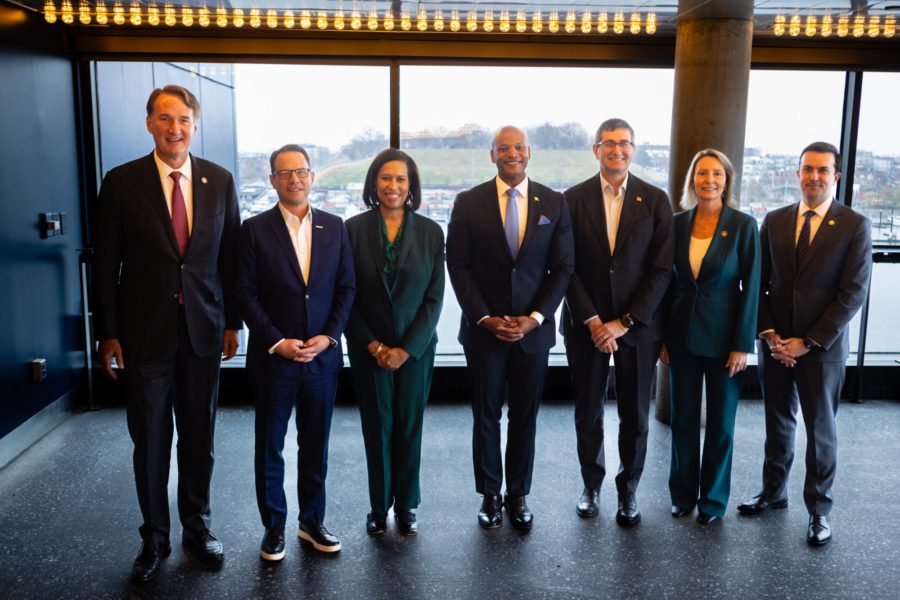
Baltimore, MD– The Chesapeake Executive Council met at the National Aquarium today to formally approve a revised Chesapeake Bay Watershed Agreement. Since 1983, the Chesapeake Bay Program has used voluntary agreements to guide restoration of the nation’s largest estuary and its watershed.
Today’s approval is the culmination of work that began more than three years ago, when the Executive Council charged the partnership with recommending a path forward that prioritized and outlined the next steps for meeting the goals and outcomes of the previous Watershed Agreement—many of which had suggested completion dates of 2025—and preparing recommendations that addressed advances in science and restoration while focusing on the future of the Chesapeake Bay Program beyond 2025. At last year’s meeting, the Executive Council formally tasked the partnership with revising the Watershed Agreement over the next year.
The result is a refreshed agreement that builds on what has already been achieved—and the work still to come—while using the latest science, elevating conservation as a key focus, and ensuring, as much as possible, that its goals are clear, measurable and time-bound.
“Today we made a commitment to the Chesapeake Bay and a commitment to the people of Maryland and our neighboring states,” said Maryland Governor Wes Moore. “The revised Chesapeake Bay Watershed Agreement will make our rivers and streams cleaner. It will bolster Maryland’s seafood, tourism and recreational businesses. Most importantly, it will ensure we protect the precious heirloom that is the Chesapeake Bay so we can pass it down to the next generations in a better condition than we received it.”
The revised Chesapeake Bay Watershed Agreement contains four goals—Thriving Habitats, Fisheries and Wildlife; Clean Water; Healthy Landscapes; and Engaged Communities—and 21 outcomes. The partnership will now update or develop new Management Strategies for each outcome that outline how it will be achieved and include considerations such as monitoring, assessing and reporting progress, as well as where coordination with partners and stakeholders is needed.
Additionally, the Executive Council approved recommendations to streamline and simplify the partnership’s structure and governance. The Chesapeake Bay Program will implement these revisions and regularly report progress to the Principals' Staff Committee for their final approval expected by July 1, 2026.
"The Chesapeake Bay Program is a model for the nation of what is possible with state-led, federally backed and community-driven restoration,” said Maryland State Senator Sara Love, chair of the Chesapeake Bay Commission. “This refreshed Chesapeake Bay Watershed Agreement marks a new chapter in our enduring partnership, made possible through contributions from experts in every field and input from every corner of the watershed. Together, we remain grounded in sound science and dedicated to providing a healthy Bay and watershed for the people.”
At today’s meeting, the Executive Council took another significant step for the future of the partnership by calling for recommendations to be developed over the next year, in collaboration with the federally recognized tribal nations of the Chesapeake Bay watershed, on how best to include tribes in the Chesapeake Bay Program moving forward. Chief G. Anne Richardson of the Rappahannock Tribe, who chairs the Indigenous Conservation Council of the Chesapeake Bay, attended the meeting along with other board representatives.
The Executive Council also heard from the partnership’s four advisory committees, which represent agricultural, local government, resident, and scientific and technical interests across the watershed. Notably, this was the first time the Agricultural Advisory Committee participated in an Executive Council meeting, having been established in December 2024.
“The Agricultural Advisory Committee brings practical insight from working farms to help shape strategies that protect water quality and support viable agriculture,” said Bill Fink, chair of the Chesapeake Bay Program’s Agricultural Advisory Committee. “With farming now fully recognized in the revised Chesapeake Bay Watershed Agreement, we see a real opportunity to move from restoration toward preserving a restored Bay watershed for future generations.”
Pennsylvania Governor Josh Shapiro was unanimously elected to be chair of the Executive Council, succeeding Maryland Governor Wes Moore, who has served in the role for the past two years.
“My Administration has accelerated Pennsylvania’s progress in restoring local waterways across the Commonwealth and reduced our share of pollution to the Bay, ensuring every Pennsylvanian has access to clean air and water while supporting our farmers and our agriculture industry,” said Pennsylvania Governor Josh Shapiro. “I’m honored to be elected as the next chair of the Chesapeake Executive Council by my fellow governors and I’m looking forward to continuing this work to get stuff done together for the people we serve.”
The Executive Council was formed as part of the Chesapeake Bay Agreement of 1983 and consists of the governors of Delaware, Maryland, New York, Pennsylvania, Virginia and West Virginia, the mayor of the District of Columbia, the chair of the Chesapeake Bay Commission and the administrator of the Environmental Protection Agency, who represents the federal government.
“The Chesapeake Bay is one of our country’s most important resources,” said U.S. Environmental Protection Agency Deputy Administrator David Fotouhi. “The efforts of the Chesapeake Bay Program over the past 42 years have shown the power of collaboration and cooperative federalism in restoring and protecting our nation’s waters. Partnerships such as the Chesapeake Bay Program help to carry out President Trump’s agenda to provide clean air, land and water for every American and support economic growth.”
Quotes
“Today we made a commitment to the Chesapeake Bay and a commitment to the people of Maryland and our neighboring states. The revised Chesapeake Bay Watershed Agreement will make our rivers and streams cleaner. It will bolster Maryland’s seafood, tourism and recreational businesses. Most importantly, it will ensure we protect the precious heirloom that is the Chesapeake Bay so we can pass it down to the next generations in a better condition than we received it.”
- Wes Moore, Governor, State of Maryland
“My Administration has accelerated Pennsylvania’s progress in restoring local waterways across the Commonwealth and reduced our share of pollution to the Bay, ensuring every Pennsylvanian has access to clean air and water while supporting our farmers and our agriculture industry. I’m honored to be elected as the next chair of the Chesapeake Executive Council by my fellow governors and I’m looking forward to continuing this work to get stuff done together for the people we serve.”
- Josh Shapiro, Governor, Commonwealth of Pennsylvania
"Delaware is committed to restoring our state’s portion of the cherished Chesapeake Bay watershed through progressive environmental planning, habitat enhancement and robust community collaboration. From planting native trees as anti-erosion agents to restoring wetlands, Delawareans are already taking the steps necessary to protect their lives and livelihoods. By continuing to provide our Chesapeake Bay watershed communities with the resources needed to implement widespread conservation practices, we can ensure a healthier Bay overall, help keep homes affordable for working families, create a more sustainable future for generations to come and advance the goals outlined in the revised Watershed Agreement.”
- Matt Meyer, Governor, State of Delaware
“New York State remains committed to our ongoing partnership with the Chesapeake Bay Program to improve the water quality of the Chesapeake Bay and the Chemung and Susquehanna River basins. New York fully supports the revised Chesapeake Bay Watershed Agreement and looks forward to strong and sustained clean water partnerships crucial to the success of restoration efforts. This beneficial work, along with increased collaboration with the federally recognized tribal nations of the Chesapeake Bay watershed, will ensure continued protection of these waters and the entire Chesapeake Bay Program moving forward.”
- Kathy Hochul, Governor, State of New York
“Throughout my Administration, protecting the Chesapeake Bay, one of our most treasured natural resources, has not been an afterthought, it has been a commitment we have reaffirmed each and every day. Through transparent engagement with our Bay Program partners and Virginia stakeholders, we have demonstrated that targeted investments combined with voluntary partnerships equal real results. Virginia is poised to meet our goals and accelerate our progress, and I am pleased that the actions taken by the Chesapeake Executive Council have set the partnership on a path for continued improvement by understanding the need for realistic targets and structural efficiencies.”
- Glenn Youngkin, Governor, Commonwealth of Virginia
"As a member of the Chesapeake Bay Program, West Virginia has been working with partners across the watershed to protect and preserve natural resources for everyone who lives, works and spends time in the Bay area. Together we are building a pathway to a cleaner, healthier Bay."
- Patrick Morrisey, Governor, State of West Virginia
“We’re proud not only of Washington, D.C.’s longstanding role in the Chesapeake Bay Program, but also our city’s leadership in meeting our collective goals and outcomes and then pushing ourselves to go even further. This revised Watershed Agreement really recognizes the importance of engaged communities, and whether through our educational programs or building on the success of our RiverSmart program, we are committed to continuing our leadership in this work. The process of revisiting and refining the agreement required significant collaboration and effort to balance the priorities of the Bay jurisdictions—while also increasing accountability, but the end result is one we should all be proud of: a stronger, more measurable and more impactful agreement.”
- Muriel Bowser, Mayor, District of Columbia
"The Chesapeake Bay Program is a model for the nation of what is possible with state-led, federally backed and community-driven restoration. This refreshed Chesapeake Bay Watershed Agreement marks a new chapter in our enduring partnership, made possible through contributions from experts in every field and input from every corner of the watershed. Together, we remain grounded in sound science and dedicated to providing a healthy Bay and watershed for the people.”
- Maryland State Senator Sara Love, Chair, Chesapeake Bay Commission
“The Chesapeake Bay is one of our country’s most important resources. The efforts of the Chesapeake Bay Program over the past 42 years have shown the power of collaboration and cooperative federalism in restoring and protecting our nation’s waters. Partnerships such as the Chesapeake Bay Program help to carry out President Trump’s agenda to provide clean air, land and water for every American and support economic growth.”
- David Fotouhi, Deputy Administrator, U.S. Environmental Protection Agency
“The Agricultural Advisory Committee brings practical insight from working farms to help shape strategies that protect water quality and support viable agriculture. With farming now fully recognized in the revised Chesapeake Bay Watershed Agreement, we see a real opportunity to move from restoration toward preserving a restored Bay watershed for future generations.”
- Bill Fink, Chair, Chesapeake Bay Program Agricultural Advisory Committee
“In the face of changing environmental and economic conditions, this new Chesapeake Bay Watershed Agreement responds with a unified vision. It balances the needs of diverse governments, economies and people. We are in this together, and together through better science, coordination and investment, we will bring about a restored Chesapeake Bay watershed.”
- Marty Qually, Chair, Local Government Advisory Committee and Commissioner, Adams County, Pennsylvania
“The Scientific and Technical Advisory Committee is excited about recent advances in science and technology that will support the partnership and the revised Chesapeake Bay Watershed Agreement, particularly with regard to artificial intelligence.”
- Dr. William C. Dennison, Chair, Scientific and Technical Advisory Committee and Provost, Vice-President for Academic Affairs, University of Maryland Center for Environmental Science
“We are excited about the recommitment to watershed wide goals that have the potential to incorporate additional approaches to reaching broader audiences to support improved water quality. We are also excited to welcome, for the first time, the new Agricultural Advisory Committee and to begin exploring a formal relationship with Indigenous voices of the Chesapeake Bay. These additional perspectives, the Stakeholders' Advisory Committee believes, will help with accountability and transparency and to take bold, collaborative actions in the protection of the Chesapeake Bay watershed."
- Abel Olivo, Chair, Chesapeake Bay Program Stakeholders’ Advisory Committee
Related Video
Recent Press Releases
Chesapeake Bay underwater grass increases 7% in 2025, nearing 2030 milestone

Chesapeake Bay watershed jurisdictions continue working toward nitrogen and phosphorus goals, with sediment goal already achieved
Annual Chesapeake Bay Awareness Week celebrates a watershed “Built by Nature, Protected Together”
Supporting Materials
- December 2025 Chesapeake Executive Council Meeting Flickr Album
- Revised Chesapeake Bay Watershed Agreement
- Chesapeake Bay Program Governance Recommendations
- Chesapeake Bay Program Structure Recommendations
- Executive Council Tribal Partnerships Charge Backgrounder
- Executive Council Tribal Partnership Charge
- Beyond 2025 Backgrounder
- Agricultural Advisory Committee Recommendations to the Executive Council
- Local Government Advisory Committee Recommendations to the Executive Council
- Scientific and Technical Advisory Committee Recommendations for the Executive Council
- Stakeholders Advisory Committee Recommendations to the Executive Council
- Advisory Committee Backgrounder