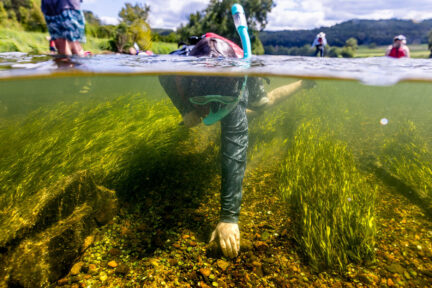
Underwater grass skyrockets in parts of the Chesapeake Bay, decreases in others
One percent overall drop in underwater grass acreage Bay-wide
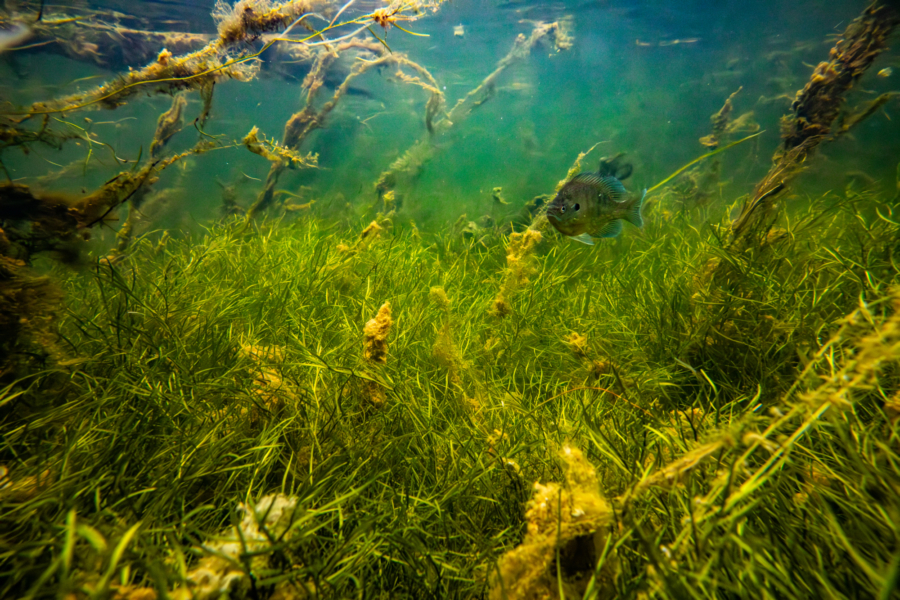
Annapolis, Maryland—In 2024, it is estimated that the abundance of underwater grasses fell by 1% in the Chesapeake Bay, despite observed gains in three out of four salinity zones. In 2024, 82,778 acres of underwater grasses were mapped in the Chesapeake Bay and its tributaries, compared to 83,419 acres in 2023. The Chesapeake Bay Program’s Bay-wide Submerged Aquatic Vegetation (SAV) Outcome remains “off-course” even as progress is made in some regions.
Scientists categorize the Bay into four salinity zones to track changes in underwater grass abundance over time, accounting for how the grass beds respond to storms, drought and other growing conditions. In 2024, researchers observed in the “very salty” Polyhaline Zone, which extends from the mouth of the Bay near Virginia Beach, Virginia up to lower Bay near the Maryland-Virginia border, a historic increase of 21,803 acres in 2023 to 24,800 acres in 2024. This is the highest coverage since annual mapping began in 1984 and is a 74% achievement of the acreage target for that region. The largest gains occurred in Mobjack Bay, Poquoson Flats and nearby Western Shore areas.
Eelgrass, a species of underwater grass that grows in the Polyhaline Zone, did particularly well. This species hit a low in 2019, when the Bay saw historic levels of rainfall. In recent years, eelgrass has recovered and then surpassed all previous monitoring records. Researchers say that eelgrass has moved into deeper parts of the Bay, expanding the available habitat for underwater grasses and indicating that water quality improvements are likely responsible.
“It’s just been amazing to watch the expansion of the meadows! We now have eelgrass happily growing at 8-9 feet at low tide in some places, which was unthinkable just a few years ago,” said Christopher J. Patrick, associate professor and director of the SAV Monitoring and Restoration Program at the Virginia Institute of Marine Science (VIMS). “But beyond the polyhaline, it’s another example of how incredibly fast SAV can expand and recover when conditions are right. We saw the same story in the Susquehanna Flats 15 years ago. It shows that recovery isn’t incremental, it's rapid when it happens, and that gives me hope for us achieving the Chesapeake Bay wide goals in the future even if they seem far off now.”
The 2024 mapping also revealed a modest increase in the Bay’s Tidal Fresh Zone and a significant increase in the slightly salty Oligohaline Zone. In the Tidal Fresh Zone, underwater grass beds increased from an estimated 19,823 acres to 20,218 acres, a 98% achievement of the SAV target of 20,602 acres for that region. In the Oligohaline Zone, underwater grass beds increased from an estimated 3,422 acres to 4,730 acres, a 46% achievement of the 10,334-acre target.
However, underwater grass decreased by 14% in the moderately salty Mesohaline Zone, from 38,371 acres to 33,031 acres, a 27% achievement of the 120,306-acre target for that zone. Losses in the Mesohaline Zone, which is the largest zone in the Bay, mainly occurred along the Eastern Shore of Maryland in the Choptank and Little Choptank rivers, as well as in Tangier Sound.
These decreases were enough to offset gains, resulting in a 1% drop in underwater grass abundance Bay-wide. This marks a 64% achievement of the SAV Outcome’s 2025 restoration target of 130,000 acres in the 2014 Chesapeake Bay Watershed Agreement and 45% of the long-term target of 185,000 acres that is needed for a fully restored estuary.
“Underwater grasses thrived in the Choptank in 2023—a year of higher-than-average salinity—but 2024 told a much different story,” said Choptank Riverkeeper Matt Pluta. “Despite drought-like conditions locally, the river’s salinity remained lower than average for much of 2024, and our SAV populations, which prefer saltier waters, declined in part because of it. This highlights how changes in freshwater runoff, including salinity and nutrient pollution inputs, are reshaping the balance in our estuary.”
Underwater grass acreage has increased 112% since 1984 when VIMS mapped 38,958 acres during their first survey. Research has shown that nitrogen and phosphorus reductions made under the Chesapeake Bay Total Maximum Daily Load have played a critical role in the overall underwater grass recovery. Warming water temperatures and intense rainfall, like what the Bay experienced in 2018 and 2019, threaten sensitive underwater grass beds.
“Despite many environmental pressures on the Bay, we continue to see signs of resilience and recovery in our underwater grasses. The increases in SAV acres observed in three of the four salinity zones this year are truly a testament to the effectiveness of long-term nutrient reductions and collaborative restoration efforts,” said Brooke Landry, chair of the Chesapeake Bay Program’s SAV Workgroup and chief of the SAV Program at the Maryland Department of Natural Resources. “But as seen with the losses in the mid-Bay, we must remain vigilant. SAV recovery is not guaranteed. Sustained investment in science-based management, conservation and public engagement will be essential to protect and accelerate not only the recovery of SAV, but the entire Chesapeake Bay.”
Underwater grass beds are critical to the Chesapeake Bay ecosystem. They provide food and shelter for fish and wildlife, sequester carbon and buffer coastal acidification, add oxygen to the water, absorb nitrogen and phosphorus pollution, reduce shoreline erosion and help suspended particles of sediment settle to the bottom. Because they are sensitive to pollution but quick to respond to improvements in water quality, underwater grass abundance is a good indicator of the Bay’s health.
Chesapeake Bay Program partners are now working to update and revise the Chesapeake Bay Watershed Agreement to guide future restoration efforts. Given the importance of underwater grasses to understanding improvements in Bay water quality, a revised SAV Outcome is proposed to be included in the updated Watershed Agreement.
The draft revised Chesapeake Bay Watershed Agreement is now available on the Chesapeake Bay Program’s Beyond 2025 webpage. Members of the public are encouraged to provide feedback to comments@chesapeakebay.net until September 1.
Recent Press Releases
Chesapeake Bay underwater grass increases 7% in 2025, nearing 2030 milestone
Chesapeake Bay watershed jurisdictions continue working toward nitrogen and phosphorus goals, with sediment goal already achieved
Annual Chesapeake Bay Awareness Week celebrates a watershed “Built by Nature, Protected Together”