
2025’s most popular Bay stories highlight generational stewardship
Take a look at the Chesapeake Bay Program’s most-read blogs from the past year
As 2025 draws to a close, we’re looking back at the stories that resonated most with readers across the Chesapeake Bay watershed over the last year.
This year, our most popular stories share a common theme of communities stewarding their lands and waters over decades—if not centuries. In southern Virginia, the Rappahannock Tribe reclaimed 969 acres of ancestral land. On Maryland’s Eastern Shore, a 12th generation family restored its eroding shoreline. And across the watershed, a decade-long oyster reef restoration project achieved its goal.
It’s only fitting that in 2025, the Chesapeake Bay Program revised the Chesapeake Bay Watershed Agreement, which was signed in 2014 and whose first iteration dates back to 1983.
Top stories of 2025
Eastern Shore park begins its transformation into a grassland bird refuge
Oxford Conservation Park on Maryland’s Eastern Shore has largely been restored from farmland into a grassland bird refuge for species like sparrows, meadowlarks and bobwhite quail. Conservation partners are removing invasive plants and planting native grasses, trees and wildflowers that benefit wildlife. The transformed property is open to the public and does a far better job absorbing stormwater runoff than the old farmland.
Rappahannock Tribe celebrates the rematriation of 969 acres of ancestral land along Fones Cliffs
The Rappahannock Tribe recently celebrated the rematriation of 969 acres of its ancestral land at Fones Cliffs along the Rappahannock River in Virginia. This land, once threatened by development, was purchased with the help of conservation partners and is now protected by easements. Fones Cliffs — a forested stretch above the river that supports wildlife like bald eagles — holds deep historical and cultural importance for the tribe, whose ancestors have lived there for centuries.
With conservation, a 12th-generation Maryland family holds on to its historic property
The Tilghman family, descendants of the original owners of Wye House Farm on Maryland’s Eastern Shore, has conserved key parts of their property through permanent easements to protect the historic and environmental value. To combat severe shoreline erosion that threatens the land and contributes sediment to local waters, the family has installed living shorelines that fortify the coastline while creating high quality habitat for fish and waterfowl. The family’s stewardship also includes protecting inland wetlands and planning habitat projects that benefit wildlife while maintaining the farm’s cultural and environmental legacy.
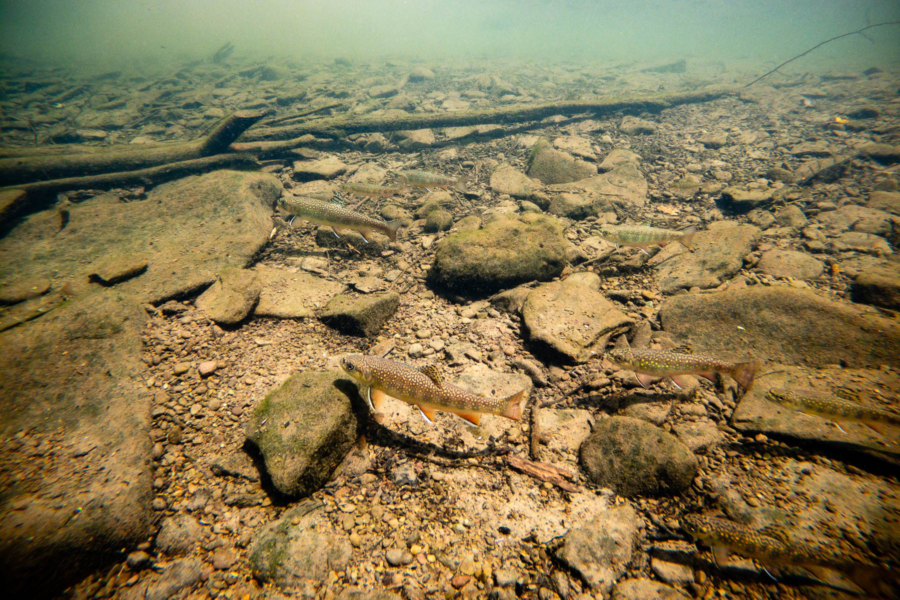
The decades-long effort to restore brook trout habitat in the Kettle Creek watershed
The Kettle Creek watershed in northcentral Pennsylvania has faced decades of habitat degradation from historical mining and erosion that left lower streams inhospitable to native brook trout. Local volunteers and conservation groups, including the Kettle Creek Watershed Association and Trout Unlimited, have spent years installing acid mine drainage treatment systems and removing fish barriers while restoring riparian forest buffers to improve water quality and habitat connectivity. These long-term efforts have helped previously impaired streams recover and have reopened miles of cold, clean water where brook trout and other aquatic life can thrive.
A rare colony of night herons nest near the Baltimore waterfront
A surprisingly thriving colony of black-crowned night herons has taken up residence in the trees near the Baltimore waterfront. These herons, native to the Chesapeake Bay region, breed in tree-top rookeries and raise their young even amid the noise and activity of city life. Local residents have noticed the birds’ presence, and injured chicks that fall onto pavement are often cared for by wildlife rescuers before being returned to the colony.
Chesapeake Bay partners complete the world’s largest oyster reef restoration project
Chesapeake Bay Program partners celebrated achieving a major outcome of the 2014 Chesapeake Bay Watershed Agreement by restoring oyster reef habitat in 10 Bay tributaries by the end of 2025. Together they restored roughly 1,900 acres of reef and planted about 7.5 billion oysters, with an additional bonus tributary bringing the total habitat to around 2,400 acres—making it the largest oyster reef restoration project in the world. Oyster reefs provide crucial habitat, help filter and clean Bay waters, and support commercially and recreationally important species.
Are there any Chesapeake Bay stories that stood out to you this year? Let us know in the comments!
Comments
There are no comments.
Thank you!
Your comment has been received. Before it can be published, the comment will be reviewed by our team to ensure it adheres with our rules of engagement.
Back to recent stories