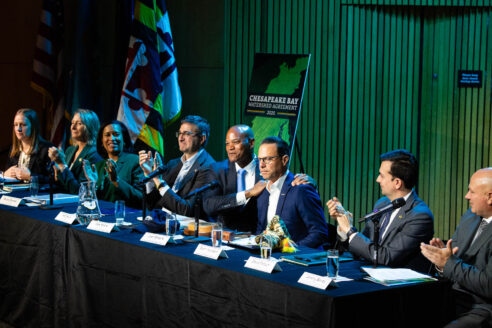
New 2012 data released today by the Chesapeake Bay Program (CBP) partnership estimates that actions taken by jurisdictions in the last three years resulted in less nitrogen, phosphorus and sediment pollution flowing into the Chesapeake Bay.
Chesapeake Bay Program partners–the District of Columbia and the six states in the Bay watershed–report annually on actions they’ve taken to decrease the amount of these three pollutants entering rivers and streams. This information is analyzed using a sophisticated suite of computer simulations of the Bay ecosystem. The resulting estimates tell us how much progress their pollution-reducing actions have made toward levels that would sustain a healthy Bay. By 2017, CBP partners are committed to having practices in place to achieve at least 60 percent of necessary reductions from 2009 levels.
Simulations of pollution reducing efforts put in place between July 2009 and June 2012 estimate CBP partners have achieved 25, 27 and 32 percent of nitrogen, phosphorus and sediment reductions needed by 2025, respectively.
Nitrogen loads to the Bay have decreased 18.5 million pounds to 264.1 million
Phosphorous loads to the Bay have decreased 1.3 million pounds to 18.0 million
Sediment loads to the Bay have decreased 431 million pounds to 8,244 million
Excess nutrients (nitrogen, phosphorous) and sediment impair water quality and underwater habitat. It is critical to reduce the amount of these pollutants entering our waters.
Too much nitrogen and phosphorus fuel the growth of algae blooms. As the algae die off, naturally occurring bacteria use up oxygen in the water, leaving behind “dead zones” unable to support aquatic life. Excess sediment clouds the water, blocking sunlight from reaching underwater grass beds and suffocating oysters and other shellfish that can’t move to healthier waters.
CBP’s “Reducing Pollution” information offers up the most current data on our partners’ progress toward their goals of lower nitrogen, phosphorus and sediment loads entering local waters. The six Bay states, D.C. and their various municipalities can use many land-based actions to improve the health of local rivers and streams and help them reach their goals. These can range from large-scale tree plantings and habitat restoration projects to wastewater upgrades and improved agricultural practices. The annual simulation data provides managers and leaders with sound, science-based information that can help them assess what practices are most effective and adapt their decisions for the most benefit.
Partners’ progress toward improved water quality through decreased pollution results from their work to meet the limits set by the Chesapeake Bay Total Maximum Daily Load (TMDL), established in 2010, and outlined in the seven Bay jurisdictions’ Watershed Implementation Plans (WIPs). The Environmental Protection Agency oversees the jurisdictions’ progress toward these goals.
“The Bay watershed partners continue to implement measures to reduce pollution from all sources. While we clearly have a lot of work to do, we are making progress in meeting water quality goals. Our management practices and reporting systems are improving, but the Bay ecosystem restoration effort remains precarious. We must redouble our efforts to restore balance in the ecosystem and rebuild its resilience."
--Nick DiPasquale, CBP Director, EPA
“It is great to see the Chesapeake Bay Program partners’ commitments and continuing efforts to reduce nitrogen, phosphorus and sediment pollution. Whether in urban environments such as the District or agricultural regions in other jurisdictions, it is critically important that we all continue to do our part for the health of our waters and our environment. We cannot live without water; our health and that of our communities depends upon it being as clean as we can possibly make it.”
--Keith Anderson, Chair, CBP Principals' Staff Committee and Director, D.C. Department of the Environment
Between 2011 and 2012, underwater grasses in the Bay and its tidal rivers declined 21 percent, approaching lows last reported in 1986. In 2012, Chesapeake Bay Program scientists from Virginia and Maryland found the Bay had 48,191 acres of grasses, a decrease of 14,892 acres from 2011 estimates. This third year of decreasing grasses is the cumulative result of unfavorable growing conditions since 2009.
Annual acreage of grasses is estimated through an aerial survey flown from late spring to early fall. Scientists chart the Bay grasses by three “zones” – upper, middle and lower Bay – and into subsections by tributaries, called “segments”. Overall declines were evident last year in all of the zones with only a few bright spots in specific locations.
The CBP scientists in both states believe losses of the Bay’s underwater grasses in the upper and middle Bay zones most likely reflect the effects of Hurricane Irene and Tropical Storm Lee in the fall of 2011 and the resulting sediment they added to the system. In the middle and lower Bay, grasses were subjected to excessively warm waters in summer of 2010 and poor water clarity since then has kept them from rebounding.
While these losses are concerning, two areas showed notable resilience and expansion. Although the large grass bed at the head of the Bay on the Susquehanna Flats decreased in size, the grasses there remained robust and very dense. In addition, grasses continued to increase in the mainstem of the James River.
CBP has created a new dynamic online mapping tool that anyone can use to see how the Bay’s underwater grasses have changed in location, abundance and species over the last thirty years.
In 2012, of the 93 tributary segments mapped during the survey, grasses increased in 17, decreased in 47 and remained unvegetated in 29 segments.
Upper Bay Grass Zone (21 segments north of Chesapeake Bay Bridge)
2012: 9,087 acres | 2011: 13,287 acres
Middle Bay Grass Zone (44 segments from Bay Bridge to Potomac River and Pocomoke Sound)
2012: 24,522 acres | 2011: 34,142 acres*
*This estimate substitutes figures from 2010 for some areas in the middle zone that were not fully mapped for 2011.
Lower Bay Grass Zone (28 segments south of the Potomac River)
2012: 14,582 acres | 2011: 15,654 acres
Freshwater grasses have remained at consistently high levels in the lower zone tributaries with new beds appearing in several areas of the mainstem James River.
Like grass on land, underwater grass beds require sunlight to grow and thrive. When the Bay’s waters become clouded with sediment and algae that result from excess nutrients in the water, grasses find it harder to survive. It is critical to reduce the amount of these pollutants entering our waters for grasses and for water quality that can support the Bay’s creatures.
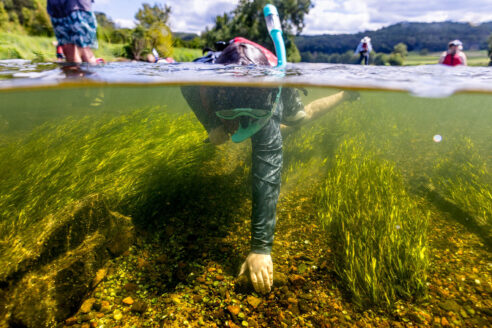
Underwater grasses are critical to the Bay ecosystem. They provide habitat and nursery grounds for fish and blue crabs, serve as food for animals such as turtles and waterfowl, clear the water by reducing wave action, absorb excess nutrients and reduce shoreline erosion.
They are also an excellent measure of the Bay's overall condition because their health is closely linked to water quality. Healthier waters can be supported by pollution-controlling efforts including better agricultural and urban management practices, upgrades to wastewater treatment plants and more conservation landscaping by homeowners.
“It has been a rough few years for Bay grasses and we were not terribly surprised by the survey results. In 2010, the unusually hot summer caused some grasses to die back in the lower Bay after we had completed the 2010 survey for that region. 2011 brought a wet spring and muddy conditions during the early growing season and a fall with two major storms that resulted in decreased water quality again. Between these factors and warming water temperatures, the Bay’s grass beds face an uphill challenge.”
--Bob Orth, Coordinator, SAV (Submerged Aquatic Vegetation) Survey (VIMS)
“In previous years, when we’ve had declines in one part of the Bay, they were offset by gains in other areas. 2012 is unusual because we saw losses in the fresh, brackish and salty parts of the Bay simultaneously. In the somewhat salty waters in the mid-Bay zone, the reduction in diversity of grass species over the last thirty years means that single-species grass beds there are less resilient to changes in water quality and temperature that we’ve seen in the last couple of years.”
--Lee Karrh, Chair, CBP SAV (Submerged Aquatic Vegetation) Workgroup (MD-DNR)
“We have both cause for concern and encouragement; while the declines are worrisome, there are still some signs of resilience in the Bay. It is good to see the Susquehanna Flats underwater grasses remaining hardy and exciting to see emerging beds in the James River. However, this year’s data is a sobering reminder of how imperative it is to continue our restoration efforts.”
--Nick DiPasquale, Director, Chesapeake Bay Program (EPA)
The Chesapeake Bay Program’s analysis of recent data on the health of the Chesapeake Bay and its watershed shows an ecosystem that is resilient, even as it remains impaired and population continues to increase. The Bay Program’s Bay Barometer: Spotlight on Health and Restoration of Chesapeake Bay and Watershed, which was released today at the Virginia Living Museum, offers a science-based snapshot of current watershed-wide progress toward a healthy Bay ecosystem.
Though health indicators continue to reflect the reality of an impaired Bay and local waterways, significant restoration actions and pollution reductions give Bay officials cause for optimism.
Chesapeake Bay Program Director Nick DiPasquale said, “While we clearly have a lot of work to do, the Bay is resilient and we have reason for hope. We know this complex ecosystem will respond to restoration efforts and we expect to see encouraging news for 2012 data. This includes news such as the increase in juvenile crabs, early reports of perhaps the smallest ‘dead zone’ in over 25 years and restoration accomplishments that will result in more positive health indicators in years to come.”
DiPasquale also noted that partners – the six Bay states, the District of Columbia, the Chesapeake Bay Commission and the Environmental Protection Agency – are making significant progress toward improved water quality by putting their local pollution-reducing plans into action. In just two years, Bay Program partners estimate that they moved 20 percent closer to their goal for reducing nitrogen, 19 percent closer for phosphorus and 30 percent closer for sediment.
“The strides the Bay partners are making to meet our water quality goals under the Bay pollution diet show we’re taking the Bay restoration effort seriously and our reporting systems are getting better and better, improving our own accountability,” said DiPasquale.
The following are some highlights of this year’s Bay Barometer:
Indicators of an Impaired Chesapeake Bay
Signs of Resilience and Hope
Major Restoration Accomplishments
Progress toward Meeting the Bay Total Maximum Daily Load (TMDL) – a.k.a. the “pollution diet”
Estimates indicate that between July 2009 and June 2011, as a result of pollution-reducing practices implemented:
“For 30 years, Chesapeake Bay Program science has been informing policies throughout the watershed,” said DiPasquale. “The Bay Barometer provides a year-end snapshot of the Chesapeake Bay’s health and efforts to protect and restore it, based on data from our partnership of more than 500 scientists, researchers and experts. It gives us an opportunity to look at the cumulative data and reflect on what it means for the Bay and the people who live here. I feel it is a great time for optimism, if we continue moving in the right direction.”
About the “Bay Barometer”
Looking at data over time helps scientists understand natural variations as well as the long-term effects of restoration efforts. The data provided in the Bay Barometer reflect the Bay’s health over the course of many years, and in some cases, decades. The publication provides a snapshot of the best available information from 2011 and 2012 on the Bay’s health and current efforts to protect and restore our national treasure and its watershed.
Full data and information can be found at “Track the Progress.” Visit our “Bay Resource Library” for videos, images and maps related to this release.
In a conference call on Tuesday, January 15, at 3 p.m., scientists with the Chesapeake Bay Program (CBP) will discuss current and forthcoming information on Chesapeake Bay pollution trends and current issues. The purpose of the call is to clarify three distinct but connected issues:
Monitoring water quality conditions over time tells us how the Bay’s health is changing in response to our land use decisions and management actions. Both the enhancement of our monitoring toolbox and the assessment will serve our ever-improving understanding and evaluation of loads of nitrogen, phosphorus and sediment reaching the Chesapeake Bay.
WHO:
WHEN:
Tuesday, January 15, at 3 p.m.
DETAILS:
Media should dial: 866.299.3188 (Access Code: 410 267 5731)
Experts in forestry at the Chesapeake Bay Program say restoration of forested areas along creeks and streams, known as riparian forest buffers, has mostly declined since its peak of 815 miles restored in 2005. In 2011, however, only 240 miles of forest buffers were restored in all the Bay jurisdictions – one-third to one-quarter of what was done just six years ago.
In 1996, Maryland, Virginia and Pennsylvania and the District of Columbia signed an agreement to restore 2,010 miles of forests along streams by 2010 in order to protect them from polluted runoff. Restoration efforts surged in the next six years and by 2002 the states had met their ten year goal. In the mid-2000’s combined reporting from the three big Bay states showed an average of 756 miles between 2003 and 2006. Since 2007, all the Bay jurisdictions have been working toward a goal of restoring forest buffers at a rate of 900 miles per year. This same restoration rate was incorporated into the federal Executive Order strategy which strives for 14,400 additional miles to be restored by 2025.
Since 1996, agricultural landowners have created most forest buffers so that excess nutrients in runoff could be absorbed by the trees and kept out of local waters. Although trees have substantial value to a healthy ecosystem, higher agriculture commodity prices in recent years have meant it is more lucrative for farmers to keep buffer areas in crops. This, combined with an emphasis and additional funding for other conservation practices such as cover crops, has meant fewer riparian forest buffers planted each year. Fortunately, farm bill programs, such as the Conservation Reserve Enhancement Program, continue to provide an attractive financial incentive to agricultural landowners to create these buffers.
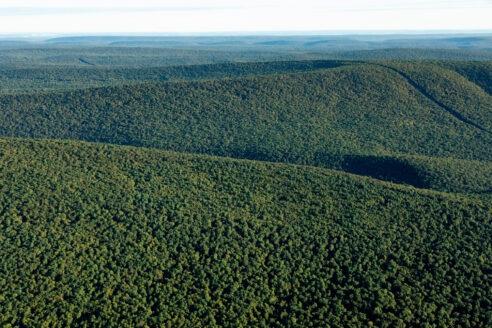
Historically, the Bay region was 95 percent forested. Forested lands play a key role in the health of streams, lands and large parts of the Bay itself since the landscape has evolved to function on the benefits they provide. Large tracts of trees act as an enormous sponge, filtering and using up excess nitrogen and phosphorus from rainwater runoff and removing any pollutants from the air. Those forested lands along streams or creeks are especially important since they shade the waters and maintain cooler water temperatures in summer heat, an important factor for the iconic brook trout and other fish that are sensitive to water conditions. In autumn, trees drop leaves into streams and creeks, providing important, specific nutrients to the local ecosystem and its creatures. Finally, strong root systems of a forest hold stream banks in place thereby reducing erosion and sedimentation of the waters.
With the establishment of the Chesapeake Executive Order and local plans to build healthy waters throughout the region, there is renewed interest in maintaining healthy forests and restoring riparian forest buffers. The Chesapeake Forest Restoration Strategy, now out in draft form, outlines the importance of forests and the actions needed to restore them.
Forest Buffer Restoration: By the Numbers
1996-2002 (Pa., Md., Va.): 2,311 miles
2003 (Pa., Md., Va.): 726 miles
2004 (Pa., Md., Va.): 754 miles
2005 (Pa., Md., Va.): 815 miles
2006 (Pa., Md., Va.): 729 miles
2007 (Pa., Md., Va.): 385 miles
2008 (Pa., Md., Va.): 449 miles
2009 (Pa., Md., Va.): 721 miles
2010 (All watershed states): 337 miles
2011 (All watershed states): 240 miles
Last year, Chesapeake Bay Program (CBP) partners restored 3,775 acres of wetlands in the Bay watershed according to the program’s habitat team tracking these efforts. This is the rough equivalent of 2,855 football-fields-worth of newly created or re-established wetland habitats. These 2011 efforts of federal, state and non-governmental partnerships build on the 14,795 wetland acres established from 1998 to 2010 and represent a solid start for the Bay jurisdictions toward meeting the goal of restoring 30,000 acres and rejuvenating 150,000 acres of these vital landscapes across the Bay’s region by 2025.
During the 2012 hurricane season, wetlands along the edges of streams, creeks, rivers and the Bay will play a critical role in healthy waters. Marshes and wetlands are the Bay’s buffers, providing unique habitats for fish and wildlife while stabilizing shorelines and protecting properties from floods and wave action. In times of heavy rains, wetlands act like a sponge, soaking up and holding large amounts of flood and stormwater runoff and gradually releasing it over time. As runoff slowly filters through the wetland, nutrients, suspended sediments and chemical contaminants in the runoff are absorbed by the soils and plants before they can flow to nearby waterways. Wetlands are especially important in urban areas where development and impervious surfaces increase the velocity and volume of polluted stormwater runoff headed for local waters.
Annual data and impacts of the late storms in 2011 illustrate the important role wetlands have in the ecosystem. Last year, suspended sediment and algae in the Bay’s waters resulted in only five percent of tidal waters meeting CBP’s goals for clarity, an all time low. Sediment-laden runoff was also a contributing factor in the 21 percent decline in acres of the Bay’s underwater grasses which need good water clarity to grow. Increased nutrients to the Bay meant lower levels of dissolved oxygen. Finally, preliminary analysis showed that oyster beds across the region were inundated by silt, making it very difficult for oysters to survive. While wetlands alone are not going to stop excess nutrients and sediment from reaching the Bay, strong, healthy ones are clearly vital to reducing impacts of polluted runoff on other natural resources and supporting the Bay’s resilience.
Wetlands Restored in 2011:
The Chesapeake Bay Program and the National Fish and Wildlife Foundation (NFWF) today announced the recipients of $9.2 million in grants for restoration and outreach initiatives in the Chesapeake Bay Watershed's six states and the District of Columbia. Among a myriad of other benefits of the 41 projects, these efforts will engage 9,000 volunteers in restoration work, restore 176 miles of streamside forests, restore 158 acres of wetlands, and establish 170,000 square feet of green roofs and rain gardens.
The funding for these environmental initiatives was awarded through the Chesapeake Bay Stewardship Fund via the Small Watershed Grants Program and the Chesapeake Bay Innovative Nutrient and Sediment Reduction Grants Program, both of which are administered by NFWF.
”The Chesapeake Bay Stewardship Fund is a model, public-private partnership that has demonstrated its ability over time to achieve measurable and significant on-the-ground conservation results that benefit fish, wildlife and the communities of the Chesapeake,” said David O’Neill, Director of the Eastern Partnership Office at NFWF. “Through these grants, diverse agencies led by the Environmental Protection Agency, the Natural Resources Conservation Service, and the U.S. Forest Service, pool resources with private funding from Altria, Wal-Mart, Wells Fargo, FedEx and others to make smart and cost-effective investments that directly benefit the Bay and its rivers.”
The Innovative Nutrient and Sediment Reduction Grants Program (INSR), funded by the Environmental Protection Agency (EPA), awarded $6.8 million to 21 projects in the Chesapeake Bay Watershed with recipients providing $10.1 million in matching funds. The INSR Program provides grants to innovative and cost-effective projects that dramatically reduce or eliminate the flow of nitrogen, phosphorus and sediment pollution into local waterways and the Chesapeake Bay. Many awardees seek to manage the amount of nutrient runoff from livestock, dairy, and crop farms by conducting outreach and providing technical assistance to farmers.
"These innovative projects, envisioned by non-profits, local governments and other agencies, are an illustration of the incredible commitment people have to restoring our rivers and streams. With NFWF’s invaluable support these projects will make a difference, supporting progress toward a Bay that is increasingly healthy and resilient," said Jeff Corbin, EPA Senior Advisor for the Chesapeake Bay and Anacostia River. "All of these efforts underscore the level of engagement we need from everyone in making daily choices for clean local and regional waters.”
The Small Watershed Grants (SWG) Program, funded by a combination of public agencies and private support, awarded $2.4 million to 20 projects in the Chesapeake Bay Watershed with recipients providing $3.4 million in matching funds. The SWG program provides grants to organizations and municipal governments working to improve the condition of their local watershed through on-the-ground restoration, habitat conservation and community engagement. The projects are expected to reach out to approximately 180,000 landowners on stewardship of their land. Many grant recipients expect to reduce pollution not only through infrastructures such as green roofs and rain gardens but through community outreach initiatives to promote sustainable landscaping and improved practices for managing runoff.
“All of us have a part to play in helping restore the Bay and the Chesapeake Stewardship Fund makes it possible for local communities to get involved in projects that will improve small watersheds in the Bay,” said U.S. Senator Ben Cardin, Chairman of the Senate Water and Wildlife Subcommittee. “The wetland and forest restoration projects help protect shorelines from erosion, control pollution and restore habitat. The Chesapeake Bay is better today than it was a decade ago thanks to the work and dedication of individuals and communities that have worked on projects like these.”
“I applaud the EPA and the National Fish and Wildlife Foundation for their diligent management of the Chesapeake Bay small watershed and nutrient and sediment removal grants,” said Jim Moran, of Virginia’s 8th Congressional District. “One of our most cherished resources, the Chesapeake Bay has fallen victim to contamination from decades of development and agriculture runoff. These grants help build local community efforts to clean the Bay, leveraging resources, and providing new and innovative approaches to fully restore the Bay’s health.”
Examples of this year’s Chesapeake Stewardship Fund grant recipients in Baltimore include:
Examples of this year’s Chesapeake Stewardship Fund grant recipients in Northern Virginia include:
Since 2006, the Innovative Nutrient and Sediment Reduction Grant Program has provided $33.6 million to 75 projects that reduce the amount of nitrogen, phosphorus, and sediment in the Chesapeake Bay Watershed. Since 1999, the Small Watershed Grants Program has provided more than $31.4 million to support 683 projects in the region and has further leveraged close to $98.4 million in local matching funds, for a total conservation investment in on-the-ground restoration of over $128.4 million.
For more information about the Chesapeake Bay Small Watershed Grants Program and the Chesapeake Bay Innovative Nutrient and Sediment Reduction Grants Program, visit www.nfwf.org/chesapeake.
The Chesapeake Bay blue crab fishery is currently operating sustainably, according to the recently released 2012 Chesapeake Bay Blue Crab Advisory Report. While the report highlights the health of the blue crab population, it also recommends continued work to sustain robust crab populations over the long term.
The report was developed by the Chesapeake Bay Stock Assessment Committee, which includes scientists and representatives from federal and state governments as well as academic institutions. It is based on data collected in the Bay-wide winter dredge survey (a cooperative effort between Maryland and Virginia) and on annual estimates of blue crab harvest. The report recommends:
"The recent history of blue crabs in the Bay is a success story, thanks to resource managers using science to make important decisions," said Peyton Robertson, director of the NOAA Chesapeake Bay Office and chair of the Chesapeake Bay Program's Sustainable Fisheries Goal Implementation Team. We at NOAA are committed to delivering science that managers use to ensure a sustainable fishery for Chesapeake Bay blue crabs.
"After 23 years of consistent sampling, the winter dredge survey has become a powerful tool for assessing the health of the stock and for offering sound management advice. Next year, we'll be looking carefully at the survival of the record 2012 year-class, since they will become our spawning crabs in 2013," said Lynn Fegley of the Maryland Department of Natural Resources, current chair of the Chesapeake Bay Stock Assessment Committee.
The advisory report, posted at http://www.chesapeakebay.net/groups/group/sustainable_fisheries (click on the Publications tab), was formally approved by the Chesapeake Bay Program's Sustainable Fisheries Goal Implementation Team. The Team provides a forum to discuss fishery management issues that cross state and other jurisdictional boundaries and better connect sound science to management decision making.
The Chesapeake Bay Program is a regional partnership that has coordinated and conducted the restoration of the Chesapeake Bay since 1983. Partners include the U.S. Environmental Protection Agency; the U.S. Department of Agriculture; the states of Delaware, Maryland, New York, Pennsylvania, Virginia and West Virginia; the District of Columbia; the Chesapeake Bay Commission, a tri-state legislative body; many federal agencies; and advisory groups of citizens, scientists and local government officials. Visit www.chesapeakebay.net.
NOAA understands and predicts changes in the Earth's environment, from the depths of the ocean to the surface of the sun, and conserves and manages our coastal and marine resources. Visit www.noaa.gov.
###
The Chesapeake Executive Council (EC) elected the District of Columbia’s Mayor, Vincent C. Gray, as their new Chair today, giving him the top leadership position within the Chesapeake Bay Program, during their annual meeting held at Gunston Hall, near Lorton, VA. Additionally, under their meeting’s theme, “Step by Step, Stream by Stream: Restoring Our Waters”, EC members discussed restoration progress since last year and considered how jurisdictions’ short-term milestones, established in 2009, will be used to track their goals for reducing pollution and creating healthy waters, as outlined in their recently-finalized Watershed Implementation Plans.
Outgoing EC Chair and EPA Administrator Lisa Jackson also announced 14 local governments from across the watershed that will be receiving technical assistance from the National Fish and Wildlife Foundation’s (NFWF’s) Local Government Green Infrastructure Initiative. Jackson noted 23 additional localities have been awarded similar assistance through NFWF’s rolling grant process, for a total of 37 localities receiving support valued at $2.3 million. The program, funded by the Environmental Protection Agency (EPA), offers local governments much-needed assistance to make progressive infrastructure changes to improve nearby water quality.
“The course we're on keeps our long-term goals in focus while making certain that we take clear, tangible actions toward a cleaner Bay. The two-year milestones set in 2009 remain on track, and we have strong commitments -- and strong support from the Local Government Green Infrastructure Initiative -- for the next phase of this effort,” said former EC Chair Lisa Jackson. “It's been my honor to chair the council, and I'm proud to support Mayor Gray as the work continues. Our local, state, and federal partners have put in tremendous efforts over the last year to finalize new plans for progress toward healthy waters. Now is the time to support the work that needs to happen at the local level, with everyone – including the millions of people who live in this region – taking part in protecting the waters that support our health, our environment and our economy."
Council members and executives in attendance – including U.S. Environmental Protection Agency Administrator Lisa P. Jackson, Maryland Governor Martin O’Malley, Chesapeake Bay Commission Chairman Senator Emmett Hanger, District of Columbia Mayor Vincent Gray, U.S. Department of Agriculture Deputy Secretary Kathleen Merrigan and representatives from Virginia, Pennsylvania, New York, West Virginia, and Delaware – heard from their three Bay Program Advisory Committees. The committees offered perspectives on issues in the areas of local government, citizen engagement and concern, and scientific and technical expertise. The EC then learned of innovative, successful partnerships and projects from Pennsylvania State University, the District Department of Environment, the Maryland Environmental Finance Center and the Virginia Association of Municipal Wastewater Agencies.
Chesapeake Bay Program partners have taken action to reduce pollution flowing to the Bay and its rivers for many years. With these final plans, the partners are making a key transition from planning for improvements under the Bay “pollution diet” to implementing more practices to improve the health of the Bay and its streams and rivers and enhance the quality of life for the more than 17 million people who live in the watershed.
“It is my great honor to accept the position of Chair to the Chesapeake Executive Council,” said Mayor Gray, “and to lead the Bay Program as we move into the next phase of protecting and restoring the great Chesapeake Bay and all the rivers and streams that feed it. The District has been a leader in recent years in urban greening and restoration projects, helping to restore our local waters to health. I look forward to deepening my involvement in the Bay-wide efforts and embracing the challenges and possibilities we face as we make progress toward a healthy Bay and a sustainable quality of life for all the residents in the region.”
The Executive Council establishes the policy agenda for the Chesapeake Bay Program and is represented by leaders from the U.S. EPA, USDA, Maryland, Virginia, Pennsylvania, New York, Delaware, West Virginia, the District of Columbia, and the Chesapeake Bay Commission. Full 2012 meeting information and materials are available on http://www.chesapeakebay.net/about/ecmeeting/2012_executive_council_meeting. Gunston Hall is the historic home of the 18th century Virginia statesman, George Mason.
In 2011, monitoring data collected by the Bay jurisdictions and other partners showed that dissolved oxygen (DO) concentrations in the Chesapeake fell to their lowest level in the last four years with 34 percent of the waters meeting the established standards for the summer months. This represents a decrease of 4 percent from the 2010 figures according to the Chesapeake Bay Program (CBP) partnership and is almost half of the higher DO values recorded a decade ago.
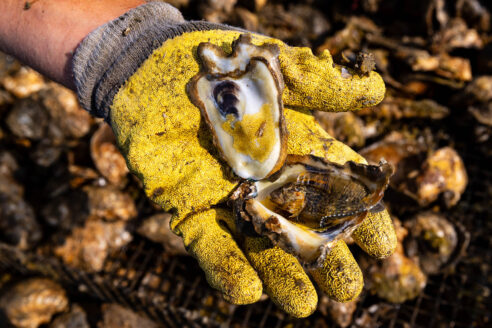
In spite of lower levels and in the face of many weather challenges, various Bay habitats and creatures that have been the target of restoration efforts showed resilience last year. In CBP news this March, scientists from Virginia Institute of Marine Sciences (VIMS) reported that despite a decrease in Bay grasses overall, the restored, healthy grass beds at Susquehanna Flats remained intact, widgeon grass beds grew (likely due to seed germination stimulated by lower salinities) and new grass beds were found in Virginia’s James River. In terms of fisheries, preliminary data by oyster scientists from Maryland Department of Natural Resources and NOAA showed good news, too. Experts estimate last year’s oyster survival rate was at its highest since 1985, oyster biomass increased 44 percent and oyster disease was at an all time low.
“Last year’s heavy rains and even this year’s early algae blooms and fish kills reinforce the critical importance of controlling polluted runoff reaching the Bay’s waters,” said Nick DiPasquale, Director of the Chesapeake Bay Program. “The survival rate of some oyster and grass beds in 2011 shows us that our efforts are working. By actively restoring and protecting valuable resources we can build a stronger, healthier Bay ecosystem that can withstand the forces of nature. Clearly, while we can’t control the weather, we can restore the watershed’s ability to survive its more extreme events. We know what works; we just need to do more of it.”
Experts were not terribly surprised by the final information on the Bay’s 2011 “dead zones” given the extreme weather. Between the very wet spring that sent excessive nutrients downstream, a hot, dry, early summer and more heavy rains accompanying Tropical Storm Lee and Hurricane Irene, conditions in the Chesapeake were bound to be affected.
Peter Tango, CBP Monitoring Coordinator and U.S. Geological Survey scientists explains, “The Bay ecosystem functions most effectively when fresh and salt water can mix, just like oil and vinegar need to mix to form salad dressing. A large fresh water influx such as that in 2011, along with intense heat, can result in vast differences in quantities of warm fresh and cool salt water in the Bay. These variables make it more difficult for water to mix vertically in the water column.”
In addition to vertical mixing, the dissolved oxygen levels in the Bay are also affected by what happens at the edges. Tango continues: “By the fall of last year, the Upper Bay became mostly fresh water due to rain. The Lower Bay became a hot tub due to heat,” illustrates Tango. “While the initial effects of the Tropical Storm Lee’s arrival was to mix the Bay more than usual in late summer, this combination of salinity and temperature conditions resulted in minimal levels of oxygen in bottom waters that lasted well into the fall (see image at left). The delay in autumn vertical mixing and the persistent summer-like water quality conditions at the northern and southern boundaries pushed on the mid-Bay waters, resulting in what we scientists call a
dissolved oxygen or ‘DO squeeze.’”
All of the Bay's living creatures – from the fish and crabs that swim through its waters to the worms that bury themselves in its muddy bottom – need oxygen to survive, although the amounts needed vary by species, season and location in the Bay. A DO squeeze challenges the health of fish, crabs, and other Bay creatures since they become compacted together – predator and prey, from north to south and bottom to top – in significantly smaller sections of water where and conditions are less-than-ideal for their survival.
In 2011, the abundance of underwater grasses in the Chesapeake Bay and its tidal rivers declined by 16,590 acres from 2010 figures according to Chesapeake Bay Program (CBP) scientists in Maryland and Virginia. Grass beds declined from 79,664 acres in 2010 to an estimated 63,074 acres in 2011. This is the lowest Bay-wide acreage since 2006 and is much more typical of what was observed prior to 1991 when grass acreages were at the lowest levels recorded by the aerial survey. Only 57,956 acres were mapped Bay-wide in 2011 and an estimated 5,119 additional acres may have been present (for an estimated Bay-wide total of 63,074).
Experts agree that extreme environmental conditions in both 2010 and 2011 contributed strongly to the decline last year. “2011 was an especially challenging year for SAV in the Bay,” says Bob Orth of the Virginia Institute of Marine Science (VIMS) and coordinator of the annual Bay-wide survey.
“The summer of 2010 was unusually hot, causing eelgrass beds in the lower bay to severely die back after they had been surveyed earlier in the year,” Orth continues. “Then in spring of 2011, during the growth season, heavy rains and freshwater runoff created very muddy conditions for many low salinity species, in the upper Bay and tributaries. This was followed in September and October by Hurricane Irene and Tropical Storm Lee that again muddied the water.”
According to Lee Karrh, chair of the Submerged Aquatic Vegetation (SAV) Workgroup, “2011 was the year that bucked two trends we’ve seen over the last decade. The Upper Bay had major decreases after years of increasing or sustained high acreages. On the other hand, the brackish parts of the Middle Bay witnessed dramatic increases in 2011, after prolonged decreases since the turn of the century.”
Despite Bay-wide losses, there was some good and surprising news for underwater grasses last year, too. Researchers were pleased to find that a huge, dense bed on the Susquehanna Flats, which had increased 3-fold in size since 1991 and passed restorations goals in 2008 through 2010, persisted through the storms and demonstrated how resilient such grass beds can be to water quality disturbances. Additionally, due to a growth of widgeon grass (which fluctuates annually), grass acreages increased over 1,200 acres in Eastern Bay, 2,400 acres in the Choptank River and over 300 acres each in the Little Choptank and Honga Rivers. Steve Ailstock, who works with freshwater and brackish species at Anne Arundel Community College, explains, “The lower salinities associated with rain events can stimulate the germination of the dormant seeds of many mid-Bay species like those of widgeon grass, redhead grass and horned pondweed that are buried in the sediments.” In a final bright spot, the survey recorded the first bed of freshwater SAV in the James River mainstem since the area was first surveyed 1998.
Underwater Bay grasses are critical to the Bay ecosystem. They provide habitat and nursery grounds for fish and blue crabs, serve as food for animals such as turtles and waterfowl, clear the water by reducing wave action, absorb excess nutrients and reduce shoreline erosion. They are also an excellent measure of the Bay's overall condition because their health is closely linked to water quality. Annual acreage of grasses is estimated through an aerial survey, which is flown from late spring to early fall.
Annual underwater grass acreage estimates are an indication of the Bay's response to pollution control efforts, such as implementation of agricultural best management practices (BMPs) and upgrades to wastewater treatment plants. Homeowners throughout the Bay region help bay grasses and overall water quality by using landscaping techniques that keep excess nutrients from flowing downstream where they can harm nearby streams and eventually the Bay. Local watershed groups and online resources such as CBP’s “Plant More Plants” campaign can offer people more information.
Karrh says, “Our hope is that the implementation of the Bay ‘pollution diet’ will help increase SAV acreages in areas that currently are below our restoration goals and reduce the impacts of extreme weather events in the future.”
Upper Bay: In the Upper Bay Zone (from the Chesapeake Bay Bridge north), underwater grasses covered about 13,287 acres, down from 21,353 acres in 2010. This is most likely an underestimate of the total area of grasses in the northern most part of the Bay, since they were photographed in November when poor water clarity finally improved, but well past the time when plants would have been at their maximum extent. One positive increase was the more than doubling of SAV in the Eastern Neck Narrows and Chester River. This again may have been due to lower salinity conditions for freshwater species in the region following the spring freshet.
Mid-Bay: In the Middle Bay Zone (from the Chesapeake Bay Bridge to the Potomac River and Pocomoke Sound), underwater grass acreage decreased 4 percent to an estimated 34,142 acres, down from 35,446 acres in 2010. Large losses occurred in the Tangier Sound region where eelgrass is dominant and had declined the previous summer after that survey was completed. The losses were offset by the large gains in widgeon grass in many upper middle bay segments, such as Eastern Bay, Choptank and Little Choptank. Only 29,023 acres were mapped in the middle Bay in 2011. It is estimated that an additional 5,119 acres may have been present (for an estimated total of 34,142). .
Lower Bay: In the Lower Bay Zone (south of the Potomac River), researchers found 15,645 acres of underwater grasses – down 32% from 22,685 acres in 2010. This decline occurred primarily in the higher salinity areas due to the hot summer of 2010, and reversed the gains that followed in 2011. These areas had been recovering from similar losses in the 2005 summer heat event. Freshwater grasses have remained at consistently high levels in the tributaries with new beds appearing in several areas of the mainstem James River.
The Sustainable Fisheries Goal Implementation Team of the Chesapeake Bay Program (CBP Fisheries Team) recently agreed on the need to manage blue and flathead catfish. These invasive species have been shown in other regions to pose a significant threat to important native species. In the Chesapeake Bay region, blue and flathead catfish may harm species such as American shad and blueback herring in rivers from Virginia to Pennsylvania. The CBP Fisheries Team will work to develop bay-wide management actions for blue and flathead catfish based on existing and new science.
Although valuable as a recreational fishery, blue and flathead catfish are problematic for several reasons. Both have the ability to grow to a large size – the world record blue catfish, caught in Virginia waters, is 143 pounds. They eat a varied diet including crustaceans, worms, other fish, and even each other. The number of invasive catfish is also a concern. Results from electrofishing sampling indicate that blue catfish represent up to 75 percent of the total fish biomass in portions of the tidal James and Rappahannock rivers, where they may be competing with native fishes and other ecologically and economically important living resources for available food. These characteristics make blue and flathead catfish “apex predators”—at the very top of the food chain—and may negatively affect native fish and their habitats. Finally, their long life span amplifies their possible long-term impacts on a given river’s ecosystem.
Although they are usually found in freshwater, these catfish can tolerate saltwater. Both species have been present in Virginia rivers since the 1960s and 1970s. In recent years they have been found in the Potomac River, Susquehanna River, and other upper Chesapeake Bay areas in Maryland. The spread of these fish may in part be due to people moving fish from one tributary to another, even though this is illegal in Maryland and Virginia.
All of these factors led the diverse CBP Fisheries Team, which includes experts from the Virginia Department of Game and Inland Fisheries, Virginia Marine Resources Commission, Potomac River Fisheries Commission, D.C. Department of the Environment, Maryland Department of Natural Resources, Atlantic States Marine Fisheries Commission, and the National Oceanic and Atmospheric Administration, to decide these catfish need to be managed.
The recently signed "Invasive Catfish Policy Adoption Statement" outlines the need to control and lessen the effects of these invasive, non-native fish on Bay tributaries and includes different perspectives such as those of recreational and commercial fishermen who have come to enjoy the sport of catching blue catfish. Actions to be considered include examining methods to reduce the high numbers of these fish and ways to limit their expansion into new rivers and evaluating the possible negative ecological impacts.
An invasive species is defined as a “non-native species that does or is likely to cause economic or environmental harm or harm to human health.” Additionally, it is one that “may prey upon, displace or otherwise harm native species, or alter ecosystem.”
The Chesapeake Executive Council (EC) held their annual meeting today in Richmond, Virginia, and announced their interim progress on Bay cleanup milestones established in 2009, discussed plans for meeting requirements under the Chesapeake Bay “pollution diet” and encouraged individual stewardship through a “Get Grounded in Your Watershed” theme. The meeting furthers the Chesapeake Bay Program’s efforts to protect the Bay and the health and environment of those who live in the region.
Council members and executives in attendance – including U.S. Environmental Protection Agency Administrator (and EC Chair) Lisa P. Jackson , Virginia Governor Bob McDonnell, Maryland Governor Martin O’Malley, Pennsylvania Governor Tom Corbett, District of Columbia Mayor Vincent Gray, Chesapeake Bay Commission Chairman Senator Michael Brubaker, U.S. Department of Agriculture (USDA) Deputy Secretary Kathleen Merrigan and representatives from, New York, West Virginia, and Delaware – heard from their three Advisory Committees who offered perspectives on issues in the areas of local government, citizen engagement and concern, and scientific and technical expertise. They also discussed challenges and opportunities under the new Bay “pollution diet” known as the Total Maximum Daily Load (or TMDL) and restoration activities during the past year. Since the Executive Council meeting in June 2010, Chesapeake Bay Program partners have continued working toward meeting short-term goals for implementing pollution controls, with the first deadline for the two-year milestones approaching on December 31, 2011.
The Executive Council establishes the policy agenda for the Chesapeake Bay Program and is represented by leaders from the U.S. EPA, USDA, Maryland, Virginia, Pennsylvania, New York, Delaware, West Virginia, the District of Columbia, and the Chesapeake Bay Commission. In their lunch meeting, the nomination of Administrator Jackson as Council chair for another year was voted on and accepted. Full 2011 meeting information and materials are available on the Council’s webpage on www.chesapeakebay.net.
"A tremendous amount of effort has been put forth by all of the Bay Restoration partners since the Council met last year in Baltimore," said EPA Administrator Lisa P. Jackson, who is Executive Council Chair. "The focus of our discussions today was on empowering every citizen in the Bay watershed to be part of restoring these important waters. The actions of federal, state, and local governments are just the beginning of revitalizing the Bay. We are also counting on the partnership of millions of people who live in this region to join in protecting the waters that support their health, their environment and their economy."
The 2011 Executive Council annual meeting was held at Maymont Foundation. Attending members and representatives met at the Nature Center and then spent part of the afternoon touring exhibits on various topics including the CBP’s Plant More Plants initiative, Bay-friendly lawn care and home certification programs, urban programs for reducing fees associated with stormwater, and soil health and testing.
The Executive Council chose this location to highlight the need to connect individuals and communities to waterways, particularly in urban areas, and to support restoration efforts of local governments, organizations and citizens. Maymont’s Nature Center and park offers people the opportunity to experience the environment along the James River, right in the city of Richmond. Their educational programs further engage young people in knowledge and stewardship of Virginia’s outdoors.
“This year’s Chesapeake Bay Executive Council meeting, here in Richmond,” said Governor Robert McDonnell, “has provided a great opportunity for us to showcase Virginia’s commitment to ensuring a clean and vibrant Chesapeake Bay for future generations to cherish. Today at the Nature Center at Maymont, participants discussed issues which will help us to implement our approved state plan to restore the Bay.” He continued, “The Chesapeake Bay is one of Virginia’s, and America’s, most valuable natural resources and we are pleased that the member states and the Executive Committee continue to work together to improve and better this important waterway.”
CBP partners discussed restoration progress undertaken since the 2010 meeting and their work during the past year to develop Watershed Implementation Plans (WIPs) as part of the Bay TMDL, the most comprehensive “pollution diet” ever for the watershed. Issued in December of 2010, this diet includes rigorous accountability for all levels of government, sources of pollution and stakeholders. Jurisdictions are currently in the second phase of developing their draft plans showing how they will meet pollution reductions on a local level. These drafts are at the end of 2011.
Nutrient levels in many tributaries of the Chesapeake Bay region have improved over the last twentyfive years. Nitrogen and phosphorus levels have decreased at almost 70 percent of the 32 monitoring locations in the watershed, according to the U.S. Geological Survey (USGS), while sediment amounts decreased at 40 percent of the sites. In this analysis, a decreasing trend may indicate improving conditions, since it means that smaller amounts of these pollutants are entering rivers that flow into Chesapeake Bay. Although this information indicates long-term improvements, the annual 2010 loads of nitrogen, phosphorus and sediment to the Bay were higher than in 2009 due to more rain, snow and river flow. Overall, the loads remain consistently too high in relationship to Chesapeake Bay Program (CBP) goals in restoring the Bay.
"Long-term trends indicate that pollution-reduction efforts, such as improved controls at wastewater treatment plants and practices to reduce nutrients and sediment on farms and suburban lands are improving water-quality conditions in many areas of the watershed," said USGS scientist Scott Phillips "However, nutrients, sediment, and contaminants will need to be further reduced to achieve a healthier Bay and streams."
A separate study by CBP partners on the health of the watershed's streams showed varied conditions. Of 7,886 stream sites sampled from 2000-2008, more than half (55 percent) were in very poor or poor condition with the remaining 45 percent in fair, good or excellent condition.
"Due to the large number of stream health monitoring sites, this indicator provides the best assessment of stream health on a small watershed scale," stated Bruce Michael of Maryland Department of Natural Resources. "It provides managers with a geographically specific tool necessary to target restoration and protection practices. Good stream health is critical not just for the Chesapeake Bay, but for local fish, wildlife and recreational activities."
In 2010:
On an annual basis, the USGS measures the amount of water in the region’s major rivers and estimates how much is reaching the Bay. This amount, called “river flow”, is measured over the 12-month period from October-September, known as the “water year.”
Generally speaking, as river flow increases, it carries more nitrogen, phosphorus and sediment downstream to the Bay, thereby affecting conditions for fish, crabs, underwater grasses and many other creatures and habitats. USGS also monitors annual loads of these pollutants in the major rivers and works with the CBP to estimate how much reaches the Bay itself. In 2010:
The CBP goal is to have a long-term average of about 202 million pounds of nitrogen and 13 million pounds of phosphorus entering the Bay from watershed and airborne sources.
Flow-adjusted Trends over Time
Nutrient and sediment levels in rivers vary greatly each year since they are influenced by changes in the amount of rainfall. Scientists adjust their analysis to remove the effects of such weather variations so that they can measure nutrient levels more consistently over time and better evaluate if long-term changes in a waterway's conditions are due to management efforts. This is what is called an analysis of "Flow-adjusted Trends."
The majority of long-term stream monitoring sites show flow-adjusted trends that indicate decreasing concentrations of nitrogen and phosphorus, with about 40 percent of the sites showing a downward trend for sediment. Between 1985 and 2009 at 32 sampling locations:
Stream Health in the Watershed
Healthy freshwater streams support a diversity of fish, wildlife and habitats and are intrinsically linked to healthy rivers and a healthy Chesapeake Bay. The average stream health scores in 7,886 of sites sampled (between 2000-08) indicated that 3,584 were in fair, good or excellent condition and 4,302 were in very poor or poor condition. This relatively new system for measuring stream health provides citizens and groups with a uniform manner in which to evaluate the health of local waterways across state lines and in the context of the entire Bay watershed.
Scientists determine the health of freshwater streams and rivers by studying the many tiny creatures that live in these waters. The abundance and diversity of snails, mussels, insects and other bottom-dwelling organisms are good indicators of a waterway's health because these creatures can't move very far and they respond to pollution and environmental stresses.
In general a healthy Bay watershed would have a majority of streams ranked as fair, good or excellent. Based on the location of streams sampled, those in natural environments such as forested areas tend to be in good to excellent condition and those in areas with more pollution- generating land uses, including urban and some agricultural areas, tend to be in very poor to fair condition.
For more information about flow adjusted trends and stream health, visit http://chesapeake.usgs.gov
The National Research Council of the National Academy of Sciences (NAS) pilot study, released today, supports the work that has been undertaken in the last 18 months by the Chesapeake Bay Program (CBP), who solicited this self-evaluation in 2009.
The new study, “Achieving Nutrient and Sediment Reduction Goals in the Chesapeake Bay: An Evaluation of Program Strategies and Implementation,” is constructive and generally focuses on accountability. Its purpose has been to increase understanding of the ways that the CBP can evaluate its efforts for cleaning up the Bay by achieving nutrient reduction goals.
"While supporting the program’s current efforts, the report also points out some critical challenges to consider in making decisions moving forward,” said EPA Mid-Atlantic Regional Administrator Shawn M. Garvin, Chair of the CBP’s Principle Staff Committee (PSC). "We welcome the report’s recommendations for strengthening the accountability of the Chesapeake Bay Program Partnership."
The NAS results reinforce the partnership’s work currently underway including the Bay Total Maximum Daily Load (TMDL), the Bay jurisdiction’s Watershed Implementation Plans (WIP), and the two year milestones. It also provides suggestions for strengthening processes in the areas of: tracking and accounting of Best Management Practices (BMPs); assessing milestones; adaptive management; and implementation strategies. CBP will evaluate and consider the science-based conclusions and recommendations offered by NAS in its future planning and implementation.
"Many of these findings also support Maryland's ongoing efforts,” said Maryland Department of the Environment Secretary Robert M. Summers, “particularly our work to hold ourselves accountable through the Maryland BayStat process, regular tracking of progress on our two-year milestones, and development of a strong Watershed Implementation Plan. These recommendations come at an opportune time for the Bay as we work with local jurisdictions on the details of Phase II Watershed Implementation Plans. With a renewed focus on Bay restoration at Federal, State and local levels, we believe a healthy Chesapeake Bay is finally within our sights, and we look forward to working with our partners to determine how the Academy's recommendations can help."
In 2008, the Executive Council of the CBP – the partnership’s top-level leadership that includes the EPA Administrator, the governors of the Bay watershed states, the Mayor of Washington, D.C. and the chair of the Chesapeake Bay Commission – requested that the Program be evaluated by a nationally-recognized, independent, science organization. The NAS analysis began the following year. The purpose of the study was to evaluate the CBP implementation efforts to achieve the nutrient reduction goals for water quality in order to accelerate reaching the protection and restoration of the Chesapeake Bay. It was jointly funded by the US Environmental Protection Agency/Chesapeake Bay Program (CBP), the District of Columbia, Maryland, Pennsylvania, and Virginia.
In the process of conducting this study, NAS recognized the complexity of the Bay watershed, the equally intricate tracking systems required to accurately report on progress and the fact that CBP is in the process of better integrating its voluntary and regulatory work. The CBP partnership will provide a written response to all the recommendations within a 90 day period.
Visit CBP’s website for information and a link to the NAS report: http://www.chesapeakebay.net
Underwater grasses covered 79,675 acres of the Chesapeake Bay and its tidal rivers in 2010, a decrease of 6239 acres from the previous year. This represents about 43 percent of the 185,000-acre baywide abundance goal, according to data from scientists with the Chesapeake Bay Program. Despite being a 7 percent decrease from 85,914 acres in 2009, these most recent estimates still rank as the 3rd highest baywide acreage since 1984, when the Virginia Institute of Marine Science (VIMS) began conducting its annual aerial survey.
“We were pleased that grasses remain healthy and abundant in two areas where nutrient pollution was reduced: the upper Potomac River and Susquehanna Flats,” said Bob Orth, scientist with the Virginia Institute of Marine Science and leader of the baywide annual survey. “However, the overall condition for bay grasses remains one of concern with many areas still having few, if any, grass beds. In 2010, our big concern arose in the lower Bay where eelgrass appeared to suffer another setback from the incredibly hot summertime temperatures. Since we had mapped those beds prior to the heat wave, losses there are not reflected in our final figures.”
Bay grasses -- also called submerged aquatic vegetation (SAV) -- are critical to the Bay ecosystem. They provide habitat and nursery grounds for fish and blue crabs, serve as food for animals such as turtles and waterfowl, clear the water by reducing wave action, absorb excess nutrients and reduce shoreline erosion. They are also an excellent measure of the Bay's overall condition because their health is closely linked to water quality. Annual acreage of grasses is estimated through an aerial survey, which is flown from late spring to early fall.
Orth continued, “We believe the really hot summer temperatures in the early part of the growing season may have just cooked the grasses before we were able to map them, e.g. parts of the Honga River. The changes also occurred in areas dominated by just one species, widgeongrass, which has been shown to be a boom or bust species. 2010 may have been the hottest on record but it was those summer time temperatures in June that may have tipped the scale for SAV in some areas.”
Grass Numbers by the Zones
Annual bay grass acreage estimates are an indication of the Bay's response to pollution control efforts, such as implementation of agricultural best management practices (BMPs) and upgrades to wastewater treatment plants. Homeowners throughout the Bay region help bay grasses and overall water quality by using landscaping techniques that keep excess nutrients from flowing downstream where they can harm nearby streams and eventually the Bay. Local watershed groups and online resources such as CBP’s “Plant More Plants” campaign – plantmoreplants.com – can offer people more information on how to get started.
”Even with the decreases in the 2010 bay grass coverage, the patterns are similar to previous years,” said Lee Karrh, living resources assessment chief with the Maryland Department of Natural Resources and chair of the Bay Program's SAV Workgroup. “Many of the fresh and low salinity areas have very high abundances, including sixteen that have reached their restoration targets, However, the saltier parts of the Bay continue to struggle, with most areas well below the restoration goals, with only the mouth of the James River exceeding the goal.”
For additional information about the aerial survey and an interactive map of SAV acreage throughout the Chesapeake Bay, visit www.vims.edu/bio/sav/. For more information about the status of underwater bay grasses in the Chesapeake Bay, visit www.chesapeakebay.net/status_baygrasses.aspx.
Thirty-four environmental projects in all six of the Chesapeake Bay watershed states and the District of Columbia were today awarded more than $3.4 million to help reduce pollution to local streams, creeks and rivers and the Chesapeake Bay. The grants are funded by the U.S. EPA’s Chesapeake Bay Program and a variety of other federal and private partners. They are administered by the National Fish and Wildlife Foundation.
The funding for the projects was awarded through the Chesapeake Bay Small Watershed Grants Program, which provides grants to nonprofit organizations and local governments working to improve the condition of their local watershed.
The 2010 grant recipients will develop conservation plans in both urban and rural settings, preserve valuable natural lands, and implement on-the-ground and in-the-water restoration practices throughout the Chesapeake Bay watershed. Many of the projects will employ social media campaigns to fully engage the community in the local restoration and conservation efforts. Some examples of the types of projects funded include:
“Local action is essential to restoring clean water to the region’s streams, creeks, rivers and the Chesapeake Bay, and EPA is committed to supporting the efforts of local governments, watershed groups and universities that do incredible work everyday,” said Shawn Garvin, EPA Regional Administrator. “Clean water is important to every community, so it’s vital that these projects will occur in all six states in the Chesapeake Bay watershed and the District of Columbia.”
The 2010 Small Watershed Grants were announced at Dundalk Veterans Park near Baltimore, Md. The project highlighted today was the “Trees for Neighborhoods” initiative of the Baltimore County Department of Environmental Protection and Resource Management. Baltimore County is using its $50,000 grant to educate homeowners about the benefits of planting trees as a way to reduce polluted runoff. In the greater Baltimore area, many projects like this one will be undertaken to address urban stormwater, restore wetland habitats and encourage environmental stewardship.
“The Small Watershed Grants program provides important funding that gives local governments and organizations the tools they need to help improve the overall health of the Chesapeake Bay’s watershed,” said Senator Benjamin L. Cardin, a member of the Environment and Public Works Committee. “From planting more trees in urban areas to improving wildlife habitat and minimizing stormwater runoff, these grants result in partnerships that help restore and protect the Bay.”
Polluted runoff from urban and suburban impervious surfaces and agricultural lands continue to be two large sources of nitrogen, phosphorus and sediment to local waterways and the Chesapeake Bay. These grants will help fund the projects necessary to reduce runoff in many areas and from all types of lands, both urban and agricultural, within the Bay watershed.
“The Chesapeake Bay is one of Maryland’s greatest resources. We must protect it so our children and grandchildren can enjoy it,” said Congressman C.A. Dutch Ruppersberger. “Whether it is eating perfectly steamed blue crabs harvested from the Bay, hiking along the many historic trails in the watershed, or spending a beautiful day on a historic skipjack, the Chesapeake Bay adds so much to our quality of life here in Maryland while also supporting thousands of jobs across our state.”
”This program is an example of a truly effective public-private partnership that delivers funding to high-impact, on-the-ground restoration projects in communities throughout the region,” explained Amanda Bassow, Acting Director of the National Fish and Wildlife Foundation’s Eastern Partnership Office. “EPA’s $2 million investment in grants has leveraged $1.4 million from other government agencies and private funders who all share the conviction that these community-based efforts to restore local rivers and streams are critical to the health of the Chesapeake Bay.
Since 2000, the Chesapeake Small Watershed Grants program has provided more than $27 million to support 626 projects around the Chesapeake Bay watershed. These projects have further leveraged close to $90 million in local matching funds for a total conservation investment in on-the-ground restoration of over $115 million. The program is administered by the National Fish and Wildlife Foundation and funded by the U.S. EPA’s Chesapeake Bay Program Office and a variety of annual partners. Additional support in 2010 was provided by the U.S. Forest Service, National Oceanic and Atmospheric Administration, and the District of Columbia Department of the Environment, as well as additional corporate funds from Altria and FedEx. Additional funding for grants in Maryland was provided through a community service payment that resulted from a plea agreement with the U.S. Department of Justice in a case involving the concealment of discharges of sludge and bilge waste.
For more information about the Chesapeake Bay Small Watershed Grants Program and a full list of this year’s grant recipients, visit the Chesapeake Bay Small Watershed Grants Program page and www.nfwf.org/chesapeake.
Eleven innovative environmental projects throughout the Chesapeake Bay watershed have received a total of $5.8 million in grants to reduce pollution to the local streams, creeks and rivers that flow to the Chesapeake Bay. The grants are funded by the U.S. EPA’s Chesapeake Bay Program and administered by the National Fish and Wildlife Foundation.
The funding for these projects was awarded through the Chesapeake Bay Stewardship Fund and its Innovative Nutrient and Sediment Reduction Grant Program. This program provides up to $1 million to innovative and cost-effective projects that dramatically reduce or eliminate the flow of nitrogen, phosphorus and sediment pollution into local waterways and the Chesapeake Bay. The awarded projects offer innovative solutions to polluted runoff from both urban and suburban stormwater and agriculture lands. As a whole, the projects are expected to result in reductions of over 1.5 million pounds of nitrogen, 51,000 pounds of phosphorus, and 20,000 pounds of sediment entering the Bay. Grant awardees provided an additional $10 million in matching funds.
"These 11 projects will have direct benefits to streams, creeks, rivers and ultimately the Chesapeake Bay, showing that the key to restoration is on-the-ground, in-the-water action," said EPA mid-Atlantic Regional Administrator Shawn M. Garvin. "I applaud the project leaders for their commitment to help restore the Bay using innovative approaches that can be modeled throughout the watershed."
Urban and suburban stormwater is a major source of pollution to the Chesapeake Bay that is still increasing. As development and population continue to increase in the Chesapeake watershed, more impervious surfaces are created, causing degradation to creeks, streams and rivers that flow to the Chesapeake Bay. Local governments can greatly influence stormwater runoff control issues via zoning and development decisions and by encouraging the use of green infrastructure planning and low-impact development. This in turn means that partnerships between governments, local groups and neighborhoods, such as those being created through many of these grants, are keys to creating change.
The Chesapeake Bay also continues to face issues of nitrogen and phosphorus pollution from agricultural lands. The grant funded projects awarded today deal with some of the problems associated with farm runoff by building new partnerships and efforts across agencies and communities, and also utilizing innovative technology to address agricultural pollution across the watershed.
There is a great need for more innovative projects like these that address pollution from agricultural and urban and suburban runoff. Collectively they exemplify creative and effective ways to bridge communities, advance technology, and implement innovative practices such as low-impact development strategies, green infrastructure, and conservation practices — all of which are necessary to restoring local waterways and the Bay.
“These projects demonstrate innovative strategies for how we can continue to live, work and play in one of the most densely populated regions of the country, while at the same time minimizing the impact on our downstream neighbors and the thousands of fish and wildlife species that call the Chesapeake Bay their home,” said Tom Kelsch, Director of Conservation Programs of the National Fish and Wildlife Foundation.
Harford County Councilwoman Mary Ann Lisanti was elected Chair of the Chesapeake Bay Program’s Local Government Advisory Committee (LGAC) at their recent meeting in Washington DC. Representing over 1,800 local governments from across the Bay watershed, LGAC’s membership includes 21 local government officials from Pennsylvania, Maryland, the District of Columbia, and Virginia.
Councilwoman Lisanti was appointed to LGAC by Governor O’Malley in 2009. Local government officials like Lisanti, who are the decision makers on land use and other Bay-related issues, are key players in helping to restore and protect the Chesapeake Bay. “Seventeen million people call this watershed home and local government is the closest to those people,” comments Lisanti. “As a former City Manager and now a small business manager and elected official, I feel keenly responsible for ensuring that local needs are identified and funded, and that clean-up efforts are focused on individual actions and shared responsibilities. Local government understands that bay cleanup is all about our quality of life and economic development.”
Lisanti will now lead the Advisory Committee in its main task of providing advice to the Chesapeake Executive Council, the Bay Program’s leadership body, about the best ways to engage local governments in this work. Currently LGAC is advising the council on how to involve local governments in the development of the Bay “pollution diet” called the Total Maximum Daily Load (TMDL). The Executive Council includes the EPA Administrator, the governors of each state, the Mayor of Washington DC, and the Chair of the Chesapeake Bay Commission.
Elected to office in 2006, Councilwoman Lisanti’s district includes Havre de Grace, Abingdon, Aberdeen Proving Ground, Perryman and Belcamp. She serves on the Maryland Association of Counties’ Legislative Committee and Education Sub-committee, the Council’s Personnel Committee, Citizens Nursing Home Board, Mental Health & Addictions Advisory Board and is Chair of the Bi-partisan Commission on School Construction.
During her professional career, she worked for the Maryland General Assembly, the County Executive and the Department of Planning and Zoning in the Harford County Government. She was City Manager of Havre de Grace, MD; from 1997-2002 and served as Vice President in 2000 and President in 2001 of the Maryland Association of City and County Managers. Additionally, Lisanti is the Executive Director of the Lower Susquehanna Heritage Greenway.
The Chesapeake Executive Council today launched ChesapeakeStat, an innovative online tool to increase government accountability and improve coordination of restoration activities by transparently presenting comprehensive information about Chesapeake Bay Program (CBP) activities, funding and progress toward goals. Visit the site at http://stat.chesapeakebay.net.
Council members and executives in attendance – including U.S. Environmental Protection Agency Deputy Administrator Robert Perciasepe, Maryland Governor Martin O’Malley, Virginia Governor Bob McDonnell, Chesapeake Bay Commission Chairman Senator Mac Middleton, District of Columbia Mayor Adrian Fenty, and representatives from U.S. Department of Agriculture (USDA), New York, West Virginia, and Delaware – also discussed on-the-ground and in-the-water restoration activities during the past year. Since the Executive Council meeting in May 2009, CBP partners have worked toward meeting short-term goals for implementing pollution controls, with the first deadline for the two-year milestones fast approaching on December 31, 2011.
The Executive Council establishes the policy agenda for the Chesapeake Bay Program and is represented by leaders from the U.S. EPA, USDA, Maryland, Virginia, Pennsylvania, New York, Delaware, West Virginia, the District of Columbia, and the Chesapeake Bay Commission.
The 2010 Executive Council annual meeting was held in Baltimore at Living Classrooms Foundation facilities, where members spent part of the afternoon with Baltimore students restoring a wetland by planting vegetation, removing trash and constructing “floating islands” of wetlands. The Executive Council chose this location to highlight the need to connect communities to waterways, particularly in urban areas, and support restoration efforts of local governments, organizations and citizens. The Living Classrooms Foundation’s programs engage young people in stewardship of the environment and provide them with green skills for the future.
“We’ve initiated a new era defined by bold action and unparalleled levels of accountability. ChesapeakeStat will be instrumental in ensuring nothing short of real, measurable results,” said EPA Deputy Administrator Bob Perciasepe. “This is the most comprehensive and creative protection effort launched in years. We’re matching the challenge of this cleanup with the expanded efforts and additional resources at all levels of the government.”
The Executive Council also unveiled the first version of ChesapeakeStat, a new online tool to improve coordination of the restoration effort and provide transparency in government activities. ChesapeakeStat allows CBP managers, federal agencies, states, local governments, non-governmental organizations and the public to use the same information to track and plan restoration. The CBP will test the value of using ChesapeakeStat as a platform for highlighting local restoration activities. Photos can be entered and watershed organizations can be located on a map, and the public can submit ideas for how the website can improve with additional information.
Governor O’Malley’s BayStat provided the inspiration and model for ChesapeakeStat, and Maryland officials will help CBP partners to best utilize the site. This is the first version of ChesapeakeStat and it will be improved and evolved in an open and transparent way.
“Since 2007, Baystat has proven a powerful tool in Maryland for assessing, coordinating, targeting and accelerating our Bay restoration and conservation programs. It gives Maryland citizens the transparency they deserve, and forces us to be accountable to our commitments," said Governor Martin O'Malley. "With Administrator Jackson’s leadership, ChesapeakeStat can provide these same critical benefits."
In addition to launching ChesapeakeStat, CBP partners discussed restoration work undertaken since the May 2009 meeting and progress on the Chesapeake Total Maximum Daily Load (TMDL). CBP partners have worked during the past year to develop the Bay TMDL, which is a tool of the Clean Water Act that, when completed in December 2010, will be the most comprehensive “pollution diet” ever in the watershed and will include rigorous accountability for all levels of government, sources of pollution and stakeholders. States are currently developing detailed plans to meet TMDL pollution limits, with draft plans due September 1 and final plans due November 1.
“The policies and practices we adopt in the states and localities that make up the Chesapeake Bay watershed will have a significant impact on the health and vitality of this national treasure,“ stated Governor McDonnell. “That is one of the reasons I am committed to conserving an additional 400,000 acres of open space in the Commonwealth over the next four years. And it is why I’m looking forward to working closely with my fellow members of the Chesapeake Executive Council in the years ahead.”
“At the end of the day, the Bay’s health will be decided by the efforts of the individual – every farmer, every community leader, every property owner, every student. One at a time and collectively, everyone needs to help,” said Maryland State Senator Thomas “Mac” McLain Middleton, Chairman of the Chesapeake Bay Commission.
Underwater bay grasses covered 85,899 acres of the Chesapeake Bay and its tidal rivers in 2009, about 46 percent of the 185,000-acre baywide abundance goal, according to data from scientists with the Chesapeake Bay Program. This was a 12 percent increase from 76,860 acres in 2008 and the highest baywide acreage since 2002.
Bay grasses – also called submerged aquatic vegetation or SAV – are critical to the Bay ecosystem because they provide habitat and nursery grounds for fish and blue crabs, serve as food for animals such as turtles and waterfowl, clear the water, absorb excess nutrients and reduce shoreline erosion. Bay grasses are also an excellent measure of the Bay's overall condition because they are not under harvest pressure and their health is closely linked to water quality.
“The overall increase in SAV acreage in 2009 was strongly driven by changes in the middle and lower Bay zones, including Tangier Sound, the lower central and eastern lower Chesapeake Bay, Mobjack Bay, and the Honga, Rappahannock and lower Pocomoke rivers,” said Bob Orth, scientist with the Virginia Institute of Marine Science and leader of the SAV baywide annual survey.
Bay grass acreage increased in all three of the Bay’s geographic zones – upper, middle and lower – for just the second time since 2001.
In the upper Bay zone (from the Chesapeake Bay Bridge north), bay grasses covered about 23,598 acres, just shy of the 23,630-acre goal for this geographic zone and a 3 percent increase from 2008. Large percentage increases were observed in the Northeast River, part of the Sassafras River and the upper central Chesapeake Bay, an area just north of the Bay Bridge. However, bay grass acreage in a few local rivers, such as the Bush and Magothy, decreased significantly and offset increases elsewhere. Overall, the massive grass bed on the Susquehanna Flats continues to dominate this zone.
“The growth and persistence of the SAV bed in the Susquehanna Flats – including the largest bed in the Bay – continues to be a major success story for bay grass recovery today,” said Lee Karrh, living resources assessment chief with the Maryland Department of Natural Resources and chair of the Bay Program's SAV Workgroup. “Many of the Bay’s lower salinity areas are doing well and seem to be driven by reductions in nutrient pollution entering the Bay. Seventeen segments in this zone have met or exceeded their restoration targets.”
In the middle Bay zone (from the Chesapeake Bay Bridge to the Potomac River and Pocomoke Sound), bay grass acreage increased 15 percent to 39,604 acres, 34 percent of the 115,229-acre goal. Eighty-four percent of the acreage increase in the middle Bay zone occurred in five segments: Eastern Bay, the Honga River, Pocomoke and Tangier sounds, and the lower central Chesapeake Bay. These changes reflect a large expansion of widgeon grass – the dominant SAV species in this zone – as well as the continued recovery of eelgrass in Tangier Sound. Elsewhere in the middle Bay zone, large percentage declines in bay grass acreage were observed in the Severn River and Piscataway Creek, a tributary of the Potomac River.
In the lower Bay zone (south of the Potomac River), researchers mapped 22,697 acres of bay grasses – a 17 percent increase from 2008 and 49 percent of the 46,030-acre restoration goal. This is the third year that bay grasses in the lower Bay zone have increased since 2005, when hot summer temperatures caused a dramatic large-scale dieback of eelgrass. Eighty-two percent of the acreage increase in the lower Bay zone occurred in Mobjack Bay, the lower Rappahannock River and the eastern lower Chesapeake Bay. Improvements in the lower Rappahannock River were due to an increase in widgeon grass, while in Mobjack Bay and the eastern lower Chesapeake Bay, eelgrass recovery was the reason for percentage gains. None of the 28 segments in the lower Bay zone saw large declines in bay grasses in 2009.
“We are cautiously optimistic about eelgrass recovery now that it is into its third year following the 2005 dieback,” said Orth. “But we are concerned about the long-term absence of eelgrass from areas that traditionally supported large dense beds, such as much of the York and Rappahannock rivers, many of the mid-Bay areas just north of Smith Island, and in the deeper areas of Pocomoke Sound. Declining water clarity noted in much of the lower Bay may be a major impediment to eelgrass recovery.”
Annual bay grass acreage estimates are an indication of the Bay's response to pollution control efforts, such as implementation of agricultural best management practices (BMPs) and upgrades to wastewater treatment plants. Bay watershed residents can do their part to help bay grasses by reducing their use of lawn fertilizers, which contribute excess nutrients to local waterways and the Bay, and participating with their local tributary teams or watershed organizations.
Bay grass acreage is estimated through an aerial survey, which is flown from late spring to early fall. For additional information about the aerial survey and an interactive map of bay grass acreage throughout the Chesapeake Bay, visit www.vims.edu/bio/sav/.
For more information about the status of underwater bay grasses in the Chesapeake Bay, view the Bay Grass Abundance indicator page.
The Chesapeake Bay Program (CBP) released the 2009 Bay Barometer today, showing that the Bay continues to be degraded and illustrating a clear need to continue to accelerate restoration efforts across the region. The science behind the Bay Barometer indicates that the Bay remains in poor condition, receiving an overall average health score of 45 percent, with 100 percent representing a fully restored ecosystem. It also states that the CBP partnership has implemented 64 percent of the needed actions to reduce pollution, restore habitats, manage fisheries, protect watersheds and foster stewardship.
At a more detailed level, the Bay Barometer presents some slight improvements for specific health indicators such as water clarity, deep-water habitat, blue crabs and bay grasses. While these upticks are important, they must be considered in the context of the Bay health overall. Water quality, for example, is only at 24 percent of its goals. The Bay's poor condition is not surprising given that it will take time for the Bay’s water quality and living resources to respond to ongoing restoration efforts. Bay Barometer also shows that much more progress is needed to reduce nonpoint source pollution from agricultural, suburban and urban runoff.
"As current Chair of the Principals' Staff Committee overseeing the Bay Program, I have witnessed first hand the way that all of our partners have stepped up to accelerate restoration efforts,” says Shawn Garvin, Regional Administrator (EPA Region 3). “The challenge now is to not only sustain that level of effort, but increase it further.”
The CBP’s Bay Barometer: A Health and Restoration Assessment of the Chesapeake Bay and Watershed in 2009 is the science-based annual review of the progress of the CBP partners toward achieving Bay health goals and implementing the needed restoration measures to fully restore the Bay ecosystem. It provides overall scores for both health and restoration efforts as well as scores for individual indicators of the Bay’s condition. In addition to the 12-page Bay Barometer executive summary, a full set of data, charts, graphs and videos about each indicator can be found in our online Bay Barometer section.
Health
Although there were improvements in some areas of the Bay’s health in 2009, the ecosystem remains in poor condition. The overall health averaged 45 percent based on goals for water quality, habitats and lower food web, and fish and shellfish abundance - a 6 percent increase from 2008.
Restoration
The Bay Program partnership achieved 64 percent of its restoration goals to reduce pollution, restore habitats, manage fisheries, protect watersheds and foster stewardship. Unfortunately, human activities continue to contribute more pollution, offsetting many of the accomplishments restoration projects have made.
Partner restoration highlights were included in the Bay Barometer this year, summarizing efforts by the states, the District of Columbia, the Chesapeake Bay Commission, the U.S. Department of Agriculture and the U.S. Environmental Protection Agency. Bay Barometer also includes a “What You Can Do” section, giving suggestions to the watershed’s nearly 17 million residents for how they can do their part to aid in Bay restoration, such as not fertilizing lawns, picking up after pets, planting native trees and shrubs, and volunteering with local watershed groups.
The Chesapeake Bay Program today launched Bay Backpack, an online resource for teachers and environmental educators to engage students in hands-on learning about the Chesapeake Bay and its local waterways. Maryland Rep. John Sarbanes, Annapolis Mayor Josh Cohen and officials with the Maryland State Department of Education helped officially launch Bay Backpack at an event today at the Annapolis Maritime Museum.
Teachers can use Bay Backpack to search by subject, location and grade level for books, lesson plans, curriculum guides and other materials to support their classroom studies. Bay Backpack includes an interactive map that teachers can use to find outdoor educational programs in their communities. A training calendar lists professional development opportunities that help educators build confidence to teach about environmental topics. Bay Backpack also lists funding programs that provide the often-missing piece to support environmental education, including field trips and projects such as schoolyard habitats.
Additionally, Bay Backpack uses a blog to feature new education initiatives and in-depth resources, such as ideas for classroom projects. Educators can share information with each other on the blog by leaving comments or writing guest entries about their own environmental education programs.
“One of the most critical components of Chesapeake Bay restoration is educating the next generation of environmental stewards,“ said Chesapeake Bay Program Director Jeffrey Lape. “Bay Backpack is a vital resource that will give educators the tools they need to teach young people about the Chesapeake Bay and its local streams, rivers and runs.”
Bay Backpack provides educators with the necessary resources to give their students a Meaningful Watershed Educational Experience (MWEE), which are extensive projects that allow students to gain a deep understanding of environmental issues in the Chesapeake Bay and its local streams and rivers. Chesapeake Bay Program partners work with state and local education departments to ensure that all students in the Chesapeake Bay watershed receive three MWEEs before they graduate from high school.
To learn more about Bay Backpack, visit www.baybackpack.com. Interested educators can also follow Bay Backpack on Twitter @baybackpack to receive additional education-related news and resources.
U.S. Environmental Protection Agency Administrator Lisa P. Jackson today became chair of the Chesapeake Executive Council, promising to continue the positive momentum of the Chesapeake Bay Program and lead the regional partnership into a new era of progress and accountability.
“It’s an honor to chair the Executive Council at this moment of unprecedented opportunity. Governor Kaine’s leadership, the work of our council partners, and President Obama’s Executive Order on the Bay made 2009 a year of historic progress – and set the stage for even greater action in 2010,” said EPA Administrator Lisa P. Jackson. “Chesapeake Bay communities have spent years calling for cleaner water and a healthier environment. We have a renewed opportunity to show them real progress.”
During a meeting of the Executive Council in Arlington, Virginia, Administrator Jackson noted that 2009 was a historic year for the Chesapeake Bay restoration effort, with the states’ commitment to two-year milestones for implementing pollution controls and President Obama’s Executive Order on the Chesapeake Bay.
Administrator Jackson said 2010, however, could be a turning point for the Chesapeake Bay through the completion of the Chesapeake TMDL and a new restoration strategy required by the Executive Order. The six states and District of Columbia will also receive an additional $11.2 million in grants from the EPA in 2010, more than doubling 2009 funding levels. These grants will go to increase permitting, enforcement and other key regulatory activities.
“Success in restoring the Chesapeake Bay and local waterways hinges on the collective effort of all stakeholders, and this partnership provides a vehicle for federal and state governments to collaborate and ultimately reach our common goals,” said Administrator Jackson, who also serves as chair of the Federal Leadership Committee established by the Executive Order. “I value the opportunity for EPA to assume a leadership role.”
The Chesapeake Executive Council chair was transferred from Virginia Governor Timothy M. Kaine, who held the position since November 2008 and whose gubernatorial term ends this month.
"Last year, we charted a new, more effective course for improving the health of Bay waters by establishing critical two-year milestones that will serve as the foundation for future success," said Governor Kaine. "I am pleased with what we've been able to accomplish by working together, and I have no doubt that Administrator Jackson will build on our progress in 2010."
Members of the Executive Council praised Governor Kaine’s actions on Bay issues. As Governor of Virginia, he permanently conserved nearly 400,000 acres of land, worked with Maryland to better protect the blue crab population, strengthened stormwater regulations, and launched climate change planning. As chair of Executive Council, Kaine led the effort to create two-year milestones, which represented a fundamental shift in goal-setting, and worked with the White House on the Executive Order, the most significant federal action on the Chesapeake Bay in 25 years.
“The health of our Chesapeake Bay is critical to the environmental and economic future of the states that surround it and the people who enjoy it, and these regional partnerships – particularly between Maryland and Virginia under Governor Kaine’s leadership – have been invaluable to these efforts,” said Maryland Governor Martin O’Malley, past chair of the Executive Council. “Adding to these efforts the passion, partnership and authority of EPA Administrator Jackson will guide us through a new era of progress and accountability. The Chesapeake Bay is a national treasure and the deepest wellspring of our history, economy, recreational life and character, and it is our obligation to preserve and protect it for future generations.”
“Governor Kaine has been a dedicated leader during a very exciting year for the Chesapeake Bay,” said Chesapeake Bay Commission Chair, Virginia Delegate John A. Cosgrove. “In Virginia, he has worked closely with the legislature on Chesapeake Bay issues over the last four years, and together we have made a tremendous amount of progress. I know that Governor-elect McDonnell will do his very best to meet the high standards set by Governor Kaine. The Chesapeake Bay Commission looks forward to continuing the strong partnership we have established with the Bay Program and working closely with Administrator Jackson in finding new and innovative ways to clean our Bay and preserve this national treasure for generations yet to come.”
The Chesapeake Bay Executive Council sets the policy agenda for the Chesapeake Bay Program. Learn more about the Executive Council.
Chesapeake Bay Program Director Jeffrey Lape will visit New York from Dec. 1-4 to learn how local citizens, government officials and community leaders are taking action to protect and restore the New York waterways that flow to the Chesapeake Bay.
Lape, who heads the federal-state Chesapeake Bay restoration partnership based in Annapolis, Md., will discuss how the Bay Program can help support the region’s environmental protection programs and encourage locals to become involved with conservation projects in their communities.
The Chesapeake Bay watershed – the 64,000-square-mile area of land that drains to the Bay – begins at Otsego Lake in Cooperstown, N.Y., which forms the headwaters of the Susquehanna River, the Bay’s largest freshwater tributary. Community-based projects to reduce pollution, preserve land and restore wildlife habitats improve both the Chesapeake Bay’s health and the quality of life for citizens in New York.
“Our New York partners are a critical link in the Chesapeake Bay restoration effort, since everything that we do upstream affects the health of the waters downstream,” Lape said. “As an Upstate New York native, I am eager to learn about local efforts to foster stewardship and protect local waterways, which have enormous benefit to the entire Susquehanna River and Chesapeake Bay.”
During his visit to the area, Lape will visit Binghamton and Cooperstown for meetings with the Department of the Environment and the Upper Susquehanna Coalition to learn about the region’s key environmental challenges and opportunities. One of these opportunities is an emerging collaborative land protection initiative among the Upper Susquehanna Coalition and four local land trusts.
Lape will also spend time in the Delaware County village of Sidney to hear from citizens, local government officials and high school students about local efforts to restore Carr’s Creek. Wetlands restoration projects and new stream monitoring and flood forecasting programs on the creek are protecting the Sidney community from future floods while having an added benefit of filtering polluted runoff and providing important wildlife habitat.
Additionally, Lape will tour Butternut Valley with representatives from the Butternut Valley Alliance, a citizen group dedicated to protecting the valley’s natural environment and farming heritage, and lodge with farmers in Franklin, N.Y., to learn about local agricultural conservation efforts.
Thirty-two environmental projects from across the Chesapeake Bay watershed were today awarded over $2.8 million in grants from the Chesapeake Bay Program and National Fish and Wildlife Foundation to help clean up local streams, creeks and rivers that flow to the Chesapeake Bay.
The funding was awarded through the Chesapeake Bay Small Watershed Grants Program, which provides grants to nonprofit organizations and local governments working to improve the condition of their local watershed.
The 2009 Small Watershed Grant recipients will develop conservation plans, preserve valuable natural lands and implement on-the-ground restoration practices throughout the Chesapeake Bay’s six-state watershed. This year’s projects will restore 620 acres of wetlands, plant 32 rain gardens and 172 acres of streamside forest buffers, and fence off 23 miles of streams to prevent livestock from entering the water. A sampling of grant recipients includes:
“Collectively, these 32 projects will have a significant positive impact on the health of the Chesapeake Bay and waterways throughout the region, which highlights the invaluable role that nonprofit organizations and local governments play as partners in the restoration effort” said Chesapeake Bay Program Director Jeffrey Lape.
The 2009 Small Watershed Grants were awarded at Heritage Baptist Church in Annapolis, Md., where several runoff-reducing practices such as rain gardens and bioswales have been installed to reduce pollution flowing to Spa Creek, a tributary of the Chesapeake Bay. The Spa Creek Conservancy will use their $109,240 grant to install similar pollution-reducing practices at St. Martin’s Evangelical Church and School in Annapolis.
“These locally driven conservation projects not only will result in on-the-ground improvements to habitat and water quality, but they also are the model of local environmental stewardship that is a crucial ingredient to any strategy to restore the Chesapeake Bay,” said Mike Slattery, director of the National Fish and Wildlife Foundation’s Eastern Partnership Office.
Since 2000, the Small Watershed Grants program has provided $23.6 million to support 587 projects. These grants have been used to leverage an additional $68.4 million from other funding sources, resulting in more than $92 million being invested in Chesapeake Bay watershed restoration efforts.
“Federal funding for projects like these will help protect and restore critical aquatic ecosystems in the Chesapeake Bay,” said Senator Benjamin L. Cardin, chairman of the Environment and Public Works Water and Wildlife Subcommittee. “One of my top priorities is to improve the health of streams, creeks and rivers that make up the Bay’s watershed and that sustain its natural habitat. I also will be introducing legislation soon that will focus on improving the water quality of the entire watershed, including authorization for more grants to states and local governments to aid in cleanup efforts.”
The Chesapeake Bay Small Watershed Grants Program is administered by the National Fish and Wildlife Foundation and funded primarily by the U.S. EPA’s Chesapeake Bay Program Office, the USDA Forest Service and the National Oceanic and Atmospheric Administration. Other funding partners include Perdue Farms and the U.S. Fish and Wildlife Service Chesapeake Bay Field Office. Additional funding for this year’s grants is from community service payments due to a plea agreement with the U.S. Attorney General District of Maryland in a case involving the illegal discharge of oil-contaminated bilge.
"NOAA is delighted to fund these efforts to restore ecological functions – water filtration provided by habitats including wetlands and marshes – that existed before human-induced changes. Science has enabled us to create projects that replicate and return some of these lost functions," said Peyton Robertson, director of the NOAA Chesapeake Bay Office.
For more information about the Chesapeake Bay Small Watershed Grants Program and a full list of this year’s grant recipients, visit www.chesapeakebay.net/smallwatershedgrants.aspx and www.nfwf.org/chesapeake.
A website launched today will increase government transparency and expand public participation in President Obama’s Executive Order on Chesapeake Bay Protection and Restoration. The website will serve as the clearinghouse for all Executive Order information, including news, documents and events from the various federal agencies working on new approaches to cleaning up the nation’s largest estuary. The public can also provide feedback on the website and use online tools to track Executive Order activities. The website address is http://executiveorder.chesapeakebay.net.
"President Obama wants real action and real results in restoring and protecting the Chesapeake Bay. The best way to ensure that we meet those goals is to reach out and engage the Bay communities,” said U.S. Environmental Protection Agency Administrator Lisa P. Jackson, who chairs the Federal Leadership Committee overseeing development of the Executive Order. “Executiveorder.chesapeakebay.net is a way for everyone – from concerned parents, environmental advocates, and men and women who make their living on the Bay – to be part of the solution. The website will help promote transparency in our work and accountability to the 17 million residents of the Chesapeake Bay watershed."
Through a blog format, a variety of content will be posted on the website in the weeks and months ahead, such as discussions of the key challenges facing the Chesapeake Bay, announcements of upcoming public meetings and events, and documents required by the Executive Order. On September 9, the draft reports on how federal agencies will address topics including water pollution, climate change and public access will be published on the website. By November 9, these reports will be incorporated into a draft strategy for restoration and protection of the Chesapeake Bay, which also will be available online.
Input from the public is critically important to the federal agencies as the various reports and overall strategy are created. When the draft strategy is released on November 9, the formal public comment period will begin. But until then, feedback can be posted on the website under the Provide Feedback section. The federal agencies will receive any information that the public posts online.
The public is also encouraged to track Executive Order developments by utilizing the RSS feed, Twitter updates and Facebook page. Video and photos will be available on the YouTube and Flickr channels. Access to these tools can be found under the Stay Connected section at http://executiveorder.chesapeakebay.net.
Executive Order Background
On May 12, 2009, President Obama signed an Executive Order that recognizes the Chesapeake Bay as a national treasure and calls on the federal government to lead a renewed effort to restore and protect the nation’s largest estuary and its watershed.
The Chesapeake Bay Protection and Restoration Executive Order established a Federal Leadership Committee that will oversee the development and coordination of reporting, data management and other activities by agencies involved in Bay restoration. The committee will be chaired by the Administrator of the Environmental Protection Agency and include senior representatives from the departments of Agriculture, Commerce, Defense, Homeland Security, Interior, Transportation and others.
These agencies will submit draft reports by September 9, 2009 that make recommendations to:
In preparing the reports, federal agencies will consult with the governments of the seven Bay jurisdictions – Delaware, Maryland, New York, Pennsylvania, Virginia, West Virginia and the District of Columbia. By November 9, the Federal Leadership Committee will integrate these reports into a draft strategy for restoration and protection of the Chesapeake Bay. This draft strategy will be available for public comment and a final strategy will be completed by May 12, 2010.
Beginning in 2010, the Federal Leadership Committee will publish an annual Chesapeake Bay Action Plan that describes how federal funding will be put toward Bay restoration in the upcoming year. It will be accompanied by an Annual Progress Report that reviews current environmental conditions and assesses implementation of the strategy. An independent evaluator will also periodically report on progress toward meeting the goals of the Executive Order.
The governors of the six Chesapeake Bay states, the mayor of Washington, D.C., and the chair of the Chesapeake Bay Commission have submitted a letter to Congress requesting that the reauthorized Federal Surface Transportation Act include a policy to reduce the flow of polluted water from federal highways. Measures to control pollution can be implemented during construction and retrofit projects.
The Federal Surface Transportation Act – formally titled the Safe, Accountable, Flexible, Efficient Transportation Equity Act: A Legacy for Users (SAFETEA-LU) – is the program that improves and maintains the surface transportation infrastructure in the United States, including the interstate highway system. SAFETEA-LU was signed into law in 2005 and expires on September 30, 2009.
Stakeholders in the effort to restore the Chesapeake Bay and its watershed believe the reauthorization of surface transportation infrastructure programs and funding presents a valuable opportunity to address a significant and growing pollution source to waterways in the region and across the country.
“Stormwater runoff from highways is a major source of pollution to waterways across our country and is especially harmful to the health of the Chesapeake Bay,” said Virginia Governor Timothy L. Kaine, who is also chairman of the Chesapeake Executive Council. “It is time to adopt policies to mitigate pollution from federal roadways so that cleaner water flows through our communities.”
Nationwide, roads and related infrastructure make up at least two-thirds of paved surfaces, which are impervious and do not allow water to soak into the ground. Instead, when it rains, pollution from sources such as tailpipe emissions, fluid leaks, break linings and tire wear are washed into the nearest sewer or waterway. Most federally funded highways were constructed without the stormwater controls needed to protect the health of streams, creeks and rivers.
About 66 percent of the waterways listed on the national Clean Water Act 303(d) list of impaired waters are polluted because of highway runoff – almost 30 percent of those waterways are in the Chesapeake Bay watershed jurisdictions of Maryland, Virginia, Pennsylvania, New York, Delaware, West Virginia and the District of Columbia. Also, in the Chesapeake Bay watershed, runoff from highways account for 22 percent of nitrogen and 32 percent of phosphorus coming from urban areas, according to a 2002 study.
Currently there are a variety of green infrastructure techniques that can mitigate the impact of stormwater runoff and, according to the letter, should be included in the reauthorized Federal Surface Transportation Act.
“Reauthorization of the Federal Surface Transportation Act provides a tremendous opportunity to reduce harmful pollution by implementing progressive green infrastructure practices,” said Virginia Delegate John Cosgrove, who is also chairman of the Chesapeake Bay Commission. “I am hopeful, as are my colleagues in the Chesapeake Bay restoration effort who joined me in signing this letter, that members of Congress can ensure that federal roadways no longer pollute local waterways.”
The letter was addressed to Representative James L. Oberstar (D-MN) and Representative John L. Mica (R-FL), who serve as chairman and ranking member, respectively, of the House Committee on Transportation and Infrastructure.
"Polluted runoff from highways and streets contributes significantly to poor water quality in our treasured estuaries and ocean coastal areas," said New York Governor David A. Paterson. "Significant federal funding to address this problem also will provide some relief to hard-pressed municipalities to ensure their important water resources remain clean for future generations."
The Chesapeake Executive Council today charted a new course for recovery of the Chesapeake Bay that will use short-term goals to dramatically accelerate the cleanup, increase government accountability and provide clean water in streams, creeks and rivers throughout the watershed. Restoration will also be greatly intensified by an Executive Order issued by President Barack Obama, who has declared the Chesapeake Bay a national treasure and deepened the federal commitment to restoring the estuary.
The new course for the restoration effort was announced at Historic Mount Vernon, Virginia, at the annual meeting of the Chesapeake Executive Council, which establishes the policy agenda for the Chesapeake Bay Program. Participating in the meeting were top executives from the U.S. Environmental Protection Agency; U.S. Department of Agriculture; the states of Maryland, Virginia, Pennsylvania, New York, Delaware, West Virginia; the District of Columbia; and the Chesapeake Bay Commission.
Instead of pursuing a distant deadline, the Chesapeake Bay Program will now focus on short-term goals every two years for reducing pollution, called milestones, with the first milestone on December 31, 2011. Many states will significantly increase the pace of cleanup. Watershed-wide, the rate of progress in reducing nitrogen will accelerate by 77 percent, for a projected reduction of 15.8 million pounds. The rate of progress in reducing phosphorus will increase by 79 percent, for a projected reduction of 1.1 million pounds. By meeting biennial milestones, all pollution control measures necessary for a restored Bay will be in place no later than 2025.
“We have charted a new course for the Chesapeake Bay’s recovery that will succeed because it includes the short-term goals necessary to make steady progress and is backed by federal and state leaders who share a profound conviction to protect our environment,” said Virginia Governor Timothy M. Kaine, chairman of the Executive Council. “It is our obligation to invest in clean water for communities today and future generations.”
President Obama’s Executive Order makes restoration of the Chesapeake Bay a greater national priority and contains many provisions, which include establishing a Bay federal leadership committee, directing EPA to fully use its Clean Water Act authorities, reducing water pollution from federal property, developing a Chesapeake Bay climate change strategy, improving agricultural conservation practices and expanding public access to the Bay.
Further federal action is coming from the U.S. Environmental Protection Agency, which is creating the Chesapeake Bay TMDL (Total Maximum Daily Load). The TMDL is essentially a pollution diet for the Bay that will drive the six states and D.C. to reduce nitrogen and phosphorus entering waterways. Under the Executive Order, the EPA will also be developing strategies to ensure compliance and enforcement with pollution laws throughout the watershed. Additionally, the Clean Air Interstate Rule will reduce nitrogen pollution to the Bay by an estimated 10 million pounds annually beginning in 2010.
"This Executive Order is a strong signal of the President's commitment to restoring this national treasure which is so vital to the environment, the local economies and the way of life for millions of people," said EPA Administrator Lisa P. Jackson. "We are bringing the full weight of this partnership to bear on this challenge, and I am extraordinarily hopeful about what we can accomplish working together."
The restoration effort will also be invigorated by an unprecedented level of funding from the American Recovery and Reinvestment Act and Farm Bill, which are providing hundreds of millions of dollars to federal agencies involved in restoration and states in the watershed.
Government accountability is a critical component of the new approach to restoration. Progress can be tracked through the two-year milestones, Chesapeake Bay TMDL and Bay Barometer, the partnership’s annual report on Bay health and restoration efforts. Also, the Executive Council has requested an independent evaluation of the Chesapeake Bay Program and the National Academy of Sciences was selected to fill this role.
At the meeting, Executive Council members called for support from local governments, watershed groups and the region’s 17 million residents. Restoration of the Chesapeake Bay and the watershed’s thousands of streams, creeks and rivers will not be possible without everyone taking personal responsibility for their impact on the water. The public can help reduce pollution by taking simple actions, such as not fertilizing lawns, installing rain barrels and rain gardens, planting native trees, picking up after pets and volunteering for watershed groups.
“Partners of the Chesapeake Bay Program have launched an ambitious new course to restore the Chesapeake Bay and, most importantly, to hold ourselves accountable for progress,” said Maryland Governor Martin O’Malley. “We are also calling on our citizens to work at the local level to improve water quality by reducing pollution from their property and neighborhoods. Each of us reaps the benefits of this magnificent estuary, and each of us has a responsibility to contribute to its recovery.
The abundance of underwater bay grasses increased by 18 percent last year, from 64,917 acres in 2007 to 76,861 acres in 2008, according to the Chesapeake Bay Program. This is the fourth largest total acreage of bay grasses recorded since the baywide survey began in 1984. Bay grasses are an excellent barometer of Bay health because of their sensitivity to small changes in water quality.
The 11,943-acre increase was driven by the continued expansion of bay grasses on the Susquehanna Flats and the steady recovery of eelgrass and widgeon grass in the middle and lower Bay. Bay grasses increased in all three geographic zones of the Chesapeake Bay for the first time since 2001. The total bay grass abundance is 42 percent of the Chesapeake Bay Program’s goal of 185,000 baywide acres.
Underwater bay grasses serve many essential functions and are among the most closely monitored habitats in the Bay. Grasses provide critical shelter to young striped bass, blue crabs and other key species; improve water clarity by filtering sediment; add oxygen to the water; reduce shoreline erosion and are a major source of food for over-wintering waterfowl.
About 60 percent of grass beds in 2008 were high-density, which is the highest percentage since the survey began 25 years ago. These high-density beds are excellent at removing pollution, filtering sediment, producing oxygen, providing shelter for fish and shellfish, and generating food for waterfowl.
Expansion of grass beds by 2,642 acres on the Susquehanna Flats continued a decade-long trend and accounted for 22 percent of the baywide increase last year. The trend is due in part to lower amounts of nitrogen entering the Bay from the Susquehanna River. The vast bay grass beds in the Susquehanna Flats may now be improving local water quality enough to allow bay grasses to expand into new areas.
These beds, which include three of the five largest beds in the Bay, are filtering water so effectively that plumes of clear water are visible flowing down-Bay. This has improved conditions for bay grasses in the upper Chesapeake Bay, which showed a 21 percent increase in 2008, and a notable improvement in water clarity.
“The expansion of bay grasses in most of the tidal fresh water areas in the Chesapeake Bay is impressive and encouraging,” said Lee Karrh, a biologist with the Maryland Department of Natural Resources and chair of the Chesapeake Bay Program’s Submerged Aquatic Vegetation Workgroup. “It is particularly good news that 13 of the Bay’s fresh water rivers have exceeded their bay grass restoration goals, with another four on the verge of passing benchmarks. As we continue to make strides towards reducing pollution, we anticipate these large bay grass beds will persist and expand in the future.”
While not as dramatic as the upper Bay, the upper Potomac continues to show increases and at 6,517 acres of bay grasses exceeds its restoration goal by 41 percent. This growth is due in part to improvements in wastewater treatment at the Blue Plains facility in Washington, D.C. in 2000.
Eelgrass, a species typically found in the saltier waters of the Bay, continued its comeback from a 2005 baywide dieback. Growth of eelgrass, along with widgeon grass, accounted for about 60 percent of the baywide increase. These notable gains include 1,337 acres (14 percent) in the Tangier-Smith Island region, 1,095 acres (21 percent) in the eastern lower Chesapeake Bay, and 1,793 acres (29 percent) in Mobjack Bay. Widgeon grass showed a very strong resurgence in the 1,972-acre increase (99 percent) in the Honga River.
“The continuing recovery of eelgrass in the lower portions of the Bay is an extremely positive sign, particularly in light of the dramatic losses of eelgrass in 2005 following its baywide die-off,” said Bob Orth, a professor at Virginia Institute of Marine Science and leader of the annual survey.
However, there were areas that had significant decreases in bay grasses. In the middle Bay, bay grass acreage at the mouth of the Choptank River decreased by 63 percent, or 798 acres, from 2007 and the lower Potomac River decreased by 42 percent, or 282 acres. In both of these rivers, water clarity is fair to poor and has not shown improvement over the last decade. Additionally, 21 of the 44 middle Bay segments remained unvegetated in 2008. In the lower Bay, the Chickahominy River lost 269 acres from the previous year and 11 of the 28 segments remained unvegetated.
Bay grasses acreage is assessed through an aerial survey, which is flown annually from late spring to early fall. For more information about the survey, visit www.vims.edu/bio/sav/maps. Additional bay grass resources are www.chesapeakebay.net/baygrass.htm, www.vims.edu/bio/sav. www.dnr.maryland.gov/bay/sav.
Despite increased restoration efforts throughout the watershed, the overall health of the Chesapeake Bay did not improve in 2008, according to a Chesapeake Bay Program report released today.
The nation’s largest estuary continues to have poor water quality, degraded habitats and low populations of several key species of fish and shellfish. Based on these conditions, the Chesapeake Bay’s health averaged 38 percent, with 100 percent representing a fully restored ecosystem. The Chesapeake Bay Program, however, exceeded its goal for land preservation with 7.3 million acres permanently protected from development.
Bay Barometer: A Health and Restoration Assessment of the Chesapeake Bay and Watershed in 2008 provides detailed results on many aspects of the ecosystem and for the first time includes overall scores for both health and restoration. The full report is available at www.chesapeakebay.net.
The Chesapeake Bay and its tributaries are unhealthy primarily because of excess nitrogen, phosphorus and sediment entering the water. The main sources of these pollutants are agriculture, urban and suburban runoff, sewage treatment plants, and air pollution. The Chesapeake Bay Program has goals for Bay health and restoration measures needed to restore the ecosystem. Bay Barometer provides an annual update on progress.
Water quality in the Bay was poor in 2008, meeting only 21 percent of goals. This includes measures for dissolved oxygen, water clarity, algae and chemical contaminants. But there were gains in the underwater bay grasses that provide shelter for aquatic life, improve water clarity, increase oxygen and reduce shoreline erosion. Last year, there were 76,861 acres of grasses, which was an increase of 11,943 acres (18 percent) from 2007.
Bay Barometer, however, showed a drop in the blue crab population. The goal is to have 200 million blue crabs in the Bay that are at least one year old, which is spawning age. Last year, the population of blue crabs was 120 million – a decrease from 143 million in 2007. The abundance of oysters and shad remained at low levels.
“While there are small successes in certain parts of the ecosystem and specific geographic areas, the sobering data in this report reflect only marginal shifts from last year’s results,” said Jeffrey Lape, Director of the Chesapeake Bay Program. “This affirms the need to take bolder actions and involve a wider network of stakeholders and resources to achieve significant improvements throughout the watershed.”
Chesapeake Bay Program partners continued to put new restoration programs and projects in place in 2008. According to Bay Barometer, restoration efforts stand at 61 percent, with 100 percent meaning that all measures needed for a restored Bay are implemented. Work is underway to reduce pollution, restore habitats, manage fisheries, protect watersheds and foster stewardship.
Bay Barometer also shows that the partnership has met its goal for land preservation. Maryland, Pennsylvania, Virginia and the District of Columbia committed to permanently protect 20 percent of their combined 34 million acres by 2010. Through the end of last year, the total land protected was 7.3 million acres, which surpassed the goal two years before the deadline. Forests, parks, wildlife refuges and other natural areas provide habitat for animals and filter pollution before it reaches the Bay and its tributaries
“Permanently protecting land from development is one of the most important ways to help the health of Chesapeake Bay,” said Virginia Governor Timothy M. Kaine, the chairman of the Chesapeake Executive Council. “Preserving more than 7 million acres of land is a tremendous success for the partners of the Chesapeake Bay Program and the citizens of the region. The Commonwealth of Virginia is proud to have made significant contributions to this worthy goal by protecting about 2.5 million acres.”
Bay Barometer also shows that the Chesapeake Bay Program is making significant progress in restoring fish passage in rivers, expanding public access locations and providing educational experiences for millions of students throughout the 64,000-square-mile watershed.
One of the greatest challenges is population growth and development in the region, which destroys forests, wetlands and other natural areas. The impact of human activity is overwhelming nature and offsetting cleanup efforts. Because the watershed’s 17 million residents have an impact on local waterways and the Bay, a section called “How You Can Help” was added to Bay Barometer. It shows simple actions that people can take to reduce pollution, such as not fertilizing lawns, installing a rain barrel or volunteering for a watershed group.
Information in Bay Barometer will be used by the Chesapeake Executive Council at their annual meeting in May. The Chesapeake Executive Council establishes the policy agenda for the Chesapeake Bay Program and is comprised of executives from the six Bay states, the District of Columbia, the Chesapeake Bay Commission, the U.S. Environmental Protection Agency and the U.S. Department of Agriculture.
U.S. Environmental Protection Agency Administrator Lisa Jackson has named J. Charles Fox as Senior Advisor on the Chesapeake Bay and Anacostia River.
Fox has an extensive and distinguished career as a champion for the environment, including serving as Assistant Administrator for Water at EPA during President Clinton’s administration and as Secretary of the Maryland Department of Natural Resources for former Governor Parris Glendening. He most recently served as a senior officer for The Pew Charitable Trusts, managing its international marine conservation programs.
Fox’s appointment is another signal that the EPA is renewing and deepening its mission to protect America’s environment under President Obama. The decision by Administrator Jackson to name Fox as a senior advisor continues the EPA’s long-standing commitment to restoring the Chesapeake Bay and tributaries such as the Anacostia River.
“I look forward to working closely with Chesapeake Bay Program Director Jeff Lape and the talented and hard-working staff in Annapolis and EPA’s regional office in Philadelphia, who share my deep dedication to the Chesapeake Bay,” Fox said. “I also value the opportunity to work collaboratively with the Chesapeake Bay Program’s many federal and state partners to make great progress in restoring our nation’s largest estuary.”
The Chesapeake Bay Program is a unique regional partnership that has coordinated and conducted the restoration of the Chesapeake Bay since 1983. Partners include the U.S. Environmental Protection Agency, representing the federal government; the U.S. Department of Agriculture; the states of Delaware, Maryland, New York, Pennsylvania, Virginia and West Virginia; the District of Columbia; the Chesapeake Bay Commission, a tristate legislative body; and advisory groups of citizens, scientists and local government officials.
Restoration of the Chesapeake Bay and its watershed will be bolstered by the release of $23 million for the Chesapeake Bay Watershed Initiative, a program of the 2008 Farm Bill that provides the region’s farmers with assistance to implement agricultural conservation practices.
The 2008 Farm Bill will provide $188 million over the next four years to support restoration of the Chesapeake Bay and its watershed, which represents one of the largest single federal investments in the clean-up effort and an unprecedented targeting of Farm Bill resources to a specific watershed. Congressionally authorized future funding levels are $43 million in 2010, $72 million in 2011 and $50 million in 2012.
Supported agricultural conservation practices such as nutrient management, cover crops, crop residue management and vegetative buffers will improve water quality, preserve and enhance natural resources, and reduce the pollutants flowing into the streams, creeks and rivers that feed the Chesapeake Bay.
Technical and financial assistance will be available to eligible landowners to address wetland, wildlife habitat, soil, water and related natural resource concerns on private agricultural land in parts of Delaware, Maryland, New York, Pennsylvania, Virginia and West Virginia. Landowners will also be assisted with planning, designing, implementing and evaluating habitat conservation and restoration.
“The Chesapeake Bay Watershed initiative is an important source of technical and financial assistance to agricultural producers who want to go the extra mile to improve and protect the Bay,” said Agriculture Secretary Ed Schafer. “This initiative will help producers control erosion and reduce sediment and nutrient levels in ground and surface water.”
Agriculture covers almost one-quarter of the watershed, representing the largest intensively managed land use. Consequently, agriculture is the leading source of nutrient and sediment pollution to the Bay, contributing an estimated 42 percent of nitrogen, 46 percent of phosphorus and 72 percent of sediment annually.
The agricultural community has made many significant contributions during the past 25 years to improve water quality and habitat. Agriculture remains a key part of the solution to Bay restoration, and the Chesapeake Bay Watershed Initiative will provide vital funding to increase necessary conservation practices.
USDA’s Natural Resources Conservation Service (NRCS) will administer the Chesapeake Bay Watershed Initiative. Many partners of the Chesapeake Bay Program, including the six Bay states and the Chesapeake Bay Commission, provided key input and information that supported the initiative’s authorization in the 2008 Farm Bill. Also through the Chesapeake Bay Program, the U.S. Environmental Protection Agency has collaborated with USDA in prioritizing and implementing nutrient reduction activities in the Chesapeake Bay Watershed through previous Farm Bill programs and will continue in this role.
“This funding will help the agricultural community turn the tide on a cleaner, healthier Bay,” said EPA Administrator Stephen L. Johnson. “Working together, the federal government and our partners can solve the challenges of the Chesapeake Bay.”
USDA leads efforts on public and private lands to help reduce the impact of nutrient and sediment pollution on wildlife habitat, forest lands and water quality, as well as supporting community involvement in managing natural resources, urban green space and land stewardship. Since its inception in 1935, NRCS continues its unique partnership approach to conservation that is based on specific, local conservation needs, while also accommodating state and national interests. For more information on NRCS, the Chesapeake Bay Watershed Initiative and other conservation programs available in local communities, visit a USDA Service Center or visit NRCS online at www.nrcs.usda.gov.