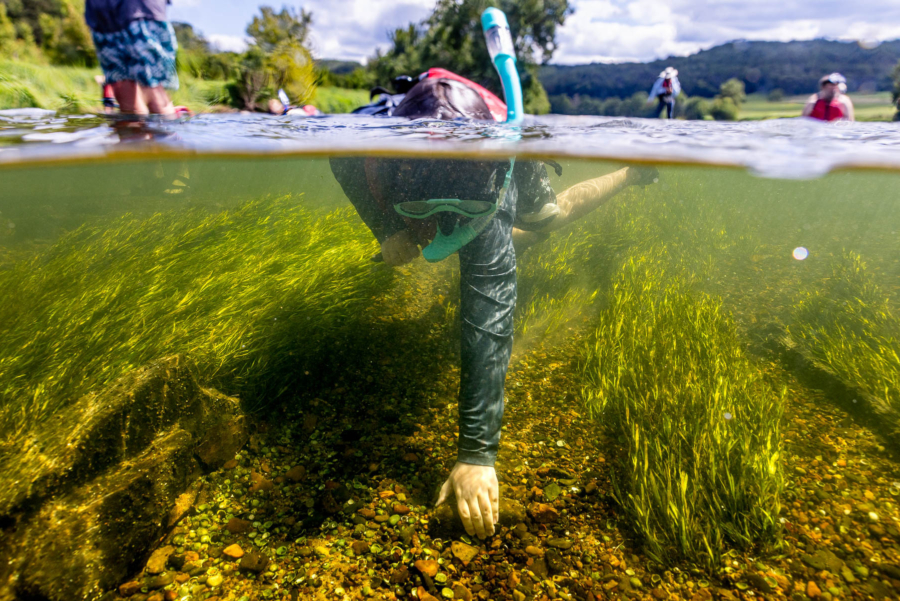
Sebastian Leavitt snorkels in the South Fork Shenandoah River during the Shenandoah Riverkeeper’s RiverPalooza Snorkeling Paddle Event in Bentonville, Va., on Aug. 29, 2025. Snorkelers explored aquatic wildlife, focusing on freshwater mussels and their role in the ecosystem. (Photo by Charlie Nick/Chesapeake Bay Program) (Photo by Charlie Nick/Chesapeake Bay Program)
As we document the Chesapeake Bay watershed and its people, our photography takes a somewhat predictable path through the four seasons.
In winter we follow the stewards braving the cold, gathering together for one of the few activities that continues through the year—monitoring water quality. And we welcome waterfowl back to Chesapeake marshes.
Spring is a time of natural rebirth…and replanting. We find ourselves among the many young forests being put into the ground once temperatures are mild enough to benefit seedlings and saplings.
Summer is for recreation, not just near water but fully immersed. Wildlife and harvests are also in full swing.
And fall is a victory lap, for oyster restoration, for scientists gathering data and for catching blue crabs just one more time. It’s a race to get things done before the air, the ground and (sometimes) the Bay itself freezes again.
Whatever the time of year, we try to introduce you to the people making a difference, who recognize they have something at stake in the health of their local waterway and the Bay downstream. It takes all kinds to do the work and we try to show you enough of a representative sample that you can fill in the rest of the picture.
We hope you enjoy the look back at 2025. You can also check out our most popular feature stories from the past year.
Emma Lloyd, 17, conducts water quality monitoring with other volunteers of the Loudoun Wildlife Conservancy at Tuscarora Creek in Leesburg, Va., on Feb. 2, 2025. Lloyd has volunteered alongside her mother Amy Ulland since both became certified stream monitors with the Loudoun Wildlife Conservancy in 2019. In 2023, as a participant in the Virginia Association of Soil and Water Conservation District's Youth Conservation Leadership Institute, Lloyd worked with NOVA Parks and individual funders to install signs for four local tributaries. "The goal of that was to put up stream signs on the W&OD Trail, to basically remind people that the streams are there and to give them a sense of connection to the stream," Lloyd said. (Photo by Will Parson/Chesapeake Bay Program) (Photo by Will Parson/Chesapeake Bay Program)
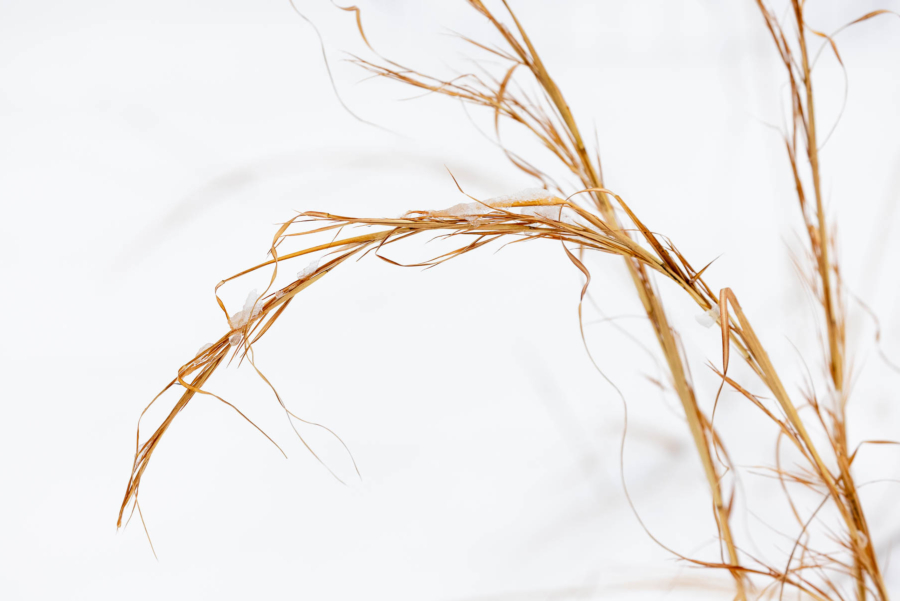
Broomsedge grass stalks and seedheads left standing in the photographer's residential garden provide overwintering habitat and food for wildlife in Anne Arundel County, Md., on Feb. 12, 2025. (Photo by Will Parson/Chesapeake Bay Program)
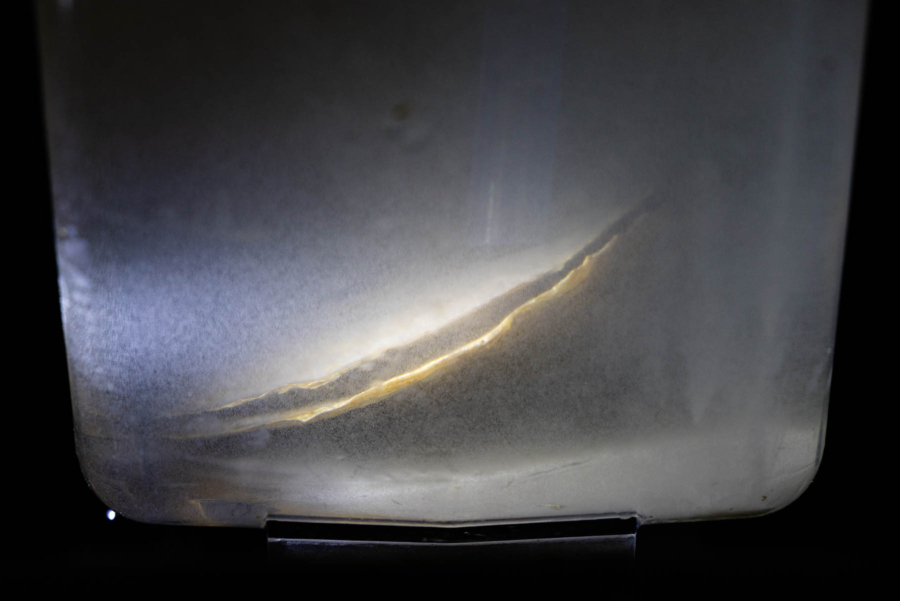
A spawning female oyster claps sporadically to release eggs at the University of Marylanc Center for Environmental Science (UMCES) Horn Point Laboratory in Cambridge, Md., on April 30, 2025. The laboratory controls the water temperature to induce spawning, growing out millions of juvenile oysters every year. (Photo by Will Parson/Chesapeake Bay Program)
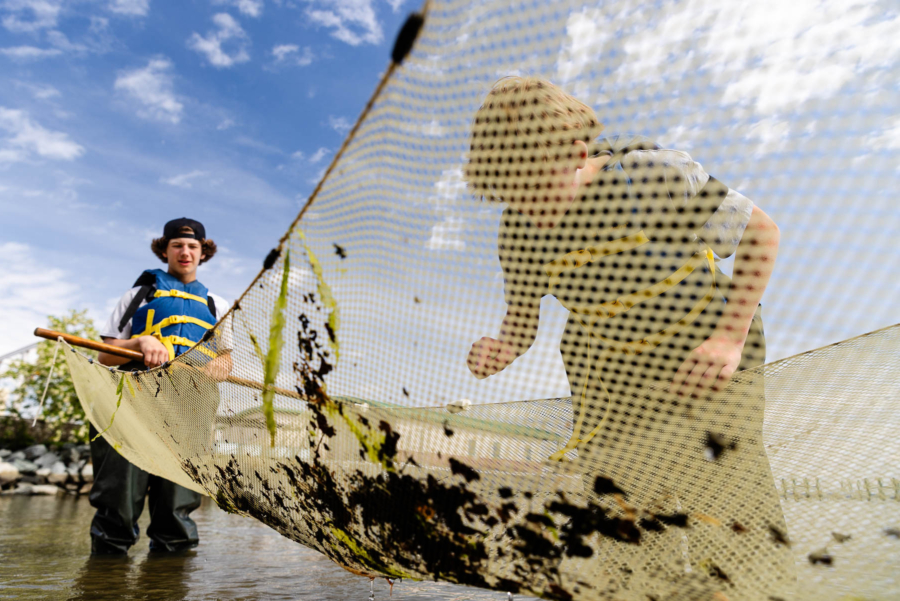
Sylis Shawacre, and Wyatt Genrich, right, ninth-grade students from St. Michaels Middle High School, drag a seine survey net through shallow water along the shoreline of the Choptank River at the University of Maryland Center for Environmental Science (UMCES) Horn Point Laboratory in Cambridge, Md., on April 30, 2025. The field trip helps schools provide students with Meaningful Watershed Educational Experiences (MWEEs), which are required by the state of Maryland and given throughout the Chesapeake Bay watershed. (Photo by Will Parson/Chesapeake Bay Program)
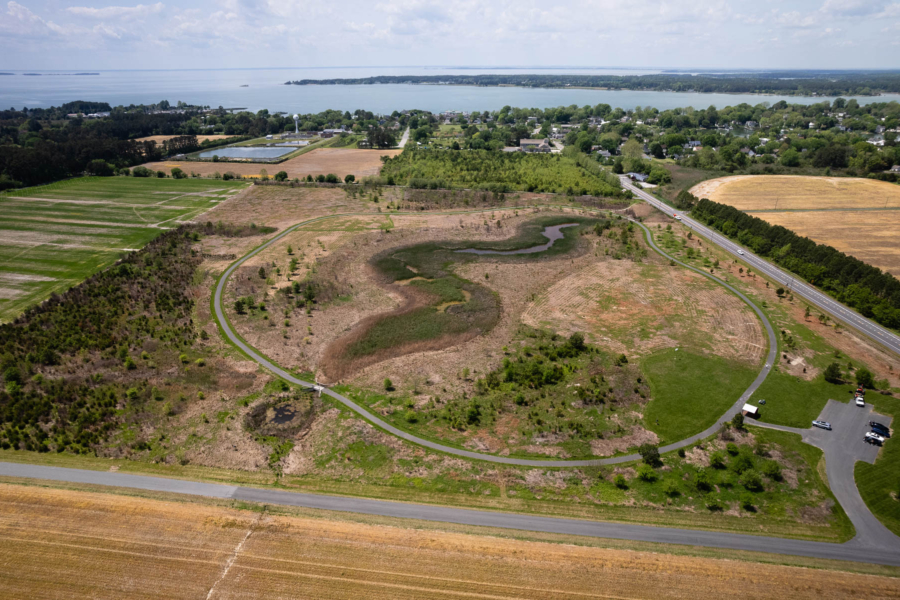
Restored meadow, forest and freshwater wetland habitat are preserved near the Tred Avon River at Oxford Conservation Park in Oxford, Md., on April 30, 2025. The park, which was formerly farmland that was slated to become a residential subdivision, added 30 additional acres of trails, trees and meadow habitat in early 2025 in a partnership between the Eastern Shore Land Conservancy and Washington College's Natural Lands Project. (Photo by Will Parson/Chesapeake Bay Program)
Will Gordon, who is the 12th generation of a family that has owned Wye House Farm since the 1650s, stands at one of the property's eroding shorelines along Shaw Bay on the Wye River in Talbot County, Md., on April 30, 2025. Gordon has helped initiate conservation projects, including living shorelines, that have protected the 1200-acre farm, 312 acres of which are permanently protected from development through two conservation easements with the Eastern Shore Land Conservancy (ESLC). (Photo by Will Parson/Chesapeake Bay Program)
Canada geese visit a restored wetland designed to filter stormwater runoff before it reaches Broad Creek near Tidewater Park in Laurel, Del., on May 1, 2025. Broad Creek is the focus of a city revitalization effort known as The Ramble. (Photo by Will Parson/Chesapeake Bay Program)
A species of small carpenter bee visits daisy fleabane blooming in the photographer's garden in Anne Arundel County, Md., on May 6, 2025. (Photo by Will Parson/Chesapeake Bay Program)
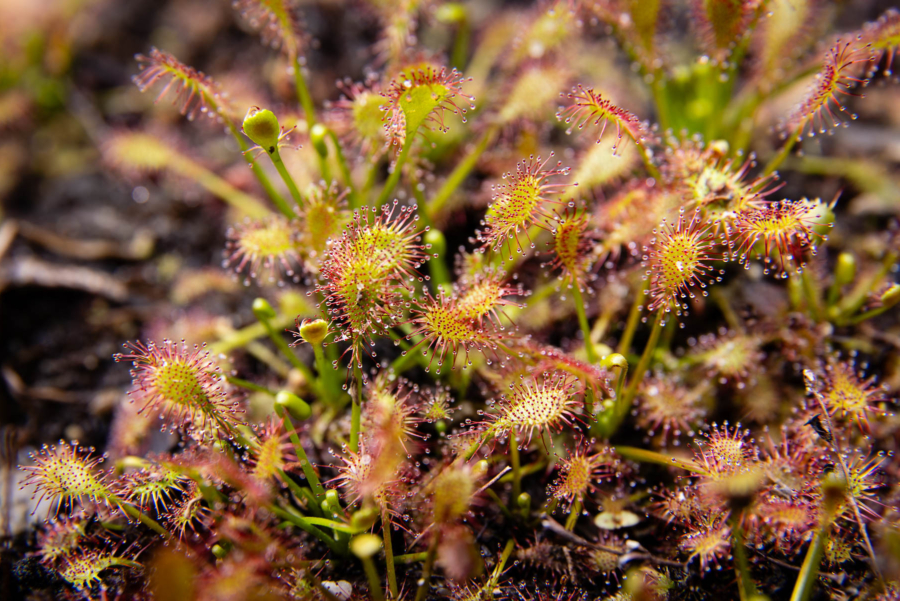
Spoonleaf sundew grows after being planted as part of a 2,600-foot stream and wetland restoration on a tributary of the Severn River known as Jabez 3 in Millersville, Md., on May 23, 2025. Funded by the Resilience Authority of Annapolis and Anne Arundel County, with $8.1 million provided by the Maryland Department of Natural Resources (DNR) and $977,640 from the National Fish and Wildlife Foundation (NFWF) EPA Innovative Nutrient and Sediment Reduction Grants program, the project was built by Underwood & Associates, Inc., to address severe erosion that was sending sediment pollution downstream into the Severn River. The design filled a 10-foot-deep eroded channel to reconnect the stream to its floodplain, using sand, gravel and wood chips to create riffles and step pools in what's known as a regenerative stormwater conveyance. "It's now controlling those pulses of floods," said Sara Caldes, the Severn Riverkeeper. "The amount of habitat that's been created in, like, one year is what I find most interesting." (Photo by Will Parson/Chesapeake Bay Program)
Male horseshoe crabs surround female horseshoe crabs as they burrow in the sand to lay eggs at Flag Ponds Nature Park in Lusby, Md., on May 24, 2025. The Calvert Nature Society invited community members to camp on the beach and experience the spawning of horseshoe crabs under the stars. (Photo by Charlie Nick/Chesapeake Bay Program)
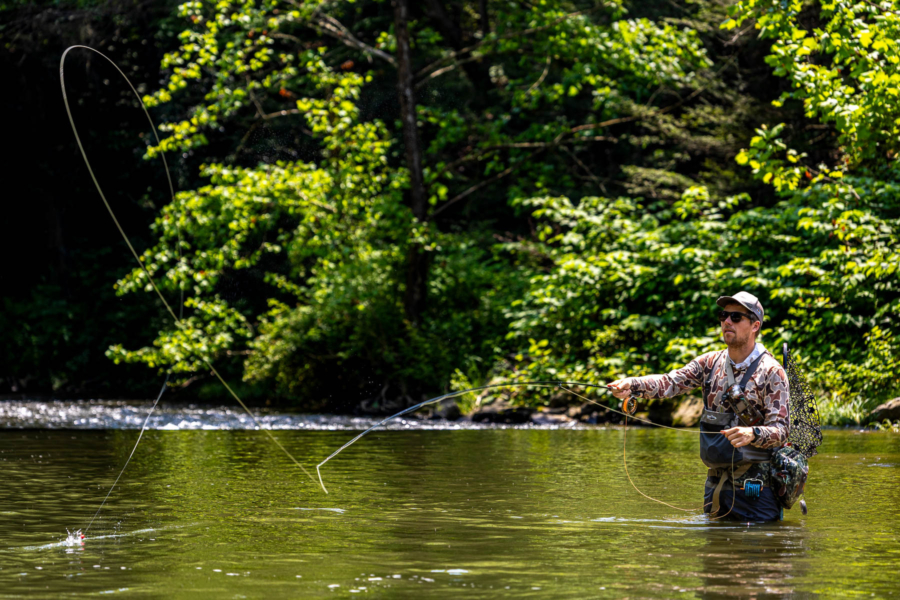
Shane Smith fly fishes for rainbow trout on Bald Eagle Creek at Soaring Eagle Wetlands in Julian, Pa., on June 12, 2025. Funded in part by the Wildlife for Everyone Foundation, recent developments of the wetlands include a new boardwalk, interpretive signage, and an ADA-accessible hiking trail. (Photo by Charlie Nick/Chesapeake Bay Program)
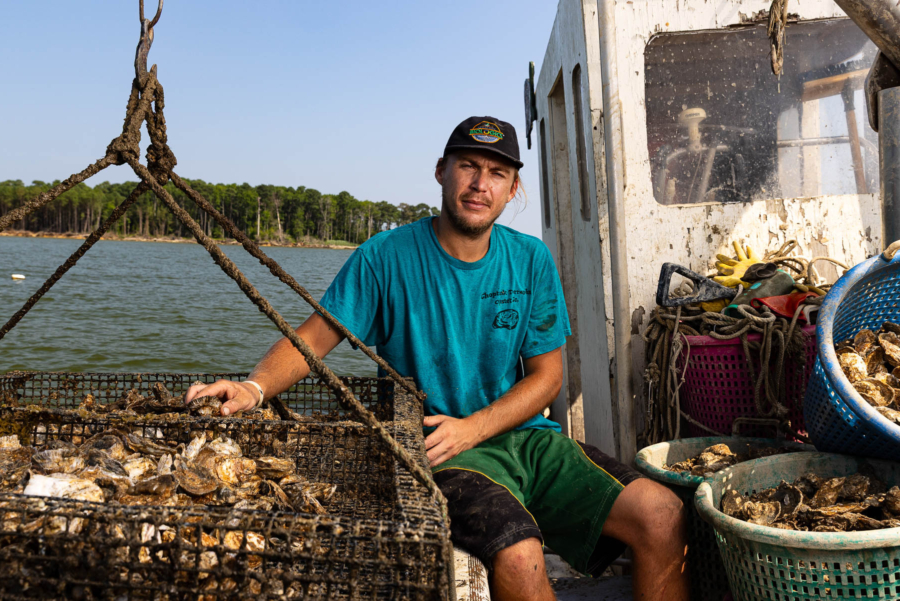
Jerry Sturmer, owner of Choptank Terrapin Oyster Co., poses for a portrait on his boat on the Choptank River near the tip of Tilghman Island in Talbot County, Md., on July 8, 2025. Sturmer started the oyster farm in 2021 and is currently the only employed person in the business that provides oysters to local restaurants and for restoration projects. This year, Sturmer was one of the providing oyster farmers for The Nature Conservancy’s Supporting Oyster Aquaculture and Restoration (SOAR) program. The SOAR program was born out of the COVID-19 pandemic to help support local oyster farmers by purchasing their oysters and placing them in oyster sanctuaries on the Chesapeake Bay. (Photo by Charlie Nick/Chesapeake Bay Program)
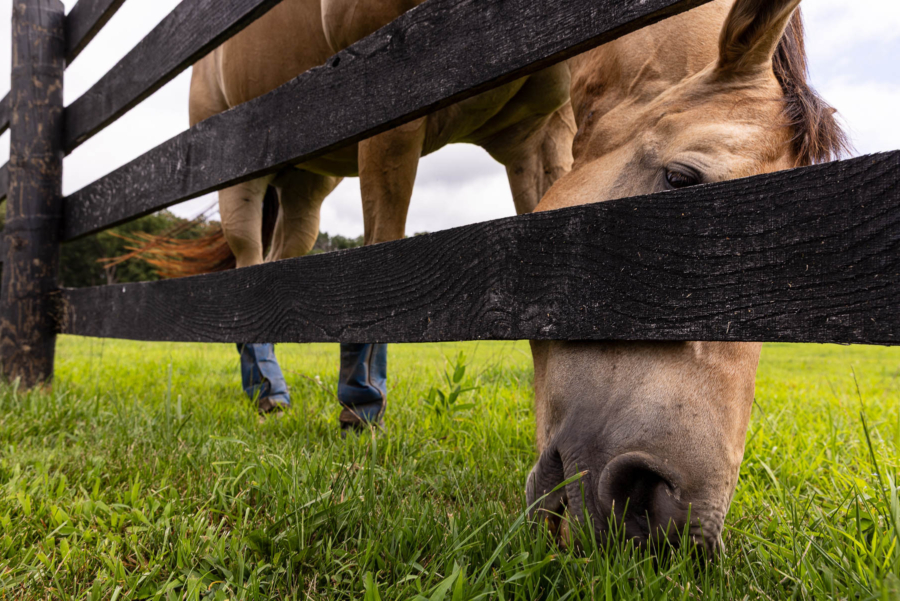
Chardy eats grass in a pasture on Wyndham Oaks II horse farm in Boyds, Md., on July 15, 2025. In 2024, the farm won the local and state Soil Conservation Service awards for its soil and water conservation practices. Wyndham Oaks II houses approximately 30 horses that are in the various stages of retirement and utilizes their manure as a natural fertilizer to add nutrients to the soil. “We are very much driven by the data,” said Lori Larson, owner of Wyndham Oaks II. “We pull soil samples to make sure we understand what is in the ground and what it needs.” (Photo by Charlie Nick/Chesapeake Bay Program)
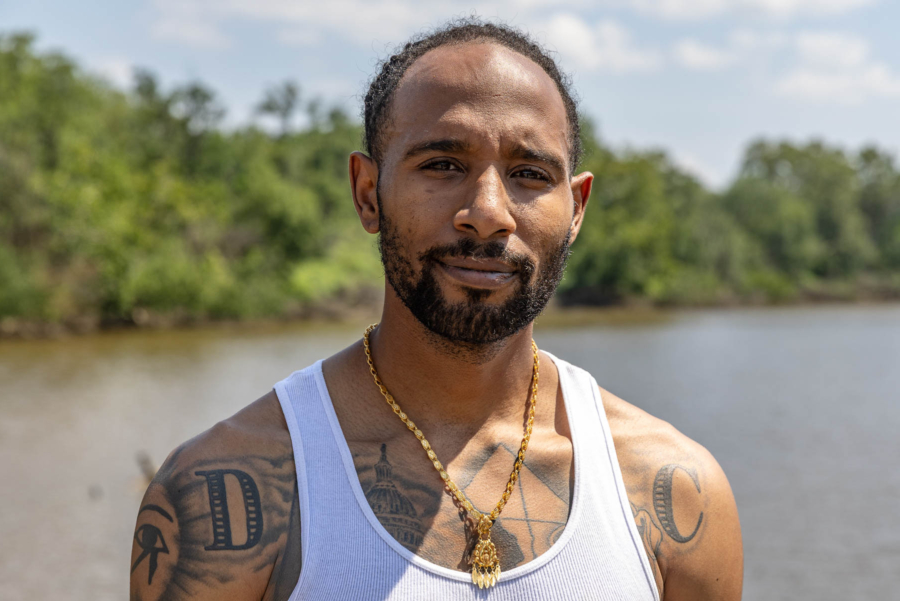
Earl Charles, owner and founder of Ancient Greene, poses for a portrait on Kingman and Heritage Island in Washington, D.C., on July 24, 2025. Charles started Ancient Greene in 2017 and wishes to bring life back into the community he grew up in. Ancient Greene is an eco-friendly landscaping business that maintains a variety of green infrastructure projects throughout the Anacostia River Watershed and Washington, D.C. (Photo by Charlie Nick/Chesapeake Bay Program)
Max Ruehrmund, electronics technician with the National Oceanic and Atmospheric Administration (NOAA), watches a static line feed in from a CTD-DO instrument submerged into the water on the Choptank River in Talbot County, Md., on July 29, 2025. Before the maintenance is performed on the hypoxia sensors, a SeaBird SB19 CTD-DO instrument is submerged at a constant drop velocity on a static line to profile the water along the water column to take in conductivity, temperature, depth, and dissolved oxygen measurements. (Photo by Charlie Nick/Chesapeake Bay Program)
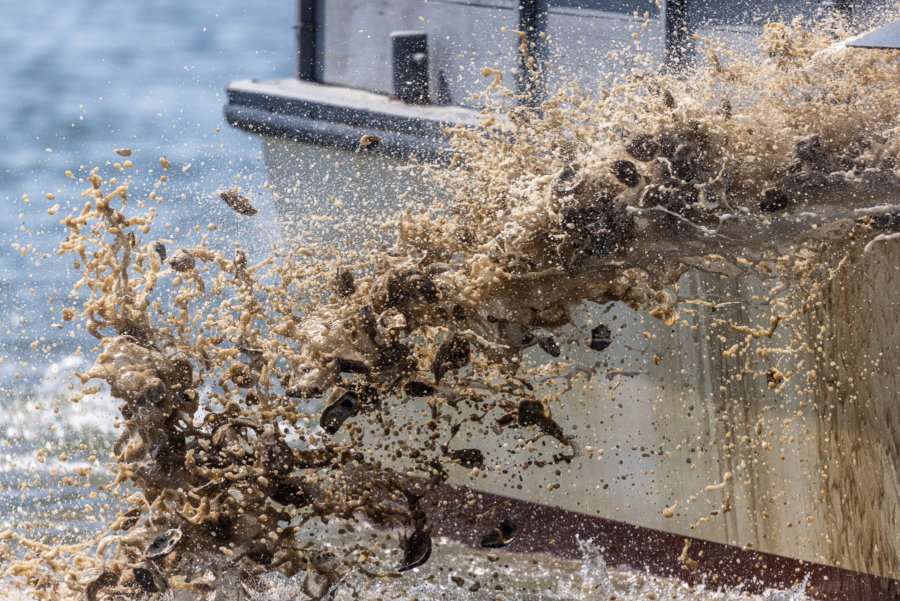
Oysters splash from Captain Wayne Goddard’s boat, “The Poppa Francis,” onto an oyster sanctuary on the Manokin River near Somerset County, Md., on July 30, 2025. The Oyster Recovery Partnership (ORP) planted a total of 14 million spat-on-shell oysters across two reefs that span 5 and 6.5 acres respectively, part of a larger restoration that was completed on the Manokin as the final tributary to be restored under the 2014 Chesapeake Bay Watershed Agreement. ORP has been working with federal and state partners, includuing the National Oceanic and Atmospheric Administration (NOAA), U.S. Army Corps and Maryland Department of Natural Resources (DNR) to restore oyster reefs in five Maryland tributaries, improving water quality and creating habitat for other species. (Photo by Charlie Nick/Chesapeake Bay Program)
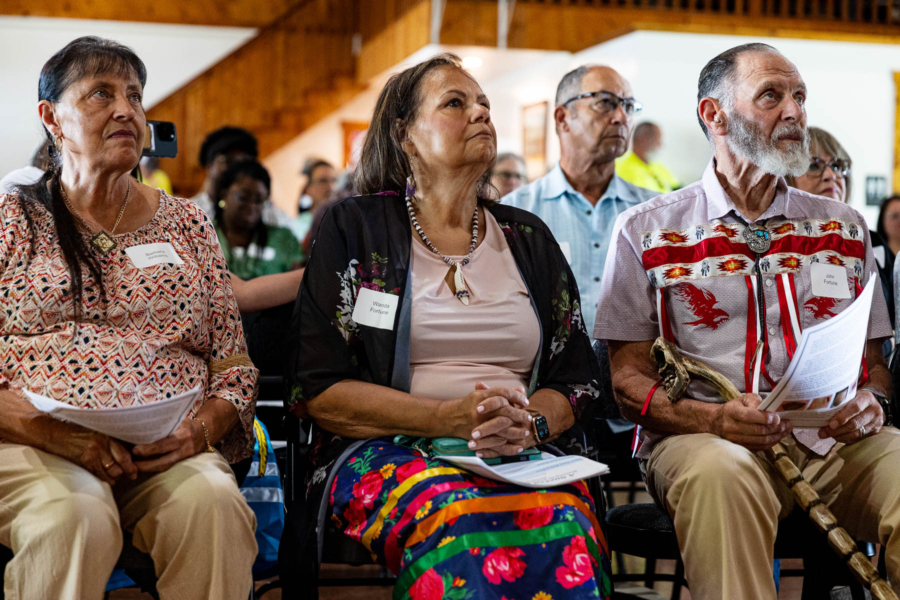
From left, Barbara Williams, Wanda Fortune and John Fortune listen to remarks during a celebration ceremony at the Rappahannock Tribe Indigenous Conservation Education Center at the Cat Point Creek Unit of Rappahannock River Valley National Wildlife Refuge in Richmond County, Va., on August 2, 2025. Members and friends gathered to celebrate the Rappahannock Tribe’s "rematriation" of 969 acres of ancestral land at Fones Cliffs. (Photo by Charlie Nick/Chesapeake Bay Program)
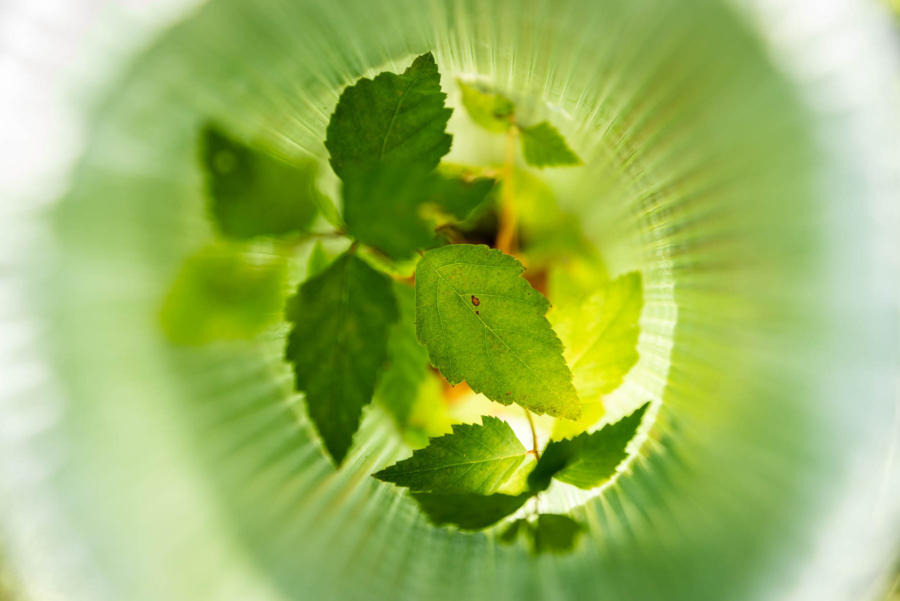
A river birch planted by Friends of the Rappahannock is part of a silvopasture addition at Triquestra Farm in Greene County, Va., on Aug. 27, 2025. Silvopasture adds trees to grazed lands in order to provide shade and other benefits to livestock, while also improving environmental conditions for nearby rivers and streams. (Photo by Charlie Nick/Chesapeake Bay Program)
Mike Dorman poses for a portrait on his farm along Smith Creek, a tributary of the North Fork Shenandoah River in Shenandoah County, Va., on Aug. 28, 2025. Dorman decided to work with the Alliance for the Shenandoah Valley to include a variety of restoration sites on his property including a riparian forest buffer to help protect the creek. (Photo by Charlie Nick/Chesapeake Bay Program)
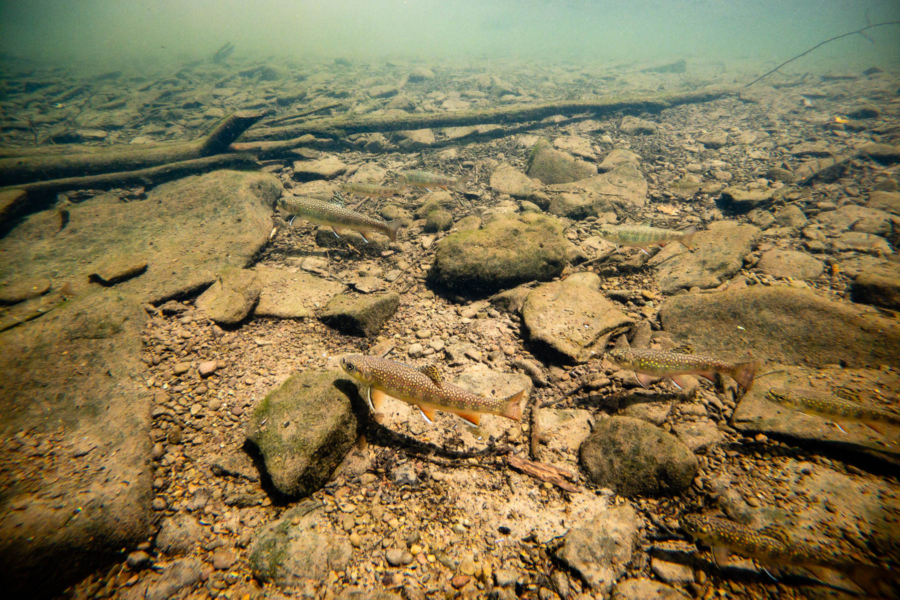
Brook trout and other fish species find habitat amid the rocks and woody debris at the bottom of a pool on Yochum Run, a tributary that joins Cross Fork before flowing into Kettle Creek, in Abbott Township, Pa., on Sept. 9, 2025. Brook trout are an indicator species for water quality and a healthy watershed and have been living in eastern streams for millions of years. Due to warming waters, pollution and fish passage degradation, many populations of fish have been threatened and isolated at the headwaters. With new treatment plans being put into place in partnership with Trout Unlimited and the Kettle Creek Watershed Association, populations of brook trout have been restored. Due to the high water quality of the Kettle Creek, much of the waters are classified to have Class-A fishing. (Photo by Charlie Nick/Chesapeake Bay Program)
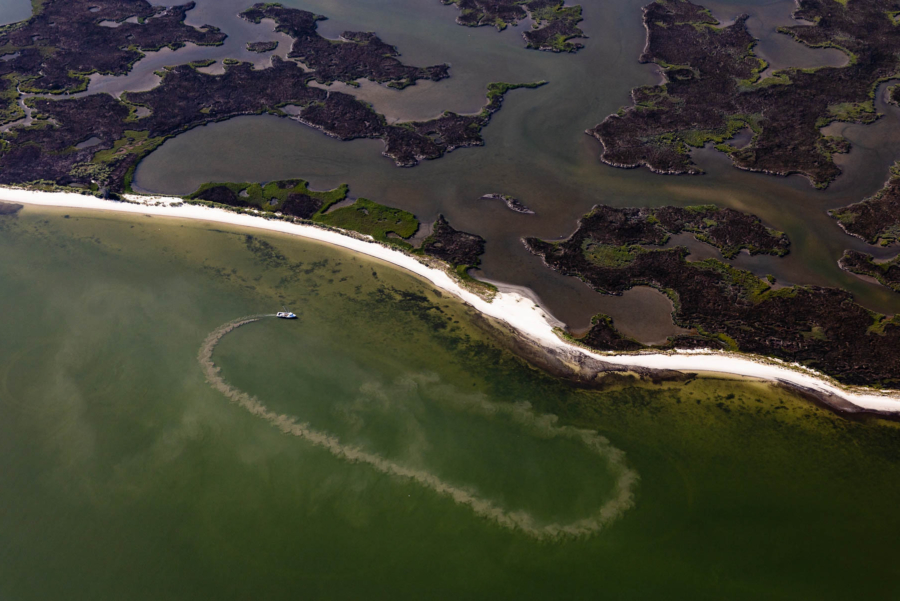
A waterman scrapes for blue crabs near the shoreline of Janes Island State Park in Somerset County, Md., on Sept. 12, 2025. The park holds roughly 30 miles of water trails through salt marsh wetlands, near Big Annemessex Sanctuary. (Photo by Charlie Nick/Chesapeake Bay Program with aerial support by Southwings)
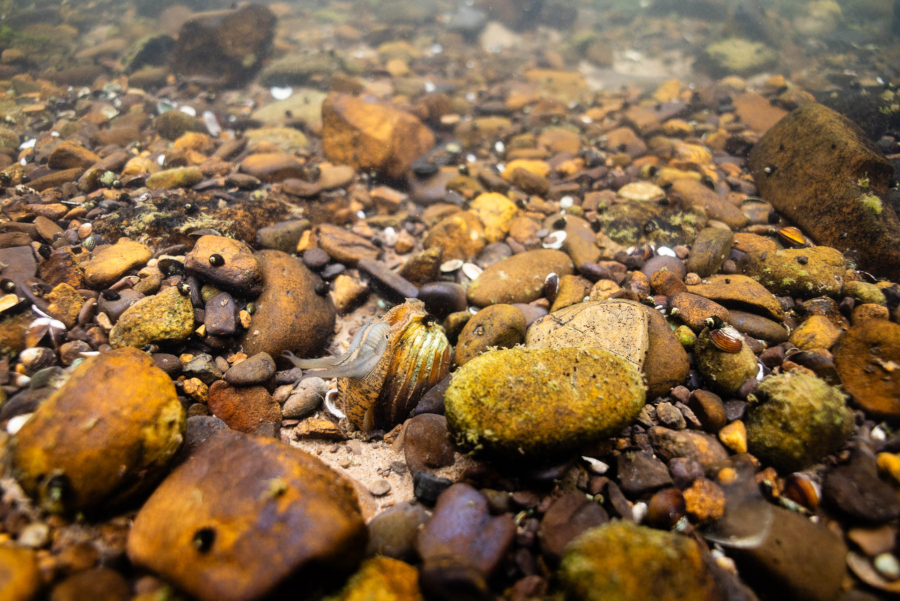
A freshwater mussel known as a lampmussel presents a reproductive behavior known as a lure display in the Potomac River in Washington County, Md., on Sept. 16, 2025. All freshwater mussels depend on various fish species to carry juvenile mussels attached to their gills, so gravid female lampmussels will exhibit part of their fleshy mantle that has evolved to mimic a prey fish, and will twitch it periodically to attract potential fish hosts. (Photo by Will Parson/Chesapeake Bay Program)
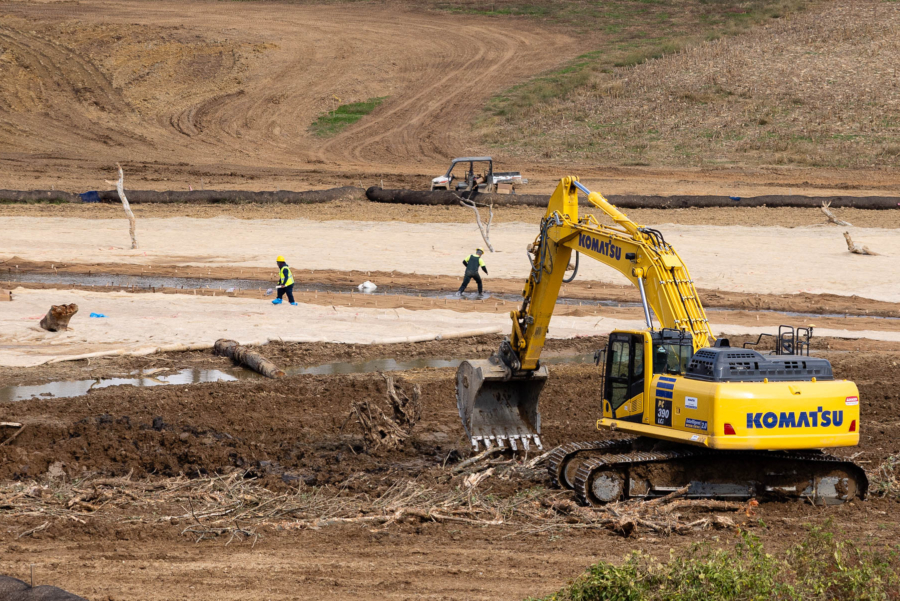
Construction continues on a project involving stream restoration, riparian forest buffer and cattle livestock exclusion at Green Hill Farm in Peach Bottom, Pa., on Oct. 24, 2025. The project will restore 7.8 acres of wetlands and 3,900 linear feet of Conowingo Creek, which flows into the Susquehanna River. The design employs woody debris from the property to store carbon and create an uneven surface that will allow water to drain slowly, eventually creating a porous substrate. It was funded by the PENNVEST Clean Water Procurement Program (CWPP). (Photo by Marisa Baldine/Chesapeake Bay Program)
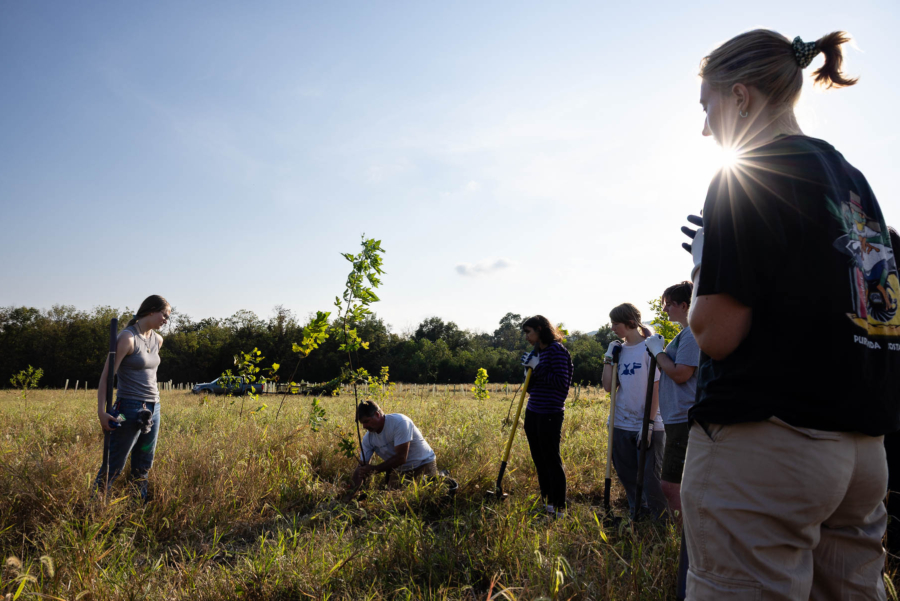
New staff hired by the nonprofit Mobilize Frederick observe John Smucker as he demonstrates how to plant a tree in Emmitsburg, Md., on Sept. 22, 2025. In 2024 and 2025, Stream Link Education recruited volunteers to plant about 18,000 trees on 60 acres of the property, which lies near Toms Creek, a tributary of the Monocacy and Potomac rivers. Following the training, Mobilize Frederick planned to plant 111 free shade trees for residents across the city of Frederick that fall. (Photo by Will Parson/Chesapeake Bay Program)
Comments
There are no comments.
Thank you!
Your comment has been received. Before it can be published, the comment will be reviewed by our team to ensure it adheres with our rules of engagement.







Comments
There are no comments.
Thank you!
Your comment has been received. Before it can be published, the comment will be reviewed by our team to ensure it adheres with our rules of engagement.
Back to recent stories