<?xml version="1.0" encoding="utf-8"?>
<rss version="2.0"
    xmlns:dc="http://purl.org/dc/elements/1.1/"
    xmlns:sy="http://purl.org/rss/1.0/modules/syndication/"
    xmlns:admin="http://webns.net/mvcb/"
    xmlns:rdf="http://www.w3.org/1999/02/22-rdf-syntax-ns#"
    xmlns:content="http://purl.org/rss/1.0/modules/content/">

    <channel>
    <title>Chesapeake Bay Program</title>
    <link>http://www.chesapeakebay.net/</link>
    <description></description>
    <dc:language>en</dc:language>
    <dc:creator>astratto@chesapeakebay.net</dc:creator>
    <dc:rights>Copyright 2013</dc:rights>
    <dc:date>2013-04-30T18:10:53+00:00</dc:date>
    <admin:generatorAgent rdf:resource="http://expressionengine.com/" />
    

    <item>
      	<title>Bay Program Partners Continue Progress to Stem the Flow of Excess Pollutants to the Chesapeake</title>
         	<link>http://www.chesapeakebay.net/presscenter/bay_program_partners_continue_progress_to_stem_the_flow_of_pollutants</link>
         		<guid>http://www.chesapeakebay.net/presscenter/bay_program_partners_continue_progress_to_stem_the_flow_of_pollutants#When:18:10:53Z</guid>
				<description>New 2012 data released today by the Chesapeake Bay Program (CBP) partnership estimates that actions taken by jurisdictions in the last three years resulted in less nitrogen, phosphorus and sediment pollution flowing into the Chesapeake Bay.&amp;nbsp;

	Chesapeake Bay Program partners&amp;ndash;the District of Columbia and the six states in the Bay watershed&amp;ndash;report annually on actions they&amp;rsquo;ve taken to decrease the amount of these three pollutants entering rivers and streams. This information is analyzed using a sophisticated suite of computer simulations of the Bay ecosystem. The resulting estimates tell us how much progress their pollution&#45;reducing actions have made toward levels that would sustain a healthy Bay. By 2017, CBP partners are committed to having practices in place to achieve at least 60 percent of necessary reductions from 2009 levels.</description>

      <dc:subject></dc:subject>
      <dc:date>2013-04-30T18:10:53+00:00</dc:date>
    </item>

    <item>
      	<title>Bay’s Underwater Grasses Decline For Third Year</title>
         	<link>http://www.chesapeakebay.net/presscenter/bays_underwater_grasses_decline_for_third_year</link>
         		<guid>http://www.chesapeakebay.net/presscenter/bays_underwater_grasses_decline_for_third_year#When:15:00:01Z</guid>
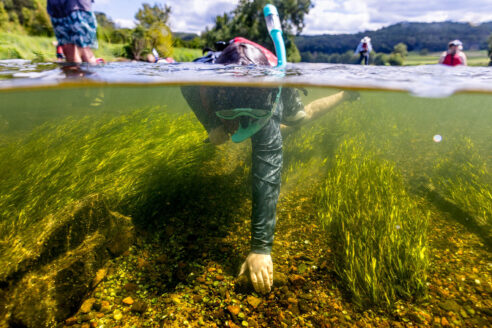
				<description>Between 2011 and 2012, underwater grasses in the Bay and its tidal rivers declined 21 percent, approaching lows last reported in 1986. In 2012, Chesapeake Bay Program scientists from Virginia and Maryland found the Bay had 48,191 acres of grasses, a decrease of 14,892 acres from 2011 estimates. This third year of decreasing grasses is the cumulative result of unfavorable growing conditions since 2009.

	Annual acreage of grasses is estimated through an aerial survey flown from late spring to early fall. Scientists chart the Bay grasses by three &amp;ldquo;zones&amp;rdquo; &amp;ndash; upper, middle and lower Bay &amp;ndash; and into subsections by tributaries, called &amp;ldquo;segments&amp;rdquo;. Overall declines were evident last year in all of the zones with only a few bright spots in specific locations.

	The CBP scientists in both states believe losses of the Bay&amp;rsquo;s underwater grasses in the upper and middle Bay zones most likely reflect the effects of Hurricane Irene and Tropical Storm Lee in the fall of 2011 and the resulting sediment they added to the system. In the middle and lower Bay, grasses were subjected to excessively warm waters in summer of 2010 and poor water clarity since then has kept them from rebounding.

	While these losses are concerning, two areas showed notable resilience and expansion. Although the large grass bed at the head of the Bay on the Susquehanna Flats decreased in size, the grasses there remained robust and very dense. In addition, grasses continued to increase in the mainstem of the James River.&amp;nbsp;

	CBP has created a new dynamic online mapping tool that anyone can use to see how the Bay&amp;rsquo;s underwater grasses have changed in location, abundance and species over the last thirty years.</description>

      <dc:subject></dc:subject>
      <dc:date>2013-04-18T15:00:01+00:00</dc:date>
    </item>

    <item>
      	<title>Bay Shows Signs of Resilience as Partners Report on Health and Progress</title>
         	<link>http://www.chesapeakebay.net/presscenter/bay_shows_signs_of_resilience_as_partners_report_on_health_and_progress</link>
         		<guid>http://www.chesapeakebay.net/presscenter/bay_shows_signs_of_resilience_as_partners_report_on_health_and_progress#When:12:10:04Z</guid>
				<description>The Chesapeake Bay Program&amp;rsquo;s analysis of recent data on the health of the Chesapeake Bay and its watershed shows an ecosystem that is resilient, even as it remains impaired and population continues to increase. The Bay Program&amp;rsquo;s Bay Barometer: Spotlight on Health and Restoration of Chesapeake Bay and Watershed, which was released today at the Virginia Living Museum, offers a science&#45;based snapshot of current watershed&#45;wide progress toward a healthy Bay ecosystem.

	Though health indicators continue to reflect the reality of an impaired Bay and local waterways, significant restoration actions and pollution reductions give Bay officials cause for optimism.&amp;nbsp;

	Chesapeake Bay Program Director Nick DiPasquale said, &amp;ldquo;While we clearly have a lot of work to do, the Bay is resilient and we have reason for hope. We know this complex ecosystem will respond to restoration efforts and we expect to see encouraging news for 2012 data.&amp;nbsp; This includes news such as the increase in juvenile crabs, early reports of perhaps the smallest &amp;lsquo;dead zone&amp;rsquo; in over 25 years and restoration accomplishments that will result in more positive health indicators in years to come.&amp;rdquo;

	DiPasquale also noted that partners &amp;ndash; the six Bay states, the District of Columbia, the Chesapeake Bay Commission and the Environmental Protection Agency &amp;ndash; are making significant progress toward improved water quality by putting their local pollution&#45;reducing plans into action. In just two years, Bay Program partners estimate that they moved 20 percent closer to their goal for reducing nitrogen, 19 percent closer for phosphorus and 30 percent closer for sediment.

	&amp;ldquo;The strides the Bay partners are making to meet our water quality goals under the Bay pollution diet show we&amp;rsquo;re taking the Bay restoration effort seriously and our reporting systems are getting better and better, improving our own accountability,&amp;rdquo; said DiPasquale.

	The following are some highlights of this year&amp;rsquo;s Bay Barometer:

	Indicators of an Impaired Chesapeake Bay

	
		Only 34 percent of the Bay met dissolved oxygen standards
	
		Water clarity was very poor
	
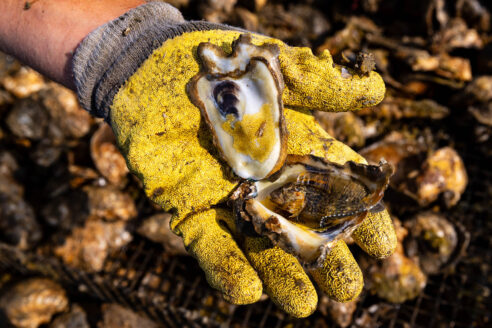
		Oyster populations remain low&amp;mdash;less than 1 percent of historic levels
	
		A majority of freshwater streams are in poor or very poor condition


	Signs of Resilience and Hope

	
		Not only did the large Susquehanna Flats grass bed survive Tropical Storm Lee in 2011, but grasses in the mid&#45;Bay witnessed dramatic increases
	
		The Bay&amp;rsquo;s rockfish population, once threatened, remains stable and above target
	
		The adult female crab population, though down, is still within sustainable range, and early news of the highest number of juveniles since 1993 gives us hope for good figures on 2012 and in 2013
	
		Early indications are that the 2012 dead zone was the smallest since 1985


	Major Restoration Accomplishments

	
		Increased 240 miles of forested buffers, largely planted by rural landowners
	
		148 more miles of streams were opened for use by migratory fish to reach necessary spawning grounds
	
		15 new public access sites opened, giving people access to the water
	
		More than 8 million acres of land have been preserved since 2000


	Progress toward Meeting the Bay Total Maximum Daily Load (TMDL) &amp;ndash; a.k.a. the &amp;ldquo;pollution diet&amp;rdquo;

	Estimates indicate that between July 2009 and June 2011, as a result of pollution&#45;reducing practices implemented:

	
		Nitrogen loads to the Bay decreased by 15.67 million pounds &amp;ndash; 21 percent of the TMDL target
	
		Phosphorus loads to the Bay decreased by 0.9 million pounds &amp;ndash; 19 percent of the TMDL target
	
		Sediment loads to the Bay decreased 396 million pounds &#45; 30 percent of the TMDL target


	&amp;ldquo;For 30 years, Chesapeake Bay Program science has been informing policies throughout the watershed,&amp;rdquo; said DiPasquale. &amp;ldquo;The Bay Barometer provides a year&#45;end snapshot of the Chesapeake Bay&amp;rsquo;s health and efforts to protect and restore it, based on data from our partnership of more than 500 scientists, researchers and experts. It&amp;nbsp; gives us an opportunity to look at the cumulative data and reflect on what it means for the Bay and the people who live here. I feel it is a great time for optimism, if we continue moving in the right direction.&amp;rdquo;

	About the &amp;ldquo;Bay Barometer&amp;rdquo;

	Looking at data over time helps scientists understand natural variations as well as the long&#45;term effects of restoration efforts. The data provided in the Bay Barometer reflect the Bay&amp;rsquo;s health over the course of many years, and in some cases, decades. The publication provides a snapshot of the best available information from 2011 and 2012 on the Bay&amp;rsquo;s health and current efforts to protect and restore our national treasure and its watershed.

	Full data and information can be found at &amp;ldquo;Track the Progress.&amp;rdquo; Visit our &amp;ldquo;Bay Resource Library&amp;rdquo; for videos, images and maps related to this release.</description>

      <dc:subject></dc:subject>
      <dc:date>2013-01-31T12:10:04+00:00</dc:date>
    </item>

    <item>
      	<title>Media Briefing: Assessing Pollution Trends from Bay’s Rivers</title>
         	<link>http://www.chesapeakebay.net/presscenter/media_briefing_assessing_pollution_trends_from_bays_rivers</link>
         		<guid>http://www.chesapeakebay.net/presscenter/media_briefing_assessing_pollution_trends_from_bays_rivers#When:15:49:49Z</guid>
				<description>In a conference call on Tuesday, January 15, at 3 p.m., scientists with the Chesapeake Bay Program (CBP) will discuss current and forthcoming information on Chesapeake Bay pollution trends and current issues. The purpose of the call is to clarify three distinct but connected issues:

	
		Annual pollution trends in the watershed and loads to the Bay
	
		New enhancements to existing monitoring of pollution trends and how the new methods are changing what we see in nine major Bay rivers; and,
	
		Ongoing assessment of sediment management strategies on the lower Susquehanna River.


	Monitoring water quality conditions over time tells us how the Bay&amp;rsquo;s health is changing in response to our land use decisions and management actions.&amp;nbsp; Both the enhancement of our monitoring toolbox and the assessment will serve our ever&#45;improving understanding and evaluation of loads of nitrogen, phosphorus and sediment reaching the Chesapeake Bay.

	WHO:

	
		Scott Phillips, Chesapeake Bay Coordinator, Chesapeake Bay Program, USGS
	
		Joel Blomquist, Hydrologist, USGS
	
		Bruce Michael, Director, Resource Assessment Service, Maryland DNR
	
		Lee Currey, Director of Science Services Administration, MDE
	
		Rich Batiuk, Associate Director for Science, Chesapeake Bay Program, US EPA&amp;nbsp;&amp;nbsp; Gary Shenk, Analysis Coordinator, Chesapeake Bay Program, US EPA


	WHEN:

	Tuesday, January 15, at 3 p.m.&amp;nbsp;

	DETAILS:

	Media should dial:&amp;nbsp;866.299.3188 (Access Code: 410 267 5731)</description>

      <dc:subject></dc:subject>
      <dc:date>2013-01-15T15:49:49+00:00</dc:date>
    </item>

    <item>
      	<title>Decline in Incentives, Higher Commodity Prices Means  Downward Trend in Forest Buffer Restoration</title>
         	<link>http://www.chesapeakebay.net/presscenter/decline_in_incentives_higher_commodity_prices_means_downward_trend_in_fores</link>
         		<guid>http://www.chesapeakebay.net/presscenter/decline_in_incentives_higher_commodity_prices_means_downward_trend_in_fores#When:16:30:27Z</guid>
				<description>Experts in forestry at the Chesapeake Bay Program say restoration of forested areas along creeks and streams, known as riparian forest buffers, has mostly declined since its peak of 815 miles restored in 2005. In 2011, however, only 240 miles of forest buffers were restored in all the Bay jurisdictions &amp;ndash; one&#45;third to one&#45;quarter of what was done just six years ago.

	In 1996, Maryland, Virginia and Pennsylvania and the District of Columbia signed an agreement to restore 2,010 miles of forests along streams by 2010 in order to protect them from polluted runoff. Restoration efforts surged in the next six years and by 2002 the states had met their ten year goal.&amp;nbsp; In the mid&#45;2000&amp;rsquo;s combined reporting from the three big Bay states showed an average of 756 miles between 2003 and 2006. Since 2007, all the Bay jurisdictions have been working toward a goal of restoring forest buffers at a rate of 900 miles per year.&amp;nbsp; This same restoration rate was incorporated into the federal Executive Order strategy which strives for 14,400 additional miles to be restored by 2025.

	Since 1996, agricultural landowners have created most forest buffers so that excess nutrients in runoff could be absorbed by the trees and kept out of local waters. Although trees have substantial value to a healthy ecosystem, higher agriculture commodity prices in recent years have meant it is more lucrative for farmers to keep buffer areas in crops. This, combined with an emphasis and additional funding for other conservation practices such as cover crops, has meant fewer riparian forest buffers planted each year. Fortunately, farm bill programs, such as the Conservation Reserve Enhancement Program, continue to provide an attractive financial incentive to agricultural landowners to create these buffers.

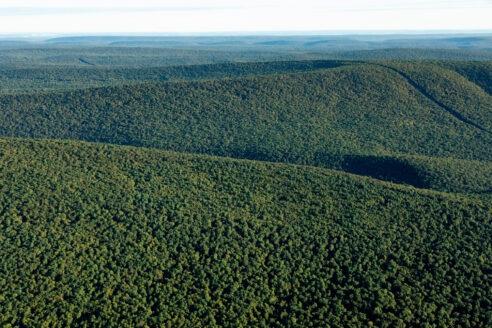
	Historically, the Bay region was 95 percent forested. Forested lands play a key role in the health of streams, lands and large parts of the Bay itself since the landscape has evolved to function on the benefits they provide. Large tracts of trees act as an enormous sponge, filtering and using up excess nitrogen and phosphorus from rainwater runoff and removing any pollutants from the air. Those forested lands along streams or creeks are especially important since they shade the waters and maintain cooler&amp;nbsp;water temperatures in summer heat, an important factor for the iconic brook trout and other fish that are sensitive to water conditions. In autumn, trees drop leaves into streams and creeks, providing important, specific nutrients to the local ecosystem and its creatures. Finally, strong root systems of a forest hold stream banks in place thereby reducing erosion and sedimentation of the waters.

	With the establishment of the Chesapeake Executive Order and local plans to build healthy waters throughout the region, there is renewed interest in maintaining healthy forests and restoring riparian forest buffers. The Chesapeake Forest Restoration Strategy, now out in draft form, outlines the importance of forests and the actions needed to restore them.

	Forest Buffer Restoration: By the Numbers

	1996&#45;2002 (Pa., Md., Va.): 2,311 miles
	2003 (Pa., Md., Va.): 726 miles
	2004 (Pa., Md., Va.): 754 miles
	2005 (Pa., Md., Va.): 815 miles
	2006 (Pa., Md., Va.): 729 miles
	2007 (Pa., Md., Va.): 385 miles
	2008 (Pa., Md., Va.): 449 miles
	2009 (Pa., Md., Va.): 721 miles
	2010 (All watershed states): 337 miles
	2011 (All watershed states): 240 miles</description>

      <dc:subject></dc:subject>
      <dc:date>2012-10-03T16:30:27+00:00</dc:date>
    </item>

    <item>
      	<title>Wetlands Play Critical Role in Bay&#8217;s Health During Hurricane Season</title>
         	<link>http://www.chesapeakebay.net/presscenter/wetlands_play_critical_role_in_bays_health_during_hurricane_season</link>
         		<guid>http://www.chesapeakebay.net/presscenter/wetlands_play_critical_role_in_bays_health_during_hurricane_season#When:15:36:21Z</guid>
				<description>Last year, Chesapeake Bay Program (CBP) partners restored 3,775 acres of wetlands in the Bay watershed according to the program&amp;rsquo;s habitat team tracking these efforts. This is the rough equivalent of 2,855 football&#45;fields&#45;worth of newly created or re&#45;established wetland habitats. These 2011 efforts of federal, state and non&#45;governmental partnerships build on the 14,795 wetland acres established from 1998 to 2010 and represent a solid start for the Bay jurisdictions toward meeting the goal of restoring 30,000 acres and rejuvenating 150,000 acres of these vital landscapes across the Bay&amp;rsquo;s region by 2025.

	During the 2012 hurricane season, wetlands along the edges of streams, creeks, rivers and the Bay will play a critical role in healthy waters. Marshes and wetlands are the Bay&amp;rsquo;s buffers, providing unique habitats for fish and wildlife while stabilizing shorelines and protecting properties from floods and wave action. In times of heavy rains, wetlands act like a sponge, soaking up and holding large amounts of flood and stormwater runoff and gradually releasing it over time. As runoff slowly filters through the wetland, nutrients, suspended sediments and chemical contaminants in the runoff are absorbed by the soils and plants before they can flow to nearby waterways. Wetlands are especially important in urban areas where development and impervious surfaces increase the velocity and volume of polluted stormwater runoff headed for local waters.

	Annual data and impacts of the late storms in 2011 illustrate the important role wetlands have in the ecosystem. Last year, suspended sediment and algae in the Bay&amp;rsquo;s waters resulted in only five percent of tidal waters meeting CBP&amp;rsquo;s goals for clarity, an all time low. Sediment&#45;laden runoff was also a contributing factor in the 21 percent decline in acres of the Bay&amp;rsquo;s underwater grasses which need good water clarity to grow. Increased nutrients to the Bay meant lower levels of dissolved oxygen. Finally, preliminary analysis showed that oyster beds across the region were inundated by silt, making it very difficult for oysters to survive. While wetlands alone are not going to stop excess nutrients and sediment from reaching the Bay, strong, healthy ones are clearly vital to reducing impacts of polluted runoff on other natural resources and supporting the Bay&amp;rsquo;s resilience.

	Wetlands Restored in 2011:

	
		Delaware: 123 ac.
	
		Maryland: 750 ac.
	
		New York: 625 ac.
	
		Pennsylvania: 254 ac.
	
		Virginia: 1,653 ac.
	
		West Virginia: 369 ac.&amp;nbsp;</description>

      <dc:subject></dc:subject>
      <dc:date>2012-09-06T15:36:21+00:00</dc:date>
    </item>

    <item>
      	<title>More than $9 Million in Grants Awarded</title>
         	<link>http://www.chesapeakebay.net/presscenter/more_than_9_million_in_grants_awarded</link>
         		<guid>http://www.chesapeakebay.net/presscenter/more_than_9_million_in_grants_awarded#When:18:16:10Z</guid>
				<description>The Chesapeake Bay Program and the National Fish and Wildlife Foundation (NFWF) today announced the recipients of $9.2 million in grants for restoration and outreach initiatives in the Chesapeake Bay Watershed&#39;s six states and the District of Columbia.&amp;nbsp; Among a myriad of other benefits of the 41 projects, these efforts will engage 9,000 volunteers in restoration work, restore 176 miles of streamside forests, restore 158 acres of wetlands, and establish 170,000 square feet of green roofs and rain gardens.

	The funding for these environmental initiatives was awarded through the Chesapeake Bay Stewardship Fund via the Small Watershed Grants Program and the Chesapeake Bay Innovative Nutrient and Sediment Reduction Grants Program, both of which are administered by NFWF.

	&amp;rdquo;The Chesapeake Bay Stewardship Fund is a model, public&#45;private partnership that has demonstrated its ability over time to achieve measurable and significant on&#45;the&#45;ground conservation results that benefit fish, wildlife and the communities of the Chesapeake,&amp;rdquo; said David O&amp;rsquo;Neill, Director of the Eastern Partnership Office at NFWF. &amp;ldquo;Through these grants, diverse agencies led by the Environmental Protection Agency, the Natural Resources Conservation Service, and the U.S. Forest Service, pool resources with private funding from&amp;nbsp; Altria, Wal&#45;Mart, Wells Fargo, FedEx and others to make smart and cost&#45;effective investments that directly benefit the Bay and its rivers.&amp;rdquo;

	The Innovative Nutrient and Sediment Reduction Grants Program (INSR), funded by the Environmental Protection Agency (EPA), awarded $6.8 million to 21 projects in the Chesapeake Bay Watershed with recipients providing $10.1 million in matching funds.&amp;nbsp; The INSR Program provides grants to innovative and cost&#45;effective projects that dramatically reduce or eliminate the flow of nitrogen, phosphorus and sediment pollution into local waterways and the Chesapeake Bay. Many awardees seek to manage the amount of nutrient runoff from livestock, dairy, and crop farms by conducting outreach and providing technical assistance to farmers.

	&quot;These innovative projects, envisioned by non&#45;profits, local governments and other agencies, are an illustration of the incredible commitment people have to restoring our rivers and streams. With NFWF&amp;rsquo;s invaluable support these projects will make a difference, supporting progress toward a Bay that is increasingly healthy and resilient,&quot; said Jeff Corbin, EPA Senior Advisor for the Chesapeake Bay and Anacostia River. &quot;All of these efforts underscore the level of engagement we need from everyone in making daily choices for clean local and regional waters.&amp;rdquo;

	The Small Watershed Grants (SWG) Program, funded by a combination of public agencies and private support, awarded $2.4 million to 20 projects in the Chesapeake Bay Watershed with recipients providing $3.4 million in matching funds. The SWG program provides grants to organizations and municipal governments working to improve the condition of their local watershed through on&#45;the&#45;ground restoration, habitat conservation and community engagement. The projects are expected to reach out to approximately 180,000 landowners on stewardship of their land. Many grant recipients expect to reduce pollution not only through infrastructures such as green roofs and rain gardens but through community outreach initiatives to promote sustainable landscaping and improved practices for managing runoff.&amp;nbsp;

	&amp;ldquo;All of us have a part to play in helping restore the Bay and the Chesapeake Stewardship Fund makes it possible for local communities to get involved in projects that will improve small watersheds in the Bay,&amp;rdquo; said U.S. Senator Ben Cardin, Chairman of the Senate Water and Wildlife Subcommittee.&amp;nbsp; &amp;ldquo;The wetland and forest restoration projects help protect shorelines from erosion, control pollution and restore habitat.&amp;nbsp; The Chesapeake Bay is better today than it was a decade ago thanks to the work and dedication of individuals and communities that have worked on projects like these.&amp;rdquo;

	&amp;ldquo;I applaud the EPA and the National Fish and Wildlife Foundation for their diligent management of the Chesapeake Bay small watershed and nutrient and sediment removal grants,&amp;rdquo; said Jim Moran, of Virginia&amp;rsquo;s 8th Congressional District.&amp;nbsp; &amp;ldquo;One of our most cherished resources, the Chesapeake Bay has fallen victim to contamination from decades of development and agriculture runoff. These grants help build local community efforts to clean the Bay, leveraging resources, and providing new and innovative approaches to fully restore the Bay&amp;rsquo;s health.&amp;rdquo;
	
	Examples of this year&amp;rsquo;s Chesapeake Stewardship Fund grant recipients in Baltimore include:

	
		The Center for Urban Environmental Research and Education at the University of Maryland Baltimore County ($324,000) will address institutional barriers to innovative stormwater practices in Maryland. The project will work with Maryland&#39;s Transit Administration and Highway Administration to adopt pervious concrete and subsoiling. The project includes a demonstration project to replace an existing parking lot at the Maryland Science Center with pervious concrete.
	
		The Gunpowder Valley Conservancy ($89,105) will use market research to design and implement a landowner outreach program in the Middle River and Tidal Gunpowder watersheds. The program will motivate 700 landowners to take restoration actions on their own land, including planting native trees and rain gardens and installing rain barrels.
	
		Blue Water Baltimore ($400,000) will expand its residential water audit program, which provides free stormwater impact assessments to property owners, provides monetary incentives for the installation of stormwater best management practices, and educates residents and students about the importance of stormwater management for healthy rivers and streams. This program will work with 5000 homeowners to install rain barrels, plant rain gardens, convert turf lawns to native landscaping, remove pavement, and install green roofs.


	Examples of this year&amp;rsquo;s Chesapeake Stewardship Fund grant recipients in Northern Virginia include:

	
		Arlington County ($80,000) will expand its &amp;ldquo;StormwaterWise Landscapes Program&amp;rdquo;, which provides incentives for private landowners to install innovative stormwater management projects on their property. The project will reduce polluted runoff from 80 residential yards, driveways and roofs, which will reduce the amount of pollution entering Four Mile Run, the Potomac River and the Chesapeake Bay.
	
		The John Marshall Soil and Water Conservation District ($49,575) will plant streamside forest buffers on eight farms in Fauquier County. Project partners train over 150 students and community volunteers to plant 20 acres of buffers with native trees.
	
		The Potomac Conservancy ($200,000) will test a model to engage absentee landowners in Northern Virginia and the Shenandoah Valley in adopting conservation practices. These landowners, who often lease their land for farming, have lower participation rates in conservation programs. The project will provide outreach to 500 landowners, and enroll at least 20 in conservation programs to install fencing that excludes cattle from streams, and establishes streamside forest buffers.


	Since 2006, the Innovative Nutrient and Sediment Reduction Grant Program has provided $33.6 million to 75 projects that reduce the amount of nitrogen, phosphorus, and sediment in the Chesapeake Bay Watershed. Since 1999, the Small Watershed Grants Program has provided more than $31.4 million to support 683 projects in the region and has further leveraged close to $98.4 million in local matching funds, for a total conservation investment in on&#45;the&#45;ground restoration of over $128.4 million.

	For more information about the Chesapeake Bay Small Watershed Grants Program and the Chesapeake Bay Innovative Nutrient and Sediment Reduction Grants Program, visit www.nfwf.org/chesapeake.</description>

      <dc:subject></dc:subject>
      <dc:date>2012-08-27T18:16:10+00:00</dc:date>
    </item>

    <item>
      	<title>New Report Highlights Ways to Keep Blue Crab Population Healthy</title>
         	<link>http://www.chesapeakebay.net/presscenter/new_report_highlights_ways_to_keep_blue_crab_population_healthy</link>
         		<guid>http://www.chesapeakebay.net/presscenter/new_report_highlights_ways_to_keep_blue_crab_population_healthy#When:19:49:11Z</guid>
				<description>The Chesapeake Bay blue crab fishery is currently operating sustainably, according to the recently released 2012 Chesapeake Bay Blue Crab Advisory Report. While the report highlights the health of the blue crab population, it also recommends continued work to sustain robust crab populations over the long term.

	The report was developed by the Chesapeake Bay Stock Assessment Committee, which includes scientists and representatives from federal and state governments as well as academic institutions. It is based on data collected in the Bay&#45;wide winter dredge survey (a cooperative effort between Maryland and Virginia) and on annual estimates of blue crab harvest. The report recommends:

	
		Female Crabs: While the target is to have 215 million adult female crabs in the Bay, estimates indicate that there were roughly 97 million adult female crabs in the Bay at the beginning of the 2012 crabbing season&amp;mdash;above the overfishing threshold of 70 million. Because the number of female crabs has declined over the past two years, the jurisdictions that manage blue crabs should ensure that harvest of female crabs is limited relative to their overall numbers.
	
		Male Crabs: Currently, management focuses on limiting the Bay&#45;wide harvest of female crabs to target levels. To ensure the overall fishery remains healthy, the jurisdictions should continue to monitor trends in male abundance and consider adopting a conservation trigger for the male component of the population.
	
		Recreational Harvest:Recreational harvest of crabs affects overall crab population figures. To sharpen accuracy of the data, improving estimates of recreational harvest of blue crabs must be made a priority.


	&quot;The recent history of blue crabs in the Bay is a success story, thanks to resource managers using science to make important decisions,&quot; said Peyton Robertson, director of the NOAA Chesapeake Bay Office and chair of the Chesapeake Bay Program&#39;s Sustainable Fisheries Goal Implementation Team. We at NOAA are committed to delivering science that managers use to ensure a sustainable fishery for Chesapeake Bay blue crabs.

	&quot;After 23 years of consistent sampling, the winter dredge survey has become a powerful tool for assessing the health of the stock and for offering sound management advice. Next year, we&#39;ll be looking carefully at the survival of the record 2012 year&#45;class, since they will become our spawning crabs in 2013,&quot; said Lynn Fegley of the Maryland Department of Natural Resources, current chair of the Chesapeake Bay Stock Assessment Committee.

	The advisory report, posted at http://www.chesapeakebay.net/groups/group/sustainable_fisheries (click on the Publications tab), was formally approved by the Chesapeake Bay Program&#39;s Sustainable Fisheries Goal Implementation Team. The Team provides a forum to discuss fishery management issues that cross state and other jurisdictional boundaries and better connect sound science to management decision making.

	The Chesapeake Bay Program is a regional partnership that has coordinated and conducted the restoration of the Chesapeake Bay since 1983. Partners include the U.S. Environmental Protection Agency; the U.S. Department of Agriculture; the states of Delaware, Maryland, New York, Pennsylvania, Virginia and West Virginia; the District of Columbia; the Chesapeake Bay Commission, a tri&#45;state legislative body; many federal agencies; and advisory groups of citizens, scientists and local government officials. Visit www.chesapeakebay.net.

	NOAA understands and predicts changes in the Earth&#39;s environment, from the depths of the ocean to the surface of the sun, and conserves and manages our coastal and marine resources. Visit www.noaa.gov.

	###</description>

      <dc:subject></dc:subject>
      <dc:date>2012-07-20T19:49:11+00:00</dc:date>
    </item>

    <item>
      	<title>Chesapeake Executive Council Elects New Chair, Announces Local Government Award Recipients and Discu</title>
         	<link>http://www.chesapeakebay.net/presscenter/chesapeake_executive_council_elects_new_chair_announces_local_government_aw</link>
         		<guid>http://www.chesapeakebay.net/presscenter/chesapeake_executive_council_elects_new_chair_announces_local_government_aw#When:18:20:36Z</guid>
				<description>The Chesapeake Executive Council (EC) elected the District of Columbia&amp;rsquo;s Mayor, Vincent C. Gray, as their new Chair today, giving him the top leadership position within the Chesapeake Bay Program, during their annual meeting held at Gunston Hall, near Lorton, VA. Additionally, under their meeting&amp;rsquo;s theme, &amp;ldquo;Step by Step, Stream by Stream: Restoring Our Waters&amp;rdquo;, EC members discussed restoration progress since last year and considered how jurisdictions&amp;rsquo; short&#45;term milestones, established in 2009, will be used to track their goals for reducing pollution and creating healthy waters, as outlined in their recently&#45;finalized Watershed Implementation Plans.

	Outgoing EC Chair and EPA Administrator Lisa Jackson also announced 14 local governments from across the watershed that will be receiving technical assistance from the National Fish and Wildlife Foundation&amp;rsquo;s (NFWF&amp;rsquo;s) Local Government Green Infrastructure Initiative. Jackson noted 23 additional localities have been awarded similar assistance through NFWF&amp;rsquo;s rolling grant process, for a total of 37 localities receiving support valued at $2.3 million. The program, funded by the Environmental Protection Agency (EPA), offers local governments much&#45;needed assistance to make progressive infrastructure changes to improve nearby water quality.

	&amp;ldquo;The course we&#39;re on keeps our long&#45;term goals in focus while making certain that we take clear, tangible actions toward a cleaner Bay. The two&#45;year milestones set in 2009 remain on track, and we have strong commitments &#45;&#45; and strong support from the Local Government Green Infrastructure Initiative &#45;&#45; for the next phase of this effort,&amp;rdquo; said former EC Chair Lisa Jackson. &amp;ldquo;It&#39;s been my honor to chair the council, and I&#39;m proud to support Mayor Gray as the work continues. Our local, state, and federal partners have put in tremendous efforts over the last year to finalize new plans for progress toward healthy waters. Now is the time to support the work that needs to happen at the local level, with everyone &amp;ndash; including the millions of people who live in this region &amp;ndash; taking part in protecting the waters that support our health, our environment and our economy.&quot;

	Council members and executives in attendance &amp;ndash; including U.S. Environmental Protection Agency Administrator Lisa P. Jackson, Maryland Governor Martin O&amp;rsquo;Malley, Chesapeake Bay Commission Chairman Senator Emmett Hanger, District of Columbia Mayor Vincent Gray, U.S. Department of Agriculture Deputy Secretary Kathleen Merrigan and representatives from Virginia, Pennsylvania, New York, West Virginia, and Delaware &amp;ndash; heard from their three Bay Program Advisory Committees. The committees offered perspectives on issues in the areas of local government, citizen engagement and concern, and scientific and technical expertise. The EC then learned of innovative, successful partnerships and projects from Pennsylvania State University, the District Department of Environment, the Maryland Environmental Finance Center and the Virginia Association of Municipal Wastewater Agencies.

	Chesapeake Bay Program partners have taken action to reduce pollution flowing to the Bay and its rivers for many years. With these final plans, the partners are making a key transition from planning for improvements under the Bay &amp;ldquo;pollution diet&amp;rdquo; to implementing more practices to improve the health of the Bay and its streams and rivers and enhance the quality of life for the more than 17 million people who live in the watershed.

	&amp;ldquo;It is my great honor to accept the position of Chair to the Chesapeake Executive Council,&amp;rdquo; said Mayor Gray, &amp;ldquo;and to lead the Bay Program as we move into the next phase of protecting and restoring the great Chesapeake Bay and all the rivers and streams that feed it. The District has been a leader in recent years in urban greening and restoration projects, helping to restore our local waters to health. I look forward to deepening my involvement in the Bay&#45;wide efforts and embracing the challenges and possibilities we face as we make progress toward a healthy Bay and a sustainable quality of life for all the residents in the region.&amp;rdquo;

	The Executive Council establishes the policy agenda for the Chesapeake Bay Program and is represented by leaders from the U.S. EPA, USDA, Maryland, Virginia, Pennsylvania, New York, Delaware, West Virginia, the District of Columbia, and the Chesapeake Bay Commission. Full 2012 meeting information and materials are available on http://www.chesapeakebay.net/about/ecmeeting/2012_executive_council_meeting. Gunston Hall is the historic home of the 18th century Virginia statesman, George Mason.</description>

      <dc:subject></dc:subject>
      <dc:date>2012-07-09T18:20:36+00:00</dc:date>
    </item>

    <item>
      	<title>2011 Levels of Dissolved Oxygen Lowest in Last Four Years</title>
         	<link>http://www.chesapeakebay.net/presscenter/2011_levels_of_dissolved_oxygen_lowest_in_last_four_years</link>
         		<guid>http://www.chesapeakebay.net/presscenter/2011_levels_of_dissolved_oxygen_lowest_in_last_four_years#When:18:15:50Z</guid>
				<description>In 2011, monitoring data collected by the Bay jurisdictions and other partners showed that dissolved oxygen (DO) concentrations in the Chesapeake fell to their lowest level in the last four years with 34 percent of the waters meeting the established standards for the summer months.&amp;nbsp; This represents a decrease of 4 percent from the 2010 figures according to the Chesapeake Bay Program (CBP) partnership and is almost half of the higher DO values recorded a decade ago.

	In spite of lower levels and in the face of many weather challenges, various Bay habitats and creatures that have been the target of restoration efforts showed resilience last year.&amp;nbsp; In CBP news this March, scientists from Virginia Institute of Marine Sciences (VIMS) reported that despite a decrease in Bay grasses overall, the restored, healthy grass beds at Susquehanna Flats remained intact, widgeon grass beds grew (likely due to seed germination stimulated by lower salinities) and new grass beds were found in Virginia&amp;rsquo;s James River.&amp;nbsp; In terms of fisheries, preliminary data by oyster scientists from Maryland Department of Natural Resources and NOAA showed good news, too.&amp;nbsp; Experts estimate last year&amp;rsquo;s oyster survival rate was at its highest since 1985, oyster biomass increased 44 percent and oyster disease was at an all time low.&amp;nbsp;

	&amp;ldquo;Last year&amp;rsquo;s heavy rains and even this year&amp;rsquo;s early algae blooms and fish kills reinforce the critical importance of controlling polluted runoff reaching the Bay&amp;rsquo;s waters,&amp;rdquo; said Nick DiPasquale, Director of the Chesapeake Bay Program. &amp;ldquo;The survival rate of some oyster and grass beds in 2011 shows us that our efforts are working.&amp;nbsp; By actively restoring and protecting valuable resources we can build a stronger, healthier Bay ecosystem that can withstand the forces of nature.&amp;nbsp; Clearly, while we can&amp;rsquo;t control the weather, we can restore the watershed&amp;rsquo;s ability to survive its more extreme events.&amp;nbsp;&amp;nbsp; We know what works; we just need to do more of it.&amp;rdquo;

	Experts were not terribly surprised by the final information on the Bay&amp;rsquo;s 2011 &amp;ldquo;dead zones&amp;rdquo; given the extreme weather.&amp;nbsp; Between the very wet spring that sent excessive nutrients downstream, a hot, dry, early summer and more heavy rains accompanying Tropical Storm Lee and Hurricane Irene, conditions in the Chesapeake were bound to be affected.&amp;nbsp;

	Peter Tango, CBP Monitoring Coordinator and U.S. Geological Survey scientists explains, &amp;ldquo;The Bay ecosystem functions most effectively when fresh and salt water can mix, just like oil and vinegar need to mix to form salad dressing.&amp;nbsp; A large fresh water influx such as that in 2011, along with intense heat, can result in vast differences in quantities of warm fresh and cool salt water in the Bay.&amp;nbsp; These variables make it more difficult for water to mix vertically in the water column.&amp;rdquo;

	In addition to vertical mixing, the dissolved oxygen levels in the Bay are also affected by what happens at the edges.&amp;nbsp; Tango continues: &amp;ldquo;By the fall of last year, the Upper Bay became mostly fresh water due to rain. The Lower Bay became a hot tub due to heat,&amp;rdquo; illustrates Tango.&amp;nbsp; &amp;ldquo;While the initial effects of the Tropical Storm Lee&amp;rsquo;s arrival was to mix the Bay more than usual in late summer, this combination of salinity and temperature conditions resulted in minimal levels of oxygen in bottom waters that&amp;nbsp; lasted well into the fall (see image at left). The delay in autumn vertical mixing and the persistent summer&#45;like water quality conditions at the northern and southern boundaries pushed on the mid&#45;Bay waters, resulting in what we scientists call a
	dissolved oxygen or &amp;lsquo;DO squeeze.&amp;rsquo;&amp;rdquo;&amp;nbsp;

	All of the Bay&#39;s living creatures &amp;ndash; from the fish and crabs that swim through its waters to the worms that bury themselves in its muddy bottom &amp;ndash; need&amp;nbsp; oxygen to survive, although the amounts needed vary by species, season and location in the Bay.&amp;nbsp; A DO squeeze challenges the health of fish, crabs, and other Bay creatures since they become compacted together &amp;ndash; predator and prey, from north to south and bottom to top &amp;ndash; in significantly smaller sections of water where and conditions are less&#45;than&#45;ideal for their survival.</description>

      <dc:subject></dc:subject>
      <dc:date>2012-06-12T18:15:50+00:00</dc:date>
    </item>

    
    </channel>
</rss>