Underwater grasses covered 79,675 acres of the Chesapeake Bay and its tidal rivers in 2010, a decrease of 6239 acres from the previous year. This represents about 43 percent of the 185,000-acre baywide abundance goal, according to data from scientists with the Chesapeake Bay Program. Despite being a 7 percent decrease from 85,914 acres in 2009, these most recent estimates still rank as the 3rd highest baywide acreage since 1984, when the Virginia Institute of Marine Science (VIMS) began conducting its annual aerial survey.
“We were pleased that grasses remain healthy and abundant in two areas where nutrient pollution was reduced: the upper Potomac River and Susquehanna Flats,” said Bob Orth, scientist with the Virginia Institute of Marine Science and leader of the baywide annual survey. “However, the overall condition for bay grasses remains one of concern with many areas still having few, if any, grass beds. In 2010, our big concern arose in the lower Bay where eelgrass appeared to suffer another setback from the incredibly hot summertime temperatures. Since we had mapped those beds prior to the heat wave, losses there are not reflected in our final figures.”
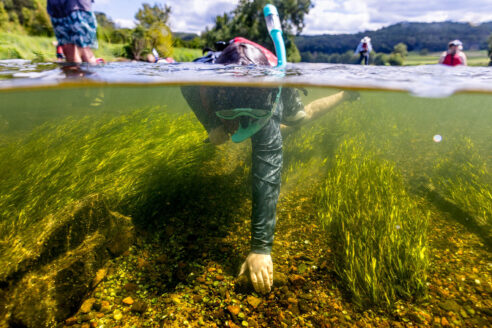
Bay grasses -- also called submerged aquatic vegetation (SAV) -- are critical to the Bay ecosystem. They provide habitat and nursery grounds for fish and blue crabs, serve as food for animals such as turtles and waterfowl, clear the water by reducing wave action, absorb excess nutrients and reduce shoreline erosion. They are also an excellent measure of the Bay's overall condition because their health is closely linked to water quality. Annual acreage of grasses is estimated through an aerial survey, which is flown from late spring to early fall.
Orth continued, “We believe the really hot summer temperatures in the early part of the growing season may have just cooked the grasses before we were able to map them, e.g. parts of the Honga River. The changes also occurred in areas dominated by just one species, widgeongrass, which has been shown to be a boom or bust species. 2010 may have been the hottest on record but it was those summer time temperatures in June that may have tipped the scale for SAV in some areas.”
Grass Numbers by the Zones
Annual bay grass acreage estimates are an indication of the Bay's response to pollution control efforts, such as implementation of agricultural best management practices (BMPs) and upgrades to wastewater treatment plants. Homeowners throughout the Bay region help bay grasses and overall water quality by using landscaping techniques that keep excess nutrients from flowing downstream where they can harm nearby streams and eventually the Bay. Local watershed groups and online resources such as CBP’s “Plant More Plants” campaign – plantmoreplants.com – can offer people more information on how to get started.
”Even with the decreases in the 2010 bay grass coverage, the patterns are similar to previous years,” said Lee Karrh, living resources assessment chief with the Maryland Department of Natural Resources and chair of the Bay Program's SAV Workgroup. “Many of the fresh and low salinity areas have very high abundances, including sixteen that have reached their restoration targets, However, the saltier parts of the Bay continue to struggle, with most areas well below the restoration goals, with only the mouth of the James River exceeding the goal.”
For additional information about the aerial survey and an interactive map of SAV acreage throughout the Chesapeake Bay, visit www.vims.edu/bio/sav/. For more information about the status of underwater bay grasses in the Chesapeake Bay, visit www.chesapeakebay.net/status_baygrasses.aspx.